Floor T-Raise
Floor T-Raise is a prone bodyweight upper-back and shoulder exercise performed lying face down with the arms stretched out to the sides in a T shape. The movement is small on purpose: you lift the chest and arms just enough to clear the floor, then lower under control. That short range keeps the emphasis on the rear delts, rhomboids, mid and lower traps, and the small spinal muscles that help hold the torso steady.
The floor setup matters because it removes momentum and makes every inch of the rep honest. With the chest supported by gravity, you have to create the lift from the shoulder blades and upper back instead of swinging the arms. That makes Floor T-Raise useful for posture work, activation before pulling sessions, or accessory work when you want cleaner scapular control without loading the spine heavily.
A good rep starts with a long neck, ribs lightly anchored, and straight arms reaching away from the shoulders. From that position, the shoulders externally rotate slightly, the shoulder blades draw down and back, and the chest floats off the floor. The body should feel long and organized rather than cranked into a big back extension. If the low back takes over, the lift is too high or the brace is too loose.
Because the exercise is bodyweight and low load, it works well for beginners, warm-ups, rehab-style sessions, and high-quality accessory volume. The right rep looks crisp and controlled, not explosive. Keep the motion smooth, pause briefly at the top, and lower with the same level of control you used to raise the arms.
Treat Floor T-Raise as a precision movement for the posterior shoulder chain and upper back. It is most effective when the range stays small, the neck stays neutral, and the shoulders do not shrug. If the rep starts to turn into a lumbar back bend or a fast arm swing, reset the position and reduce the height until the upper back is doing the work again.
[ Workout Log & Planner ]
Put your next workout in Fitwill
Keep your plan and training log ready when you are.


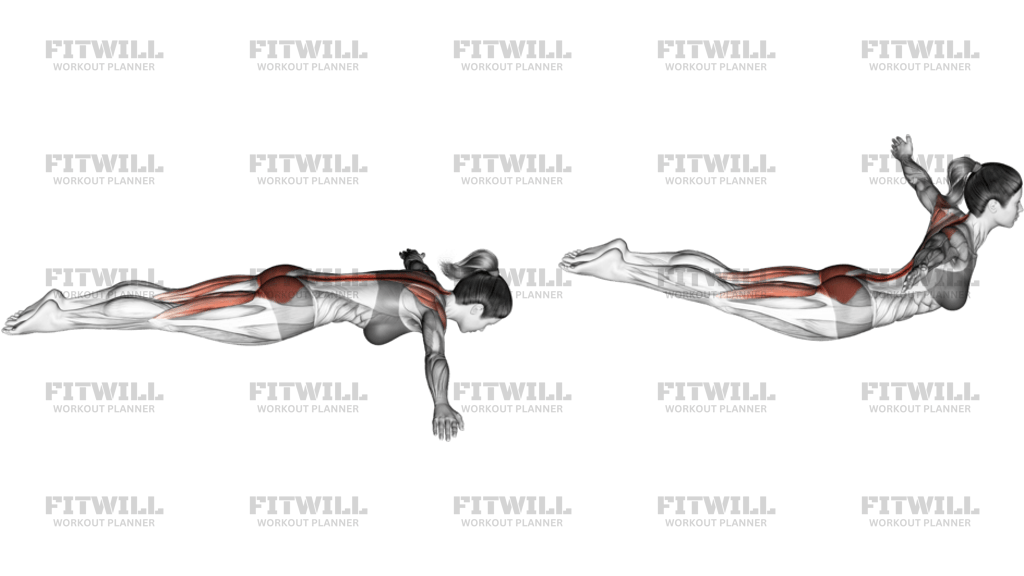
Instructions
- Lie face down on the floor with your legs long, arms reaching out to the sides at shoulder height, and your thumbs turned slightly up.
- Set your forehead or chin just above the floor, keep your neck long, and lightly brace your abs so your ribs stay down.
- Reach the fingertips away from your shoulders before you lift so the arms stay straight and active.
- Exhale and raise your chest and both arms a few inches off the floor until the hands clear the ground.
- Draw the shoulder blades down and back as you lift, keeping the motion small and controlled.
- Pause briefly at the top with your neck neutral and your lower back quiet.
- Inhale and lower the chest and arms back to the floor without dropping or shrugging.
- Reset the long body position, then repeat for the planned reps.
Tips & Tricks
- Think about lifting the sternum, not throwing the head or chin upward.
- Keep the thumbs slightly up if that helps the shoulders stay open and comfortable.
- If your low back starts to arch hard, lower less and keep the ribs heavier on the floor.
- Let the shoulder blades move down and back without shrugging toward the ears.
- A slow lower exposes the rear delts and mid-back more than a rushed drop.
- Keep the elbows long; bent arms change the exercise into something closer to a row.
- Use a tiny pause at the top instead of trying to lift higher.
- Stop the set if you need momentum to get the hands off the floor.
Frequently Asked Questions
What muscles does Floor T-Raise work most?
It mainly trains the rear shoulders and upper back, especially the rhomboids, mid and lower trapezius, and posterior deltoids.
Is Floor T-Raise more about strength or mobility?
It is mostly a control and strength exercise, with a mobility feel because the chest stays low while the arms open and lift.
Do my legs stay on the floor during the rep?
Yes. Keep the legs long and relaxed so the lift comes from the upper back and shoulders instead of a hard back extension.
Should I look forward at the top?
No. Keep the neck long and the gaze mostly down so you do not jam the neck or turn the movement into a back bend.
Can beginners do this exercise?
Yes. Beginners usually do best with a small lift, a short pause, and a slow lowering phase.
What is the most common mistake?
The biggest mistake is shrugging the shoulders or arching the lower back to get the chest higher off the floor.
How can I make Floor T-Raise harder without adding weight?
Slow the lowering phase, add a longer pause at the top, and keep the arms perfectly straight while staying strict.
What should I do if I feel it mostly in my lower back?
Shorten the range, brace the abs more firmly, and keep the ribs heavier on the floor before you lift again.