Standing Side Bend
Standing Side Bend is a bodyweight lateral-flexion drill that trains the side body to shorten and lengthen under control. The image shows a simple standing position with no external load, so the main goal is not to chase range for its own sake. It is to move one rib cage and shoulder line away from the other while keeping the pelvis, knees, and feet steady and facing forward.
This movement mainly challenges the obliques and quadratus lumborum, with the intercostals, spinal stabilizers, and hip muscles helping you stay stacked instead of twisting or drifting forward. That makes the exercise useful when you want better trunk control, cleaner side-to-side symmetry, or a low-intensity core drill that still demands precision. The quality of the rep depends on keeping the torso in one plane while the rest of the body stays quiet.
A good repetition starts tall: feet about hip width apart, weight evenly balanced, knees soft but not bent, ribs over pelvis, and arms relaxed at your sides. From there, bend only through the torso to one side as if one shoulder were sliding toward the same hip. The hips should not shift out to the side, the chest should not rotate, and the head should stay aligned with the spine. The return should be slower and more deliberate than the descent so you can feel the side body work through the full arc.
Breathing matters here because a rushed breath usually turns the rep into a sway. Exhale as you bend, then inhale as you come back to center without losing height through the crown of the head. If you want more challenge, increase the control and pause briefly at the end range instead of forcing a bigger bend. If you feel this mostly in the lower back or if the movement starts looking like a hip shift, the range is too large or the torso is no longer staying stacked.
Standing Side Bend fits well in warmups, core sessions, mobility blocks, or as a light accessory drill between heavier lifts. It is also a useful teaching tool for beginners because it exposes side-body control without needing equipment. Done well, it should feel smooth, even, and deliberate rather than aggressive or shaky.
Fitwill
Log Workouts, Track Progress & Build Strength.
Achieve more with Fitwill: explore over 9600 exercises with images and videos, access built-in and custom workouts, perfect for both gym and home sessions, and see real results.
Start your journey. Download today!




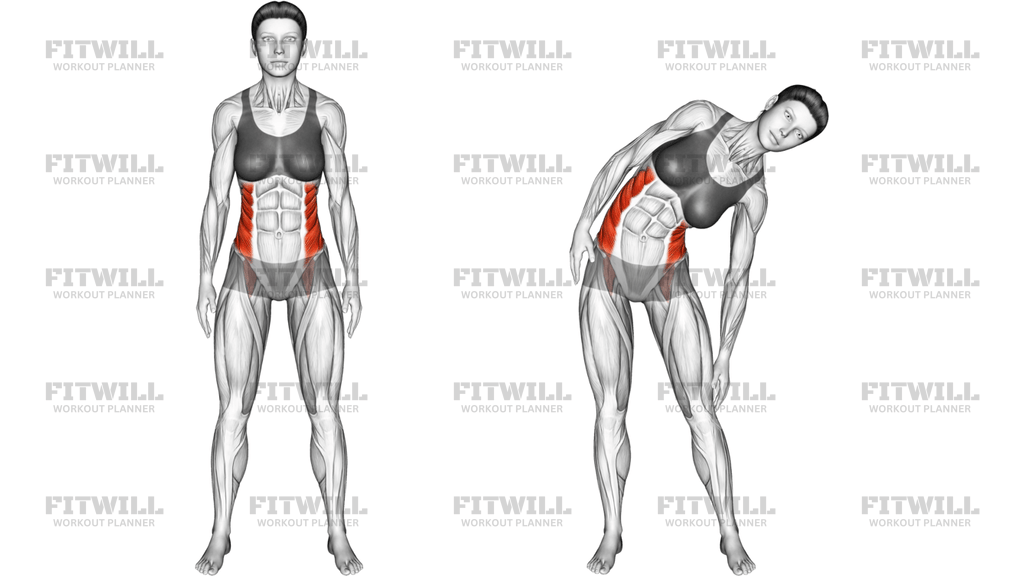
Instructions
- Stand tall with your feet about hip-width apart and your weight spread evenly across both feet.
- Let your arms hang by your sides, keep your knees soft, and stack your ribs over your pelvis.
- Set your chin slightly tucked so your neck stays long and your head does not drift forward.
- Brace gently through your midsection before you start the first rep.
- Bend your torso to one side, letting the shoulder and rib cage move laterally without turning the chest.
- Keep both hips facing forward and avoid pushing the hip out to help the bend.
- Pause briefly at the end of the side bend when you feel the side body shorten, then stop before the lower back takes over.
- Return to the upright start position under control, lengthening the working side as you come back to center.
- Exhale as you bend and inhale as you return, then repeat for the planned number of repetitions before switching sides.
Tips & Tricks
- Think about shortening one side of your waist, not about collapsing your torso sideways.
- Keep the shoulders level as long as possible on the return so the rep does not turn into a shrug.
- If your hips slide or your feet roll, reduce the range until the pelvis stays quiet.
- The movement should happen in one clean plane; any twist through the chest means the rep is drifting off target.
- A slower lowering phase makes the side body work harder and keeps the motion from becoming a bounce.
- Stop the bend when the rib cage starts to spin forward or when the lower back takes over the stretch.
- Keep the neck relaxed so the head does not lead the movement.
- Use short pauses at the bottom instead of chasing a larger range of motion.
- Match the number of reps on both sides so you do not build a strength imbalance in the trunk.
Frequently Asked Questions
What does Standing Side Bend train most?
It mainly trains the obliques and quadratus lumborum, with the intercostals and spinal stabilizers helping control the side-bending motion.
Does this exercise need any equipment?
No. The image shows a bodyweight standing side bend, so the key challenge is controlled lateral flexion rather than external resistance.
Should my hips move while I bend?
No. Keep the hips facing forward and as still as possible so the movement comes from the torso, not a side shift.
How do I know if I am twisting instead of side bending?
If one shoulder starts moving forward and the rib cage turns, you are rotating. Keep the chest pointed straight ahead and bend in one plane.
Is this a good beginner exercise?
Yes. It is simple to learn and lets beginners practice trunk control without loading the spine or using complicated setup.
Where should I feel the stretch or effort?
You should feel the working side of the waist and rib area lengthen and shorten, not a pinch in the lower back or a pull through the hips.
How far should I bend to the side?
Only as far as you can keep the torso stacked and the pelvis quiet. A smaller, cleaner range is better than a bigger bend with momentum.
Can I add this to a core workout?
Yes. It fits well as a light accessory drill, especially when you want side-body control, posture work, or a low-load trunk movement.
What is the most common mistake?
The most common mistake is letting the body sway or the hips slide to fake more range. Keep the movement strict and slow.