Lying Leg Raise To Side
Lying Leg Raise To Side is a floor-based core exercise that asks you to control straight legs while your pelvis stays quiet and your torso stays planted. The movement looks simple, but it becomes challenging fast because the abs have to manage the weight of the legs while the hips try to tip or rotate. That makes it useful for training lower-ab control, oblique tension, and the kind of trunk stability that carries over to harder leg-raise variations.
Most of the work comes from the abs and hip flexors, with the side muscles of the waist helping resist rotation as the legs travel in an arc. The exercise is not about kicking the legs upward or throwing them side to side. It is about keeping the ribs down, keeping the low back from arching, and moving the legs only as far as you can without losing contact between your torso and the floor.
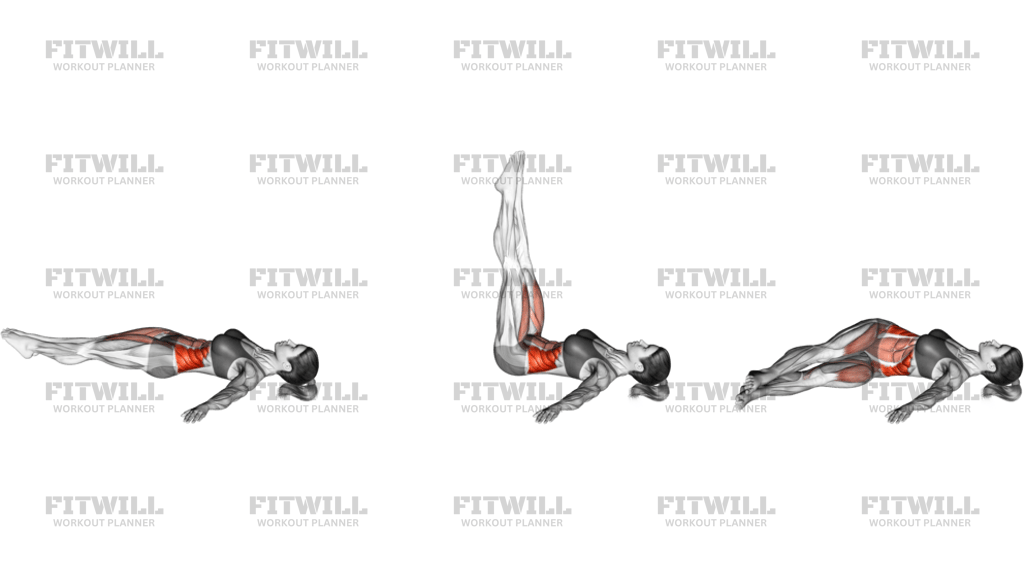
Set up on a mat and lie flat on your back with your arms out for balance. Keep your legs straight, squeeze them together, and start from a position that lets your low back stay close to the floor. From there, raise the legs under control and then lower them in a controlled arc toward one side, letting the movement come from the hips and trunk rather than from momentum. If the range gets too large, shorten the arc before your pelvis twists or your back lifts.
Because this is a body-weight floor drill, the quality of each repetition matters more than the number of reps. It works well as accessory core work after bigger lifts, as part of an ab circuit, or as a technique drill for athletes who need stronger pelvic control. Beginners can do it with a smaller range or bent knees, while more advanced lifters can keep the legs straighter and the arc lower to the floor.
Treat the exercise as a test of control, not flexibility. If you feel the hips rolling hard or the low back pinching, reduce the range and slow the lowering phase. When performed well, Lying Leg Raise To Side builds cleaner trunk control, stronger abdominal bracing, and better control through side-to-side movement without needing any equipment.
[ Workout Log & Planner ]
Put your next workout in Fitwill
Keep your plan and training log ready when you are.


Instructions
- Lie on your back on a mat with your arms out to the sides for balance and your palms pressing lightly into the floor.
- Keep your legs straight, squeeze them together, and set your heels a few inches off the floor with your low back gently anchored.
- Brace your abs so your ribs stay down and your pelvis does not tip as the legs start moving.
- Lift both straight legs toward vertical until you can keep the motion smooth instead of swinging them up.
- Lower the legs in a controlled arc toward one side, keeping the knees locked and the feet together.
- Stop the descent before your opposite hip lifts or your low back comes off the mat.
- Bring the legs back through center with the same slow control, then repeat toward the other side if the set calls for alternating reps.
- Exhale as the legs travel away from center and inhale as you bring them back under control.
- Lower your feet to the floor and reset your pelvis if the next rep starts to feel rushed or unstable.
Tips & Tricks
- Keep your shoulders heavy on the mat; if they pop up, the legs are swinging too far.
- A smaller side arc is better than forcing the feet to touch the floor and arching your low back.
- Press your palms into the mat to help stop the torso from twisting when the legs drift sideways.
- If straight legs are too hard to control, bend the knees slightly and keep the thighs together.
- Think about lifting from the lower abs, not kicking from the hip flexors.
- Move slowly enough that you can feel the pelvis stay stacked instead of rolling side to side.
- Keep the feet together or lightly squeezed so the legs behave like one lever.
- Stop the set when you lose the ability to lower the legs without momentum.
Frequently Asked Questions
What muscle does Lying Leg Raise To Side target most?
It mainly challenges the lower abs and the side muscles of the waist, with the hip flexors helping move and hold the legs.
Can beginners perform this exercise?
Yes, but beginners usually need a shorter range or a slight bend in the knees so the low back stays down.
Should my low back stay flat during Lying Leg Raise To Side?
It should stay close to the mat. If the low back arches away, shorten the range before you raise the legs higher.
Why do my hips twist when I lower the legs to one side?
The side arc is probably too large or too fast. Reduce the range and keep the shoulders pressed down so the pelvis stays under control.
Is Lying Leg Raise To Side a lower-ab exercise or an oblique exercise?
It trains both. The leg raise loads the lower abs, while the side-to-side control demands extra work from the obliques.
Can I bend my knees if straight legs are too hard?
Yes. A slight knee bend shortens the lever and makes it easier to keep the pelvis from rocking.
Where should I place Lying Leg Raise To Side in a workout?
It fits well after your main lifts or as part of a core block, when you can focus on slow control instead of speed.
What if I feel this mostly in my hip flexors?
Lower the legs less aggressively and focus on keeping the ribs down. If needed, bend the knees slightly to shift more work back toward the abs.