Weighted Muscle Up
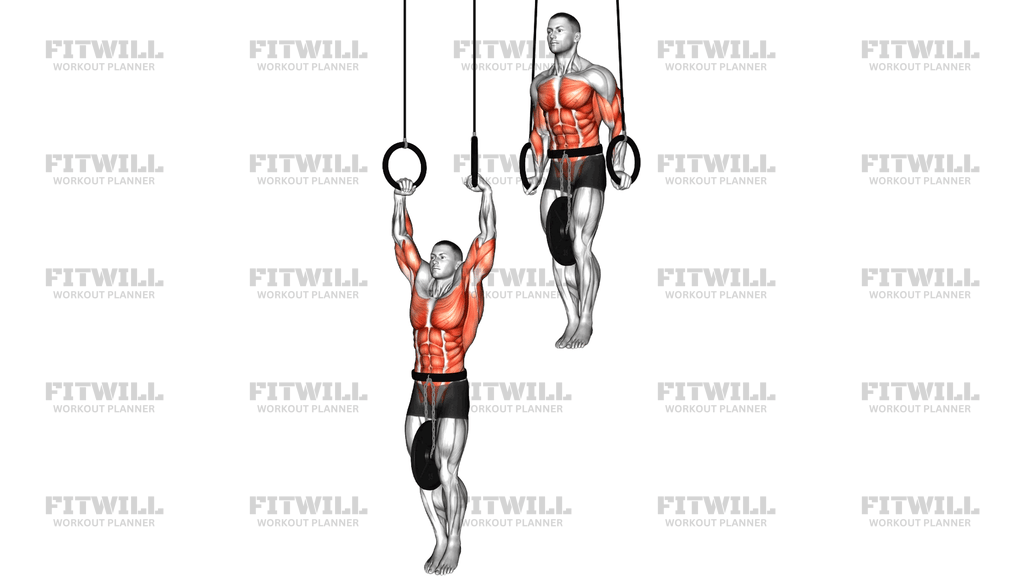
Weighted Muscle Up is an advanced ring strength movement that combines a powerful pull, a fast turnover, and a strict dip with extra load hanging from a dip belt. The image shows the body suspended on rings with the weight hanging below the hips, so the exercise should be performed as a controlled ring muscle-up rather than a generic upper-body pull.
This movement trains the muscles that drive the pull and press together: lats, upper back, biceps, chest, shoulders, triceps, forearms, and core. Because the rings move freely, the exercise also demands a high level of shoulder control, scapular stability, and timing through the transition. The load makes every part of the rep more demanding, especially the turnover and the top support position.
The setup matters more here than in most pulling exercises. The belt should hang centered so the weight stays under the body instead of swinging forward or twisting to one side. Start from a dead hang or active hang with the ribs stacked, legs together, and shoulders controlled. If the body opens into a big arch or the rings drift away from the torso, the transition becomes much harder and the shoulders take more stress.
On the pull, drive the rings down and back toward the lower chest and upper ribs instead of trying to muscle the weight straight upward. As the chest rises to ring level, keep the rings close and turn the wrists over so the shoulders travel above the hands. The second half of the rep is a strict dip: press the rings down beside the hips until the elbows lock out and the body is tall and stable over the rings.
Weighted muscle-ups are best used as a strength skill, not as a high-rep conditioning drill. Low reps, long rest periods, and crisp setup positions keep the movement honest. Use this exercise only when unweighted ring muscle-ups are already clean, because the added load exposes weak turnover timing, sloppy swinging, and incomplete lockouts very quickly. Lower under control, reset the hang, and repeat only when every rep can stay tight from the first pull to the final support position.
Fitwill
Log Workouts, Track Progress & Build Strength.
Achieve more with Fitwill: explore over 9600 exercises with images and videos, access built-in and custom workouts, perfect for both gym and home sessions, and see real results.
Start your journey. Download today!




Instructions
- Attach the weight to a dip belt, then grip the rings with straight wrists and arms fully extended in a dead hang.
- Set the rings just outside shoulder width and stack the ribs over the pelvis so the belt hangs straight below you.
- Squeeze the legs together and keep a slight hollow body to reduce swing before the first pull.
- Pull the rings down and back toward the lower chest and upper ribs while keeping them close to your torso.
- As your chest reaches ring height, lean the shoulders forward and rotate the wrists over the rings for the turnover.
- Press the rings down beside your hips until the elbows lock out in a tall ring support position.
- Lower under control by reversing the dip, then let the body travel back to a full hang without dropping out of position.
- Reset the swing, rebrace, and repeat for the planned number of reps.
Tips & Tricks
- Use a very small added load first; the transition gets harder fast once the belt starts swinging.
- Keep the belt centered between the legs so the weight does not twist you during the pull and turnover.
- Pull to the lower chest or sternum, not just the chin, or the turnover usually stalls.
- Keep the rings close to your torso the entire time; if they drift wide, the rep turns into a slow, shoulder-heavy grind.
- Do not kick or arch aggressively to get over the rings, because that steals tension from the pull and stresses the shoulders.
- Press to a true lockout over the rings with the body tall and stable, not with bent elbows or soft shoulders.
- Lower with the same control you used on the way up so the next rep starts from a clean hang instead of a swing.
- Stop the set if one ring turns faster than the other or the dip belt starts swinging enough to pull you off line.
Frequently Asked Questions
What muscles does a weighted ring muscle-up work most?
It trains the lats, upper back, biceps, chest, shoulders, triceps, forearms, and core together.
Is this exercise good for beginners?
No. You should already own a clean unweighted ring muscle-up before adding load.
Why are the rings and dip belt important here?
The free-moving rings make the turnover and support position more demanding, and the belt adds load without changing the hand path.
Should I use a false grip on the rings?
A false grip is optional, but many lifters use it because it shortens the turnover and helps keep the wrists over the rings.
What is the hardest part of the movement?
The turnover from the pull into the dip is usually the sticking point, especially once extra weight is added.
How heavy should I load it?
Start with a very small plate and only add weight when every rep reaches a stable lockout without swinging or twisting.
Can I do this for high reps?
Usually no. Weighted muscle-ups work best for low-rep strength sets with long rest and clean technique.
How do I avoid shoulder irritation?
Keep the rings close, avoid over-arching to get over the top, and stop the set if the turnover gets sloppy.