Weighted Hyperextension On Stability Ball
Weighted Hyperextension On Stability Ball is a loaded back-extension pattern that trains the spinal erectors, glutes, hamstrings, and the deep core muscles that keep your torso from collapsing over the ball. The exercise is useful when you want posterior-chain work without a fixed bench or machine, because the stability ball forces you to control both the hinge and the balance of the pelvis at the same time.
The setup matters more here than on a rigid back-extension station. The ball should sit under the lower abdomen and hip crease, not under the ribs, so you can hinge freely without folding at the waist. Your feet need enough contact with the floor to keep traction, and the weight should stay close to the chest so the load challenges the trunk without pulling you out of position.
Each repetition should feel like a smooth extension of the spine, not a throw of the upper body. Lower until your torso drapes comfortably over the ball, then squeeze the glutes and extend back up until your body is in a long line. The neck stays quiet, the ribs stay controlled, and the movement should come from the hips and spinal erectors rather than from swinging or bouncing.
This is a good accessory lift for posterior-chain strength, trunk endurance, and body control. It works well after bigger lower-body or pulling movements, or as a lighter strength builder when you want to train the low back without heavy external loading. Use a plate or dumbbell only if you can keep the ball steady, maintain a neutral neck, and finish every rep with the same range and rhythm. If the ball shifts, the lower back pinches, or the hips pop off the ball, reduce the load and tighten the setup before continuing.
Fitwill
Log Workouts, Track Progress & Build Strength.
Achieve more with Fitwill: explore over 9600 exercises with images and videos, access built-in and custom workouts, perfect for both gym and home sessions, and see real results.
Start your journey. Download today!




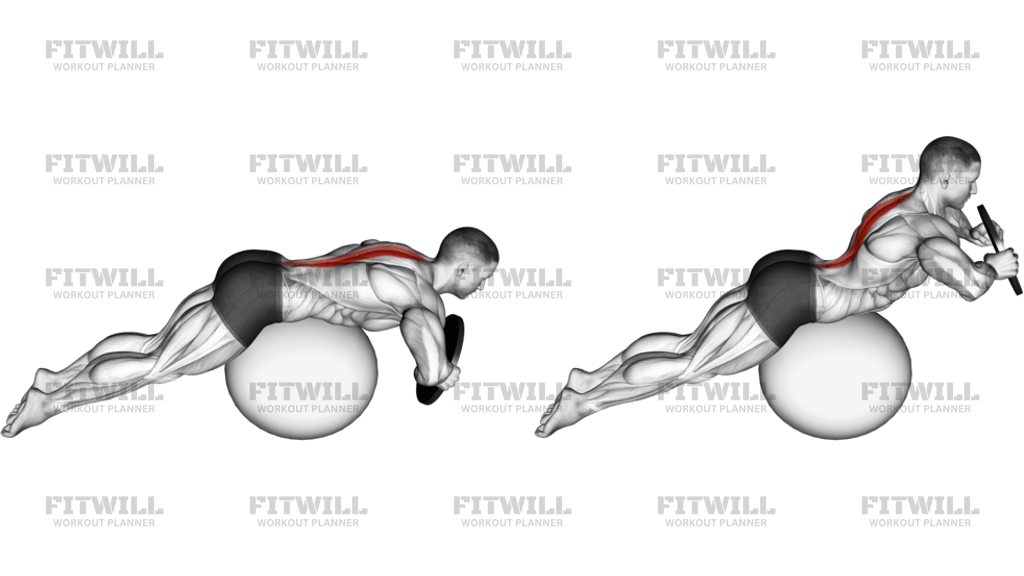
Instructions
- Place the stability ball under your lower abdomen and hip crease, then walk your feet back until your legs are long and your toes can grip the floor for balance.
- Hold the weight plate close to your chest with both hands and let your torso drape over the ball so your body starts in a long, relaxed hinge.
- Set your feet about hip-width apart, squeeze your glutes lightly, and brace your midsection before the first rep so the ball stays centered under you.
- Lower your chest a little farther toward the floor by hinging at the hips and allowing your spine to flex only as far as the ball and your range allow.
- Exhale and raise your torso by squeezing the glutes and extending through the low back until your body reaches a straight line from head to heels.
- Keep your neck neutral and your eyes down as you lift, and avoid pulling the plate away from your chest.
- Pause briefly at the top without over-arching past a straight line, then lower under control until your torso settles back over the ball.
- Reset your brace before each repetition and repeat for the planned number of reps without bouncing or shifting the ball.
Tips & Tricks
- Keep the plate glued to your chest; letting the weight drift forward makes the lever longer and usually turns the rep into a low-back yank.
- If the ball slides under you, move your feet wider or press more firmly through the toes before adding load.
- Think about lifting your sternum, not throwing your head back, so the neck stays in line with the upper spine.
- Stop the ascent when your torso is straight with your legs; going higher usually turns into lumbar compression instead of better extension.
- A small pause at the top is enough. If you have to hold your breath or arch harder to stay up, the load is too heavy.
- Lower slowly so the hips stay in contact with the ball instead of rolling off the top of it.
- Use a lighter plate than you would on a fixed back-extension bench because the ball adds a balance demand.
- If your hamstrings cramp, shorten the range a little and reset the ball a bit lower on the hips before the next set.
Frequently Asked Questions
What muscles does Weighted Hyperextension On Stability Ball work?
It mainly trains the spinal erectors, glutes, and hamstrings, with the core working hard to keep the torso steady on the ball.
Where should the stability ball sit during the rep?
The ball should sit under your lower abdomen and hip crease so you can hinge freely without feeling jammed in the ribs.
Should I hold the weight plate at my chest or behind my head?
Hold it close to your chest for the safest and most stable setup. Moving the load behind your head makes the leverage harder and increases the chance of overextending.
How high should I lift my torso?
Lift until your body forms a straight line from head to heels. Past that point, the movement usually turns into an unnecessary low-back arch.
Can beginners do this exercise?
Yes, but start with bodyweight or a very light plate until you can keep the ball stable and control the lowering phase.
What is the most common mistake on the stability ball version?
Letting the torso swing up or letting the plate drift away from the chest usually steals work from the posterior chain and makes the ball wobble.
Should I feel this in my lower back or glutes?
Both can work, but the rep should feel controlled through the whole posterior chain rather than like a sharp pinch in one spot.
How do I progress this movement safely?
Add a little load only after you can keep the ball still, the neck neutral, and every rep at the same range and tempo.