Straddle Planche
Straddle Planche is a bodyweight strength skill that teaches you to support your entire body on straight arms while the legs are spread wide to shorten the lever. The position is far more demanding than a standard planche lean because the shoulders, chest, triceps, serratus, and core have to work together to keep the torso level and the hips from sagging.
The wide-leg shape is not just a stylistic choice. It reduces the torque you have to fight, which makes the hold more accessible while still demanding very high shoulder and trunk control. Done well, Straddle Planche builds the kind of pressing strength, scapular control, and body awareness that carries over to calisthenics, gymnastics, and advanced push-up progressions.
Setup matters more here than on most exercises. Place your hands on the floor or on parallettes slightly wider than shoulder width, spread your fingers, and keep the elbows locked from the start. Lean the shoulders forward of the wrists before you lift anything so the balance demand is already organized through the hands, wrists, and shoulder girdle.
Once the lean is set, open the legs into a controlled straddle and keep the knees straight and the toes pointed. Press the floor away to protract the shoulder blades, keep the ribs tucked, and let the hips rise only enough to bring the body close to parallel with the floor. If the line turns into a pike or the elbows soften, the hold is no longer a Straddle Planche and the load shifts into a less useful position.
Quality reps are short, sharp holds rather than long, shaky battles. Most lifters will get better results from crisp 5 to 15 second holds, repeated with full recovery, than from grinding until the shoulders collapse. Use it as a high-skill strength drill, not as a fatigue chase, and stop each set as soon as the shoulder angle, elbow lock, or hip line starts to break down.
Because the exercise is so demanding, progression should be conservative and deliberate. Move from tuck and advanced tuck variations into one-leg and assisted straddle positions before chasing a free hold. The safer and more productive version is the one where you can keep the shoulders forward, the body long, and the breathing controlled for the full hold.
Fitwill
Log Workouts, Track Progress & Build Strength.
Achieve more with Fitwill: explore over 9600 exercises with images and videos, access built-in and custom workouts, perfect for both gym and home sessions, and see real results.
Start your journey. Download today!




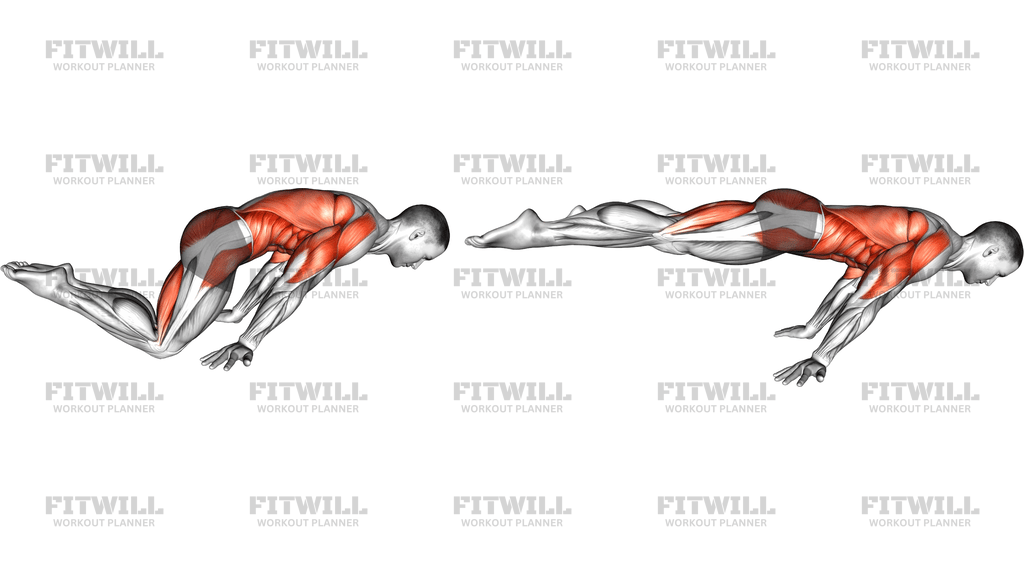
Instructions
- Warm up the wrists, then place your hands on the floor or parallettes slightly wider than shoulder width with your fingers spread for balance.
- Lock your elbows, turn the shoulders forward so they sit in front of the wrists, and lean your bodyweight into your hands before lifting the feet.
- Open your legs into a wide straddle with straight knees and pointed toes, keeping your hips level as you shift more weight into the hands.
- Press the floor away to protract the shoulder blades and round the upper back slightly without bending the arms.
- Lift the feet until the torso is nearly parallel to the floor and the hips stay in line with the shoulders instead of piking upward.
- Hold the position with steady pressure through the palms and fingertips while keeping the ribs tucked and the glutes tight.
- Take short, quiet breaths without letting the shoulders drift back or the elbows soften.
- Lower one foot at a time or bring the knees back under you under control, then reset before the next hold.
Tips & Tricks
- A wider straddle shortens the lever and usually makes the hold cleaner, so use the widest leg position you need to keep the feet light.
- Keep the shoulders ahead of the wrists; if they drift back, the position turns into a bent-arm balance and gets much harder to control.
- Press hard through the fingertips as well as the palm to help manage the forward lean and stop yourself from tipping.
- Lock the elbows before you lift; even a small bend changes the stress on the shoulders and makes the hold less stable.
- Point the toes and actively push the legs apart so the pelvis does not sag between the hips.
- Use parallettes if wrist extension limits your hold on the floor or if you need a little extra clearance for the shoulders.
- If the hips keep piking, shorten the hold time or reduce the forward lean before trying to make the straddle narrower.
- Stop the set the moment the body line breaks; long shaky holds build compensation patterns faster than strength.
Frequently Asked Questions
What muscles does Straddle Planche work most?
Straddle Planche mainly trains the shoulders, chest, triceps, serratus, and deep core, with the hips and legs helping keep the straddle position organized.
Is Straddle Planche a beginner exercise?
No. Most people need to build up through planche leans, tuck planche holds, and assisted variations before they can hold a clean Straddle Planche.
Should I do Straddle Planche on the floor or on parallettes?
Both work, but parallettes are often easier on the wrists and give you a little more room to find the forward shoulder position.
How wide should my legs be in Straddle Planche?
Wide enough to keep the hold controlled and the feet light. A wider straddle lowers the leverage, while a narrower one makes the position much more demanding.
Why do my hips keep sagging in Straddle Planche?
Usually the shoulders are not far enough forward or the core and glutes are not staying tight enough. Shorten the hold and rebuild the line before trying a longer attempt.
Should my elbows bend during Straddle Planche?
No. Keep the arms straight and locked; bending the elbows turns the exercise into a different strength pattern and usually breaks the balance.
How long should I hold Straddle Planche?
Most quality sets are very short, often 5 to 15 seconds. The goal is a clean, stable position, not a long grind with collapsing shoulders.
What is the best progression toward Straddle Planche?
Use tuck planche, advanced tuck, one-leg planche, and assisted straddle holds before trying a free Straddle Planche. Progress when the shoulders stay forward and the body line stays consistent.