Oblique Crunches With Straight Leg Lift
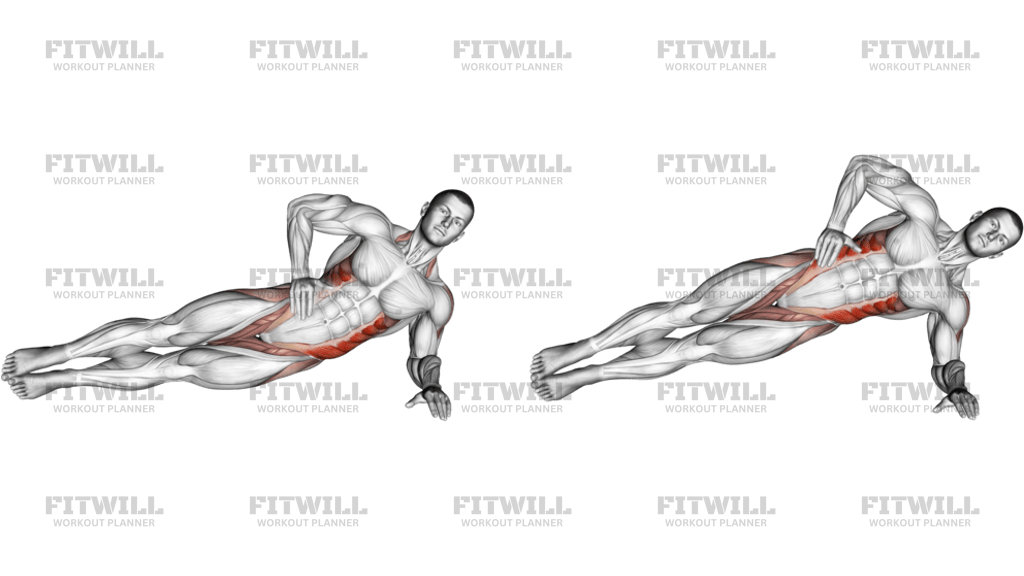
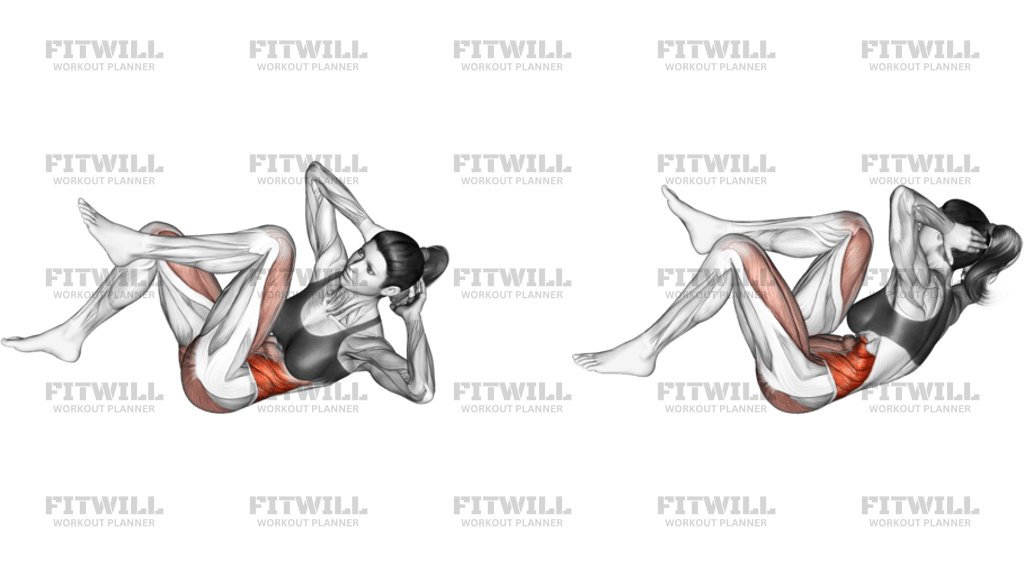
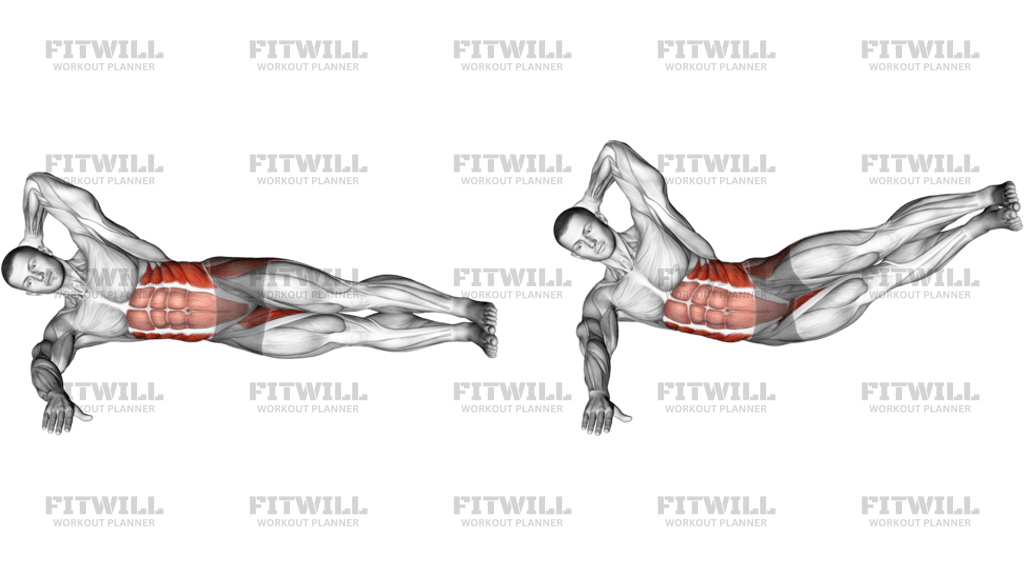
Oblique Crunches With Straight Leg Lift is a side-lying bodyweight core exercise that combines a sideways crunch with a straight-leg raise. It trains the obliques through spinal flexion and lateral flexion while the hip and trunk work together to keep the body lifted in a long, controlled line. The movement is small but demanding, and the quality of the rep depends more on position and control than on speed.
The setup matters because the exercise starts from an asymmetric side-lying position. You support yourself on one forearm with the elbow under the shoulder, stack the hips, and place the top hand lightly behind the head or at the temple. From there, both legs stay straight as they lift and lower with the torso, so the waist has to initiate the movement instead of the hips or lower back taking over. If the shoulder collapses or the ribs flare, the exercise becomes much less precise.
At the top of each rep, the ribs should travel toward the hip on the working side while the straight legs rise with control. That paired action creates a compact side crunch rather than a big swing. The goal is a clean squeeze through the side waist, not a yank of the head or a kick from the legs. Lower with the same control you used to lift, keeping tension on the obliques instead of dropping out of position.
This exercise is useful when you want a bodyweight oblique drill that also challenges hip control and side-body endurance. It fits well in core circuits, warmups, accessory blocks, or as a focused abdominal finisher. Beginners can use it if they keep the motion small and keep the supporting shoulder stable, while more advanced lifters can slow the tempo or hold the top position briefly to increase time under tension.
The main safety points are to keep the neck long, avoid rolling backward, and stop the set if the lower back starts to arch to gain height. Because the movement is performed on one side at a time, it is also a good option for noticing left-right differences in trunk control. Use smooth reps, clean alignment, and a range you can repeat consistently from the first rep to the last.
Fitwill
Log Workouts, Track Progress & Build Strength.
Achieve more with Fitwill: explore over 9600 exercises with images and videos, access built-in and custom workouts, perfect for both gym and home sessions, and see real results.
Start your journey. Download today!




Instructions
- Lie on one side on a mat and support your upper body on the forearm of the lower arm, with that elbow stacked under the shoulder.
- Extend both legs straight, stack the feet, and keep the hips slightly forward so your body starts in one long line.
- Place the top hand lightly behind your head or at your temple without pulling on the neck.
- Brace through the side waist and lift the straight legs and torso together into a side crunch.
- Bring the ribs toward the hip on the working side while keeping the lower shoulder stable on the floor.
- Pause briefly at the top when the obliques are fully shortened and the legs are still straight.
- Lower the torso and legs together under control until you are back in the starting side-lying line.
- Keep the movement smooth and repeat on the same side for the planned reps before switching sides.
Tips & Tricks
- Keep the elbow directly under the shoulder so the supporting arm does not collapse as you crunch.
- Let the side waist initiate the lift; do not yank the head forward with the top hand.
- Stay on the same side of the body instead of rolling backward onto the low back during the raise.
- Hold the legs straight and together so the hip flexors do not turn this into a loose leg swing.
- Exhale as you lift to help the ribs close toward the hip and keep the waist tight.
- Use a small, controlled range if your shoulder or neck starts to take over the rep.
- Lower slowly; the eccentric phase is where the obliques have to resist the body dropping away.
- If your lower back arches, shorten the lift and keep the pelvis more stacked over the mat.
Frequently Asked Questions
What does Oblique Crunches With Straight Leg Lift train?
It mainly trains the obliques, with extra work for the deep core, hip stabilizers, and shoulder support from the side plank-style setup.
Can beginners perform this exercise?
Yes, but beginners should keep the range small and focus on keeping the elbow stacked under the shoulder and the neck relaxed.
Should the top hand pull on my head?
No. The top hand should only support the head lightly so the neck stays long and the obliques do the work.
What is the biggest form mistake on this movement?
Rolling backward or arching through the lower back to fake a bigger lift is the most common error.
Why are the legs kept straight?
Straight legs increase the lever arm and make the obliques and side body work harder to control the lift.
What should I feel at the top of the rep?
You should feel a strong squeeze through the working-side waist and a stable shoulder on the supporting arm.
Is it better to move fast or slow?
Slow and controlled is better. The exercise works best when you can keep the torso and straight legs moving together without swinging.
How do I progress this exercise?
Use a longer pause at the top, a slower lowering phase, or more reps per side while keeping the side-lying alignment clean.