Dumbbell Single Stiff Leg Deadlift
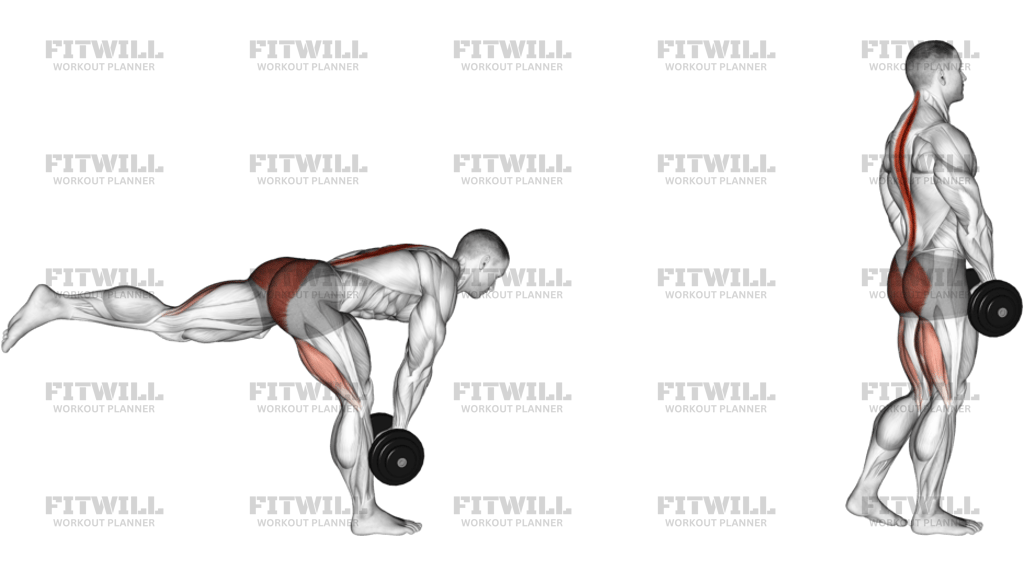
Dumbbell Single Stiff Leg Deadlift is a single-leg hip hinge that trains the back of the body while also challenging balance and coordination. The working leg stays rooted while the other leg reaches back as a counterbalance, which makes the movement more demanding than a standard deadlift variation. It is useful when you want to build stronger hamstrings and glutes without relying on heavy bilateral loading.
The setup matters because the position of the dumbbell, the standing foot, and the pelvis decides how much tension stays on the posterior chain. In Dumbbell Single Stiff Leg Deadlift, the dumbbell hangs on the working side, the standing knee stays softly bent, and the torso tips forward from the hips instead of rounding through the spine. That combination lets the hamstrings lengthen under control while the core and upper back keep the trunk organized.
Each rep should feel like a smooth hinge rather than a reach for the floor. Lower the dumbbell close to the standing leg, keep the free leg long behind you, and stop when your torso and back leg can stay aligned without the pelvis twisting open. On the way up, drive through the standing heel and squeeze the glute to bring the hips back under you without leaning backward at the top.
Dumbbell Single Stiff Leg Deadlift works well as accessory strength work, warm-up loading for a lower-body session, or a single-leg stability drill when you want more control than a conventional deadlift gives you. It is especially useful for lifters who need better hip hinge mechanics, hamstring strength in a lengthened position, and cleaner balance on each side. Keep the motion strict, choose a load that does not pull your torso out of position, and stop the set before the lower back starts taking over.
Fitwill
Log Workouts, Track Progress & Build Strength.
Achieve more with Fitwill: explore over 9600 exercises with images and videos, access built-in and custom workouts, perfect for both gym and home sessions, and see real results.
Start your journey. Download today!




Instructions
- Stand tall on one leg with the dumbbell in the hand on that same working side and the other foot lightly off the floor behind you.
- Soften the knee of the standing leg, square your hips forward, and let your free leg reach straight back as a counterbalance.
- Brace your midsection, keep your chest long, and begin the rep by sending your hips straight back.
- Let the dumbbell slide down the front of the standing thigh while your torso tilts forward from the hip joint.
- Keep a slight bend in the standing knee and hold your back flat instead of reaching by rounding your spine.
- Lower until you feel a strong hamstring stretch or until your torso and lifted leg can stay aligned without your hips opening.
- Pause briefly at the bottom, then drive the standing heel into the floor and pull the hips forward to rise.
- Finish tall with the glute of the standing leg, keep the dumbbell close to your side, and reset before the next rep or before switching legs.
Tips & Tricks
- Keep the dumbbell close to the standing leg so it tracks straight instead of swinging away from your body.
- Use only a small bend in the standing knee; locking it out makes the hinge feel like a reach and usually shifts stress into the back.
- Think about sending the back heel long behind you rather than lifting the free leg high.
- If your hips start to open toward the floor, shorten the range and stop a little higher on the next rep.
- Lower for two or three seconds so the hamstrings stay loaded and you do not rush through the eccentric phase.
- Press through the heel and midfoot of the standing leg, not the toes, to keep the hip hinge centered.
- Keep your ribs stacked over your pelvis at the top; leaning back to finish turns the rep into a low-back extension.
- If balance is the limiting factor, reduce the load before you reduce control.
- Use a mirror or video from the side to check that the dumbbell stays under the shoulder and close to the shin path.
Frequently Asked Questions
What does Dumbbell Single Stiff Leg Deadlift work most?
It mainly trains the hamstrings and glutes, with the core, lower back, and grip working to keep the body stable.
Should the standing leg stay locked on Dumbbell Single Stiff Leg Deadlift?
No. Keep a soft bend in the standing knee so the movement stays in the hips instead of pulling on the joint.
How low should I go on Dumbbell Single Stiff Leg Deadlift?
Go down until you feel a strong hamstring stretch and can still keep your hips square and your spine flat. Depth is limited by control, not by how close the dumbbell gets to the floor.
Why does the free leg go straight back?
It acts as a counterbalance so your torso can hinge forward without tipping over. Keeping it long helps you load the standing-side hamstrings more cleanly.
Which hand should hold the dumbbell?
Use the hand on the same side as the working leg for the version shown here. Keep the bell close to the thigh as you hinge.
Is Dumbbell Single Stiff Leg Deadlift good for beginners?
Yes, if you start light and keep the hinge small. Beginners should focus on balance, hip position, and a slow lowering phase before increasing load.
What is the most common mistake in Dumbbell Single Stiff Leg Deadlift?
Rounding the back and twisting the hips open are the biggest problems. If that happens, reduce the range and keep the dumbbell closer to the standing leg.
Should I feel Dumbbell Single Stiff Leg Deadlift in my lower back?
You may feel your lower back working to stabilize, but the main sensation should stay in the hamstrings and glutes. If the back is taking over, shorten the range and lighten the load.