Single Leg Heel Touch Squat
Single Leg Heel Touch Squat is a bodyweight unilateral squat that builds glute strength, hip control, and trunk stability while challenging balance on one working leg. The free leg folds behind you as you lower, and the heel touch cue helps you stay honest about depth and control instead of dropping into the bottom position and bouncing back up.
The exercise is most useful when you want the working side to do the job without help from the other leg. Glutes do most of the work, while the hamstrings, core, and lower back keep the pelvis steady and the torso organized. In anatomy terms, the main driver is the Gluteus maximus, with support from the Biceps femoris, Rectus abdominis, and Erector spinae. The movement should feel like a controlled single-leg squat, not a reach-and-fall balance drill.
Start by standing tall on one foot with a stable tripod foot, the knee softly unlocked, and the chest stacked over the hips. From there, sit the hips back and down while the standing knee tracks over the middle toes. The free heel can skim or lightly touch the floor as a balance reference, but it should not become the thing that carries your weight. Keep the arch of the working foot active so the knee and hip stay aligned.
At the bottom, pause long enough to prove you own the position, then drive through the heel and midfoot to stand back up. Keep the descent smooth, the rise deliberate, and the pelvis level enough that one hip does not dump sideways. If you need more control, shorten the range or lightly hold a rack or wall. If you feel pinching in the knee, hip, or ankle, reduce depth and reset your stance before continuing.
This movement fits well in bodyweight strength work, warm-ups for lower-body training, or accessory sets where unilateral control matters more than load. It is a good choice when you want to expose side-to-side imbalances, build single-leg squat capacity, or prepare for more demanding split-squat and pistol-squat progressions without jumping straight to heavy resistance.
[ Workout Log & Planner ]
Put your next workout in Fitwill
Keep your plan and training log ready when you are.


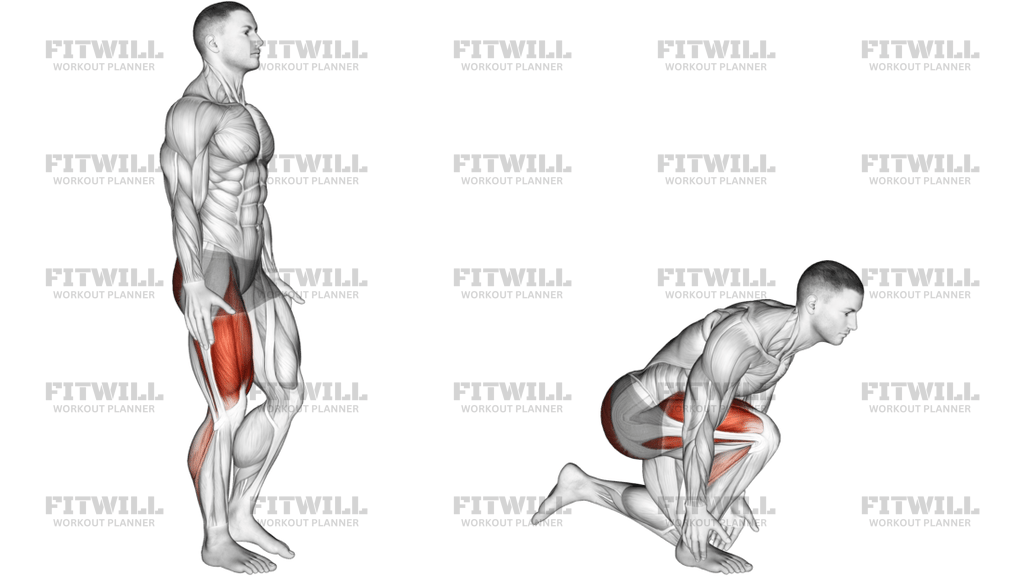
Instructions
- Stand tall on one leg with the working foot flat, the arch active, and the non-working leg folded behind you so you can balance without twisting the pelvis.
- Set your ribs over your hips, brace lightly, and focus your eyes on a fixed point ahead before you start the first descent.
- Unlock the standing knee and sit the hips back and down, keeping the knee tracking over the second and third toes.
- Let the free heel skim or lightly touch the floor as a depth cue if that is how you perform the variation, but keep the standing leg doing the real work.
- Lower until you reach a controlled depth that still lets the heel, knee, and hip stay aligned.
- Pause for a brief moment in the bottom position without collapsing into the standing hip or arch.
- Drive through the heel and midfoot to stand back up, squeezing the glute at the top without leaning backward.
- Reset fully before the next repetition, then repeat all reps on one side before switching.
Tips & Tricks
- Keep the working foot in a tripod contact pattern so the heel, base of the big toe, and base of the little toe stay grounded.
- A small forward torso lean is normal; it usually helps the glute work and keeps the squat from turning into a knee-dominant reach.
- If the standing knee caves inward, shorten the range and slow the descent until the hip can hold the line.
- Treat the free heel touch as a balance reference, not a second point of support that steals load from the standing leg.
- Use a slower lowering phase if you tend to drop into the bottom and lose control of the pelvis.
- Keep your chin neutral and eyes forward so you do not fold through the upper back while trying to stay balanced.
- Exhale as you drive back up through the sticking point, especially if you feel your trunk wobble on the way up.
- Hold a wall, pole, or rack lightly if balance is the limiting factor, then reduce the assistance as control improves.
Frequently Asked Questions
What does Single Leg Heel Touch Squat train most?
It primarily trains the glutes, with the hamstrings and core helping keep the working side stable.
Does the free heel have to touch the floor?
No. A light heel touch is only a depth or balance cue; if touching the floor makes you shift weight away from the working leg, keep it hovering.
How low should I squat on this movement?
Go only as low as you can while keeping the standing knee tracking cleanly and the pelvis from dumping to one side.
What is the most common mistake with the heel touch cue?
People turn it into a weight transfer. The working leg should still own the rep, with the heel touch used only for balance or depth awareness.
Can beginners use this exercise?
Yes, but many beginners should start by holding a support or shortening the depth until they can keep the standing foot and knee aligned.
Should my torso stay perfectly upright?
Not necessarily. A slight forward lean is normal and often helps the glute work, as long as the spine stays long and controlled.
What should I do if I keep losing balance?
Use a light fingertip hold on a wall or rack, slow the lowering phase, and reduce depth until the working leg can stay stable.
How do I make this exercise harder?
Increase depth first, then slow the eccentric, then remove balance assistance, and only after that add external load.