Bodyweight Pulse Squat
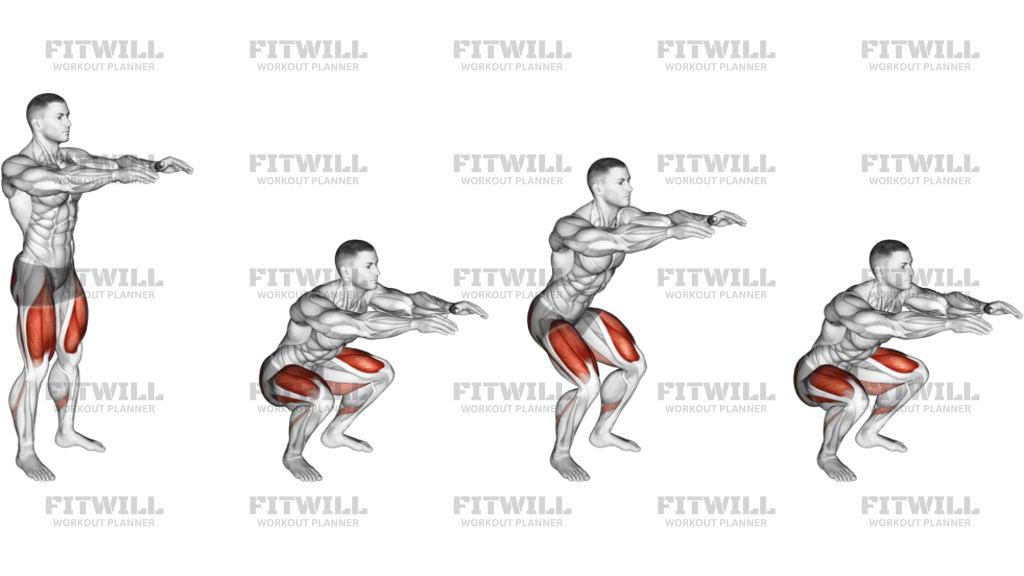
Bodyweight Pulse Squat is a lower-body bodyweight squat variation that keeps the legs under constant tension by adding small pulses at the bottom of the squat. The image shows a standing setup with the arms held straight forward, then a deep squat position, and finally a short up-and-down pulse range that stays low instead of rising all the way to standing. That makes the exercise useful for building endurance, positional control, and repeatable tension in the hips and thighs without needing external load.
The main training emphasis is on the glutes, with the quads, hamstrings, adductors, and trunk working to keep the torso stacked and the knees tracking cleanly. In anatomy terms, the primary work centers on the Gluteus maximus, with support from the quadriceps, Biceps femoris, Rectus abdominis, and Erector spinae. Because the range stays short, the exercise is less about maximal force and more about staying organized in the bottom half of the squat where many people lose balance, cave the knees, or dump the chest forward.
The setup matters because the arms-forward stance in the image is not decoration; it helps counterbalance the torso as you sit back and down. Set the feet about shoulder width apart with a slight toe-out, keep the heels rooted, and lower until the thighs are near parallel or slightly below if your mobility allows. From there, the pulses should move only a few inches, enough to keep tension in the legs without bouncing or losing depth. The torso should stay braced, the chest open, and the head in line with the spine.
Use this movement when you want a bodyweight squat that challenges stability, lower-body burn, and position control more than absolute strength. It works well in warmups, finishers, conditioning circuits, or as a teaching drill for squat depth and knee tracking. Keep the pulses smooth, breathe steadily, and stop the set if the heels lift, the knees collapse inward, or the torso starts to fold because the exercise is only useful when the bottom position stays clean.
[ Workout Log & Planner ]
Put your next workout in Fitwill
Keep your plan and training log ready when you are.


Instructions
- Stand with your feet about shoulder width apart, toes slightly turned out, and your arms extended straight forward at shoulder height for balance.
- Brace your midsection, keep your chest lifted, and sit your hips back and down into a squat until your thighs are near parallel or slightly below.
- Keep your heels flat and your knees tracking in line with your toes as you settle into the bottom position.
- Hold the bottom of the squat and begin small controlled pulses a few inches up and down instead of standing all the way up.
- Keep the pulses smooth and centered over midfoot, avoiding any bounce or shift into the toes.
- Breathe out as you pulse up and in as you settle back down, maintaining tension through the legs and trunk.
- Stay low for the planned reps or time, keeping the torso tall and the arms fixed in front of you.
- When the set is finished, stand up under control and reset before the next round.
Tips & Tricks
- Keep the pulse range small; if you rise too high, the set turns into ordinary squats instead of continuous bottom tension.
- Let the arms stay parallel to the floor so the torso does not tip forward as fatigue builds.
- Press the whole foot into the floor, especially the heels and big toe, to keep balance through the bottom position.
- Do not let the knees cave inward on the pulse up; track them in the same direction as the toes.
- Keep the chest proud and ribs stacked so the lower back does not arch to fake depth.
- Use a depth that you can repeat cleanly for every pulse instead of chasing the lowest possible squat.
- Move under control rather than bouncing off the bottom, because the goal is tension, not speed.
- Stop the set when the heels lift or the torso starts folding forward, since the pulse will no longer train the intended position.
Frequently Asked Questions
What does the Bodyweight Pulse Squat train most?
It mainly trains the glutes and quads, with the hamstrings and core helping you hold the bottom squat position.
Why are my arms held out in front during the squat?
The forward arm position helps counterbalance your hips as you sit into the squat and makes it easier to stay upright in the bottom.
How low should I go before starting the pulses?
Go to a depth where your heels stay down, your chest stays lifted, and you can keep the knees tracking cleanly before beginning the short pulses.
Should the pulses be big or small?
Keep them small. The value of the exercise comes from staying under tension in the bottom of the squat, not from standing up and dropping back down.
Can beginners do this exercise?
Yes. Beginners should use a comfortable squat depth and shorter pulse sets, then build control before adding more time or reps.
What is the most common mistake?
Rising too high between pulses or bouncing through the bottom usually means the set has lost tension and the target position is no longer being trained.
How should I breathe during the set?
Keep breathing steady and controlled. A light exhale on the upward pulse and an inhale on the lower part of the pulse usually works well.
What should I do if my heels come up?
Reduce the squat depth, widen the stance slightly, or shorten the pulse range until you can keep the full foot planted.