Bodyweight Incline Side Plank Right Side
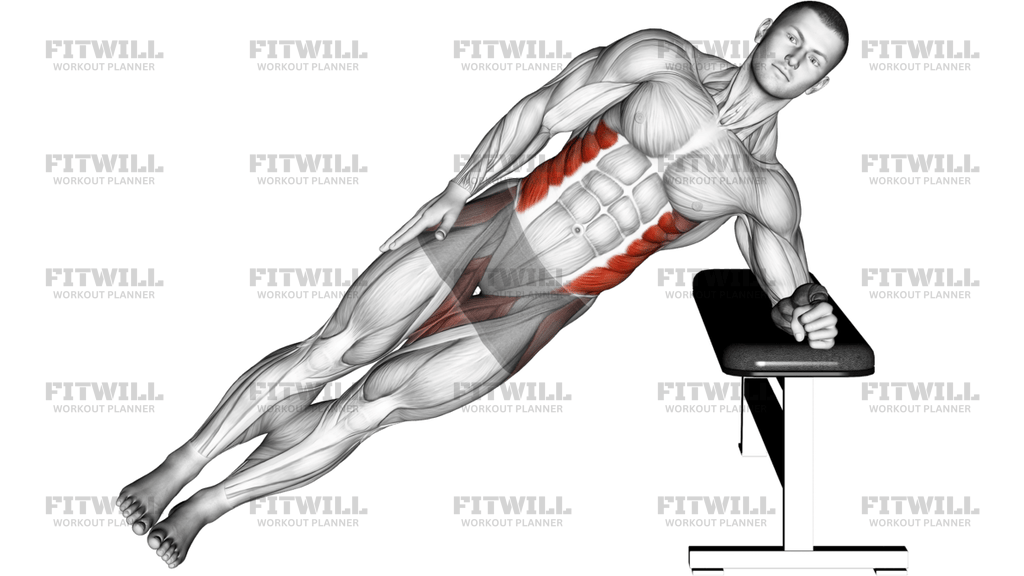
Bodyweight Incline Side Plank Right Side is a bodyweight core hold that builds lateral trunk strength while challenging shoulder stability and hip control. With the forearm supported on a bench, the body works against side-bending and rotation, so the obliques have to keep the torso stacked instead of letting the waist collapse. It is a useful regression from a floor side plank when you want the same pattern with a shorter lever and a little more stability.
The main effort comes from the obliques, with the rectus abdominis, transversus abdominis, and spinal erectors helping keep the torso rigid. The hips also have to stay lifted and aligned, which makes the movement useful for anyone who needs better control through the waist and pelvis. Because the right forearm is the base of support, the right shoulder must stay packed and stacked instead of drifting toward the ear.
The setup matters more than people expect. Place the right forearm on a stable bench with the elbow directly under the shoulder, then extend the legs away from the bench so the body forms one long diagonal line. Keep the feet stacked or slightly staggered if you need more balance, and set the left hand on the hip or reach it upward if you want a stricter anti-rotation challenge. From there, the torso should feel long, not twisted open or folded forward.
To perform Bodyweight Incline Side Plank Right Side well, press the forearm into the pad, lift the hips, and keep the ribs, pelvis, and ankles aligned. The goal is not to twist up to the ceiling or sag back into the shoulder, but to hold a clean line from head to heels while the waist stays hard. Breathe behind the brace, keep the neck relaxed, and lower with control when the set is complete.
This exercise fits well in core circuits, warm-ups, accessory work, and athletic programs where trunk stiffness matters. A higher support surface makes the hold easier, while a lower bench or box increases the challenge. If the shoulder starts to shrug, the low back takes over, or the hips drift behind the torso, shorten the hold and clean up the position before adding time.
[ Workout Log & Planner ]
Put your next workout in Fitwill
Keep your plan and training log ready when you are.


Instructions
- Place a stable bench or box beside you and put your right forearm on the pad with the elbow directly under the right shoulder.
- Extend both legs away from the bench, keeping the body angled in one long line and the head turned slightly toward the floor or forward.
- Stack the feet or place the top foot slightly in front of the bottom foot if you need a steadier base.
- Set the left hand on your hip or reach it straight up, then squeeze the glutes and pull the ribs down before lifting.
- Press the right forearm into the bench and lift the hips until the head, ribs, pelvis, knees, and ankles are aligned.
- Hold the top position without letting the shoulder shrug, the chest roll open, or the waist collapse.
- Breathe in short, controlled breaths while keeping tension through the side of the waist and the outer hip.
- Lower the hips under control, reset the shoulder position, and repeat for the planned hold or rep count.
Tips & Tricks
- Keep the right elbow directly under the shoulder; if it slides forward, the shoulder will feel unstable fast.
- A taller bench makes Bodyweight Incline Side Plank Right Side easier, while a lower support increases the lever and the challenge.
- Stacking the feet is stricter, but a slight stagger is a good fix if your hips keep wobbling.
- Think about pulling the right ribcage away from the right hip; that cue keeps the obliques doing the work.
- Do not let the top shoulder drift toward the ear, or the neck and upper trap will take over.
- If the low back pinches, shorten the hold and keep the pelvis slightly tucked instead of arching.
- Exhale before and during the hold to keep the ribs from flaring open.
- Stop the set as soon as the body line breaks, even if the timer is not finished.
Frequently Asked Questions
What muscles does Bodyweight Incline Side Plank Right Side work most?
It mainly trains the obliques, with help from the abs, glutes, lower back, and shoulder stabilizers.
Should my right forearm or my hand be on the bench?
Use the right forearm on the bench so the elbow can stay stacked under the shoulder and the side of the waist can do the work.
Do I keep my feet stacked for Bodyweight Incline Side Plank Right Side?
Stacked feet make the hold harder and cleaner, while a slight stagger gives you more balance if the hips keep rocking.
Is Bodyweight Incline Side Plank Right Side beginner friendly?
Yes. The incline support makes it easier than a floor side plank, so it is a good entry point for learning side-plank control.
Why does my top shoulder get tired so fast?
That usually means the shoulder is shrugging instead of staying packed. Push the forearm down into the bench and keep the neck long.
What is the most common form mistake on this bench variation?
Letting the hips drop behind the torso or letting the chest rotate open usually reduces oblique tension and shifts work away from the side of the waist.
How long should I hold Bodyweight Incline Side Plank Right Side?
Most people do best with short holds of 10-30 seconds, long enough to stay aligned without losing shoulder or hip position.
Can I switch this to a floor side plank?
Yes, but expect a much harder lever. Use the floor version only when you can keep the bench variation perfectly aligned.