Band Assisted Sprinter Run
Band Assisted Sprinter Run is a partner-assisted sprint drill that uses a light forward pull to help you move faster while you practice sprint mechanics. The band does not replace your effort; it gives you a controlled assist so you can feel quicker turnover, sharper knee drive, and a more aggressive acceleration angle without muscling through every step. It is best used as a technical speed drill, not as a fatigue-based conditioning movement.
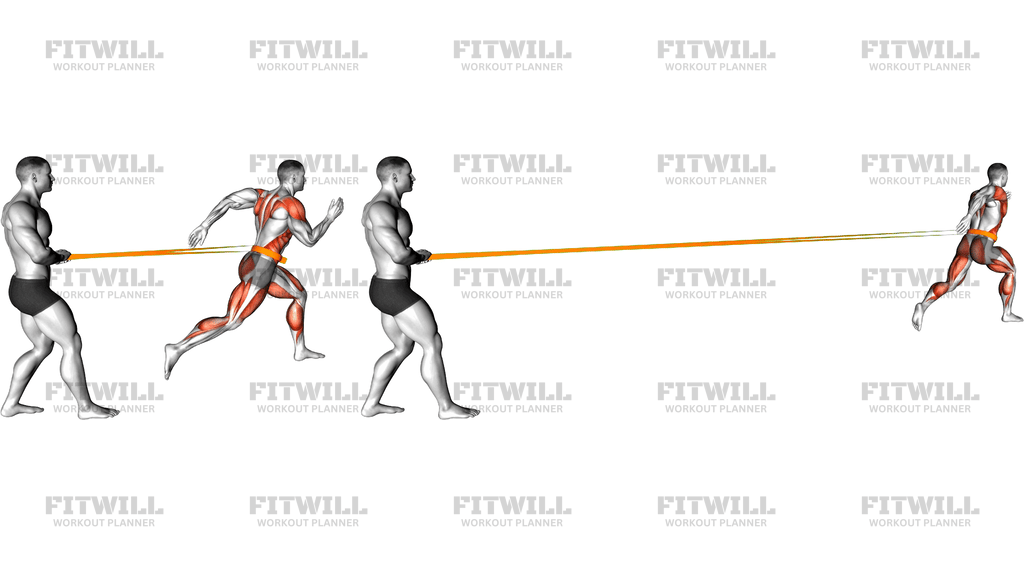
The setup matters because the band should help your sprint pattern, not distort it. In the image, the runner leans forward from the ankles while the partner stands behind and keeps the line of pull centered through the waist. That arrangement lets you stay tall through the hips, keep the ribs stacked over the pelvis, and move with a clean forward projection instead of getting yanked upright by the tension.
Each rep should feel like a smooth acceleration. Push the ground away, cycle the knees quickly under the body, and drive the arms in the same rhythm as the legs. The goal is to preserve sprint posture while moving slightly faster than your normal unassisted turnover. If the band is too strong, your stride will reach out in front of you, your torso will collapse, and the drill stops being useful.
Use Band Assisted Sprinter Run after a thorough warm-up or as a contrast drill next to short unassisted accelerations. Keep the distance short, the tension moderate, and the mechanics crisp from the first step to the last. It is especially useful for athletes working on acceleration, foot speed, and clean sprint positions, but only when the assistance is light enough that you can still own every step.
[ Workout Log & Planner ]
Put your next workout in Fitwill
Keep your plan and training log ready when you are.


Instructions
- Loop the band around your waist or sprint belt and have your partner stand behind you with light forward tension.
- Set one foot slightly ahead of the other, point both toes forward, and lean your body from the ankles into a sprint start angle.
- Keep your ribs stacked over your pelvis, brace your midsection, and set your arms in a sprint position before you move.
- Drive the front knee forward and push the rear foot hard into the floor as the band begins to pull you ahead.
- Keep your chest low enough to match the acceleration angle without folding at the waist.
- Let the feet cycle quickly under your hips instead of reaching out in front of your center of mass.
- Pump the arms close to your body so the upper body stays synchronized with the lower body.
- Run the planned distance with crisp steps, then decelerate under control before the band goes slack.
Tips & Tricks
- Use only enough band tension to quicken the turnover; if the pull jerks your posture upright, it is too strong.
- Keep the band low and centered so the assist comes through the hips instead of twisting your torso.
- Think about pushing the ground back on the first two steps so you do not overstride as soon as the band loads.
- Short reps of about 10 to 20 meters usually keep the mechanics cleaner than long assisted runs.
- Keep your head neutral and eyes slightly down; looking up early often drops the hips and shortens the drive phase.
- Drive the elbows back in line with the body instead of swinging the hands across the midline.
- If your foot starts landing far in front of your body, reduce the assist and reset the drill.
- Let your partner release smoothly at the end of the rep so you can finish without getting yanked off balance.
Frequently Asked Questions
What does the band do in Band Assisted Sprinter Run?
It gives you a light forward assist so you can practice faster sprint turnover and acceleration mechanics.
Where should the band sit on my body?
It should sit low around a sprint belt or waist so the pull stays centered through your hips.
Do I need a partner for this drill?
A partner is the cleanest setup, because they can keep the pull smooth and adjust tension as you run.
How far should each rep be?
Keep the runs short, usually 10 to 20 meters, so you can stay sharp instead of drifting into fatigue.
What should it feel like if the setup is right?
It should feel like a quicker, lighter version of acceleration, not like you are being dragged or forced upright.
What are the biggest technique mistakes?
Overstriding, hinging at the waist, and letting the band pull your torso out of a sprint line are the main errors.
Can beginners use this exercise?
Only if they already understand basic sprint posture and can handle a very light assist without losing balance.
When should I program Band Assisted Sprinter Run?
Use it after a warm-up or next to unassisted accelerations when the goal is speed mechanics rather than conditioning.