Curtsey Squat
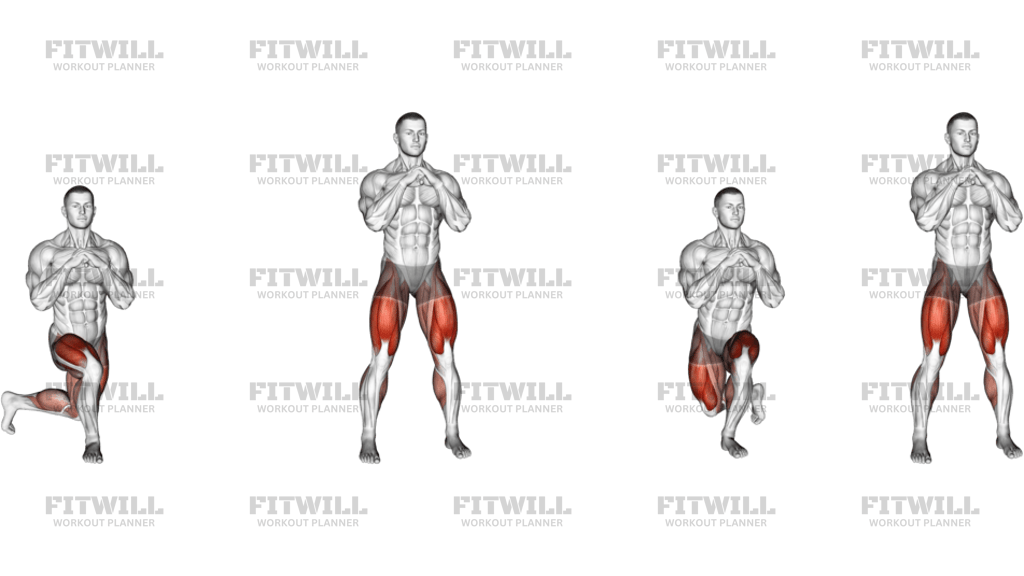
Curtsey Squat is a bodyweight lower-body exercise that combines a squat and a diagonal cross-behind step to challenge the glutes, quads, inner thighs, and trunk together. The curved, behind-the-body step shifts more work into the hips than a straight squat and asks the standing leg to control both knee tracking and pelvic stability. The image shows the torso staying tall with the hands held at the chest, which is a useful default because it keeps the load centered and makes balance easier to monitor.
This movement is especially useful when you want single-leg control without loading a barbell or machine. The working leg needs to stay rooted through the heel and midfoot while the trailing leg crosses behind and lowers only as far as the hips, knees, and ankles can stay organized. If the crossing step is too long or the stance gets too narrow, the front knee tends to cave inward and the torso starts to twist. Keeping the hips mostly square to the front and the chest lifted makes the repetition feel like a controlled lower-body pattern rather than a balance trick.
A clean Curtsey Squat begins from a stable standing position, then the back leg reaches diagonally behind the body and the hips drop under control. The standing knee bends in line with the toes while the back knee moves toward the floor. At the bottom, the front foot should still feel planted and the spine should stay long, not folded over. Drive back up through the front heel and midfoot, then bring the trailing leg back under you before the next rep or before switching sides.
This exercise fits well in warmups, accessory work, glute-focused sessions, and home workouts where equipment is limited. It is also a useful regression before holding dumbbells, because the bodyweight version exposes balance and knee-control issues clearly. Use a range of motion you can repeat cleanly, and stop the set if the landing becomes noisy, the hips shift hard to one side, or the front knee keeps collapsing inward. When done well, Curtsey Squat builds control and lateral hip strength without needing external load.
[ Workout Log & Planner ]
Put your next workout in Fitwill
Keep your plan and training log ready when you are.


Instructions
- Stand tall with your feet about hip-width apart, chest lifted, and hands clasped at your chest for balance.
- Brace your trunk, shift your weight onto one working leg, and keep that foot planted through the heel and midfoot.
- Reach the other leg diagonally behind and across your standing leg so the knees do not crash together.
- Begin lowering by bending the standing knee and hip while keeping your hips mostly square to the front.
- Descend until the back knee approaches the floor and the front thigh reaches a comfortable depth without losing alignment.
- Keep the front knee tracking over the second or third toe and avoid rolling onto the inside edge of the foot.
- Drive through the front heel and midfoot to stand back up, keeping the torso tall instead of leaning forward.
- Bring the trailing leg back under you, reset your stance, and switch sides or repeat on the same side as programmed.
Tips & Tricks
- Keep the crossing step diagonal, not straight back, so the movement stays like a curtsey and not a reverse lunge.
- Use a shorter step if your front knee collapses inward or your balance gets shaky.
- Think about lowering between your hips rather than twisting your torso toward the floor.
- Keep pressure through the big toe, little toe, and heel of the standing foot so the arch does not cave.
- Let the back knee travel toward the floor, but do not force it to touch if the pelvis twists or the front foot lifts.
- Exhale as you drive up to help keep the ribcage stacked over the pelvis.
- Hold the chest-high hand position from the image if you need better balance and cleaner trunk control.
- Stop the set when the standing knee starts drifting inward on every rep.
Frequently Asked Questions
What muscle does Curtsey Squat target most?
The glutes are the main driver, with the quads, adductors, hamstrings, and core helping control the descent and stand back up.
Is Curtsey Squat a good bodyweight exercise for beginners?
Yes, as long as you keep the cross-behind step short and the range of motion controlled. The bodyweight version is a good way to learn balance and knee tracking.
How far should the back leg cross behind the standing leg?
Only far enough to create the diagonal curtsey shape while keeping the hips mostly square. If the step is too deep, the front knee usually caves in and the torso twists.
Should my back knee touch the floor?
No. Lower until it is close to the floor and you can still keep the standing foot planted and the torso tall.
Why does my front knee cave inward on this movement?
That usually means the crossing step is too narrow, the load is shifting onto the inside edge of the foot, or you are dropping too fast. Shorten the step and keep pressure through the full foot.
What should I feel at the bottom of the rep?
You should feel the front glute and thigh working hard, with the inner thigh and trunk helping you stay steady. The movement should not feel like a twist in the lower back.
Can I hold dumbbells for Curtsey Squat?
Yes, but only after you can repeat clean bodyweight reps without losing balance or knee alignment. Dumbbells make the control demands much higher.
What is a good variation if balance is limited?
Use a smaller crossing step, keep the hands at chest height, or lightly hold a rack or wall until the standing leg feels stable.