Handboard Open Hand Grip
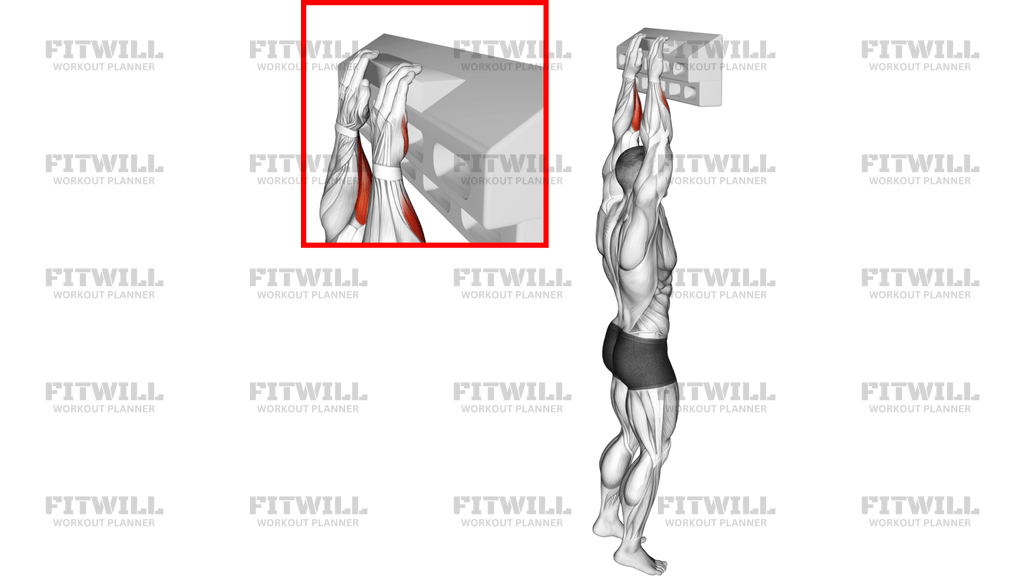
Handboard Open Hand Grip is a climbing-style grip hold performed on a handboard or hangboard edge with the fingers in an open-hand position. The exercise is designed to build finger and forearm strength, grip endurance, and the shoulder control needed to keep an overhead hold stable. Because the contact point is small, the quality of the hand position matters more than brute force.
In the open-hand grip, the finger pads load the edge while the knuckles stay gently bent and the thumb stays relaxed or lightly wrapped depending on the board. That position usually places the greatest demand on the wrist flexors and the rest of the forearm flexor chain, with brachioradialis, biceps, and wrist extensors helping stabilize the arm. The shoulders and upper back also contribute by keeping the body organized under the hold.
Set the board at a height where you can reach with straight arms and choose the amount of load you can control. Some athletes will take full bodyweight, while others will keep one or both feet on the floor or a box to reduce the demand. The goal is a steady, repeatable hold with no swinging, shrugging, or finger collapse. A clean setup also keeps the wrists neutral and makes it easier to distribute force evenly across the fingers.
Perform the hold by gently taking tension onto the board, setting the shoulders down away from the ears, and keeping the ribs stacked instead of flaring. Breathe in a calm, controlled rhythm while the hands stay quiet on the edge. If the fingers begin to open, the shoulders rise, or the body starts to sway, the set has already moved past useful quality.
This movement is most useful for climbers, grip-focused training, and athletes who need specific finger endurance without turning every session into a max-effort test. It can be a warm-up, a technique drill, or a strength accessory, but it should be progressed carefully because the fingers and elbows adapt more slowly than the larger pulling muscles. Keep the effort sharp, the volume conservative, and the setup consistent from set to set.
[ Workout Log & Planner ]
Put your next workout in Fitwill
Keep your plan and training log ready when you are.


Instructions
- Set the handboard or hangboard overhead so you can reach the edge with straight arms, then stand, step, or hang in a position that lets you control the load.
- Place the fingers on the edge in an open-hand grip with the finger pads on the hold, the knuckles slightly bent, and the thumb relaxed unless the hold requires it.
- Keep the wrists neutral and the forearms aligned so the load stays on the fingers instead of collapsing into the wrist.
- Pull the shoulders down and away from the ears before you take full tension onto the board.
- Brace the ribs and trunk, then load the hold smoothly without kicking, swinging, or bouncing into position.
- Hold the position with steady arm tension and quiet shoulders while you breathe in a controlled rhythm.
- Keep the fingers evenly loaded and stop the set if the hand opens, the elbow bends to cheat, or the shoulders shrug up.
- Release one hand at a time or step back down under control, then rest fully before the next effort.
Tips & Tricks
- Use a shallower hold or keep a foot on the floor if the open-hand position feels too aggressive for the fingers.
- Do not hard-hook the thumb unless the board or drill specifically calls for it; the open-hand version should feel finger-dominant.
- Keep the wrist from bending back sharply, because an extended wrist shifts stress away from the intended grip pattern.
- If the shoulders creep toward the ears, reduce the load; the hold should stay active but not turn into a shrug.
- Chalk helps keep the contact points consistent on small edges, especially as sweat builds during longer sets.
- Short, high-quality holds are usually better than long sloppy hangs for this movement.
- Rest long enough for the fingers to recover between sets so the next hold starts with the same hand position.
- Stop before the fingertips peel open or the elbows start bending to rescue the hold.
Frequently Asked Questions
What does Handboard Open Hand Grip train most?
It mainly trains the finger flexors and forearm muscles, with the shoulders and upper back helping you keep the overhead hold stable.
What is an open-hand grip on the handboard?
It means the fingers stay slightly bent over the edge instead of being aggressively crimped. The thumb is usually relaxed or only lightly wrapped, depending on the hold.
Should I fully hang from the board or keep my feet down?
Either can work. Beginners often keep one or both feet on the floor or a box to control the load, while advanced climbers may use full bodyweight.
What are the most common mistakes on the handboard?
Shrugging the shoulders, bending the wrists back, over-gripping with a crimp, and letting the body swing are the main issues.
Is this exercise beginner-friendly?
Yes, if the edge is easy enough and the load is scaled with foot support or shorter holds. Newer athletes should keep the effort submaximal.
How long should I hold the grip?
Use a hold time that you can maintain without form breaking down. For strength work that usually means a short, crisp hold rather than a long grind.
How is this different from a crimp grip?
The open-hand version keeps the finger joints less sharply folded, which usually reduces stress on the fingertips and lets the forearm do the work in a more controlled way.
How should I progress this movement?
Progress by using a slightly smaller edge, less foot assistance, longer holds, or more total volume, but only one change at a time.