Kettlebell Burpee
Kettlebell Burpee turns a classic burpee into a more structured conditioning drill by using the kettlebell handles as elevated hand positions. That small change matters: it gives you a clearer setup, keeps the hands off the floor, and often makes the transition into plank easier on the wrists while still demanding the legs, core, shoulders, and breathing.
The exercise is useful when you want full-body work without a long list of moving parts. It asks you to squat down, brace, shift weight into your hands, kick or step back to a solid plank, then return to standing with the same control. The goal is not to collapse through the middle or race through the rep, but to keep each transition crisp enough that your posture looks the same from the first rep to the last.
Setup is the part that decides whether Kettlebell Burpee feels smooth or awkward. Place the kettlebells on a flat, stable surface, usually about shoulder-width apart, and stand just behind them so you can lower into a squat without reaching too far forward. When you bend down, keep your chest over the bells, your spine long, and your feet grounded so the handles are easy to grab without rounding your lower back.
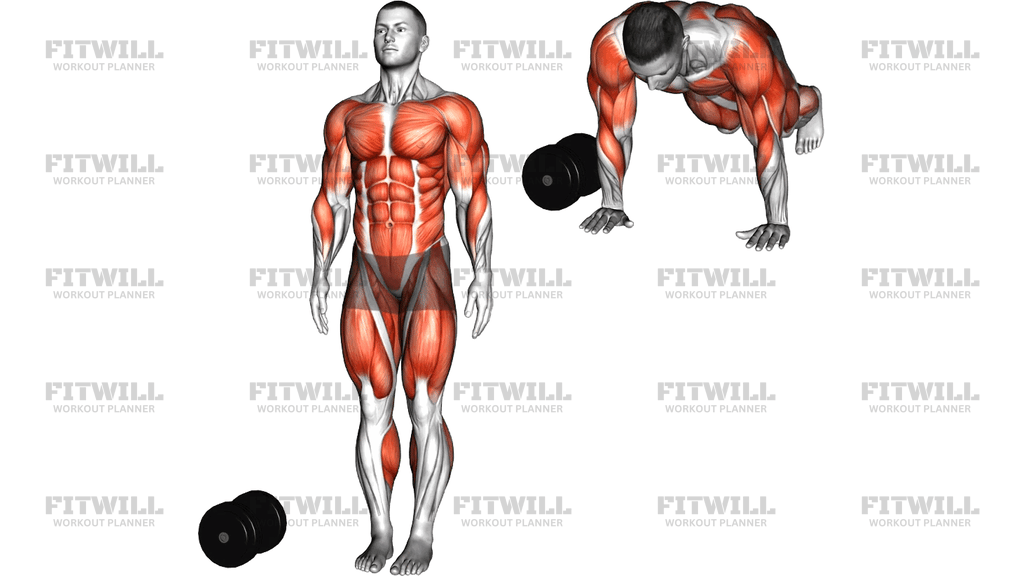
From there, the rep should flow in a clear pattern: hands on the handles, core braced, feet back to a strong plank, then feet back under you to stand. If your version includes a push-up, that usually happens after the plank is established and before you step back in. The important part is that the torso stays organized through each change of level, because the exercise becomes much less effective when the hips sag, the shoulders drift behind the bells, or the landing turns noisy and rushed.
Kettlebell Burpee fits well into conditioning blocks, finishers, and athletic circuits where you want work capacity and coordination at the same time. It can be scaled for beginners by stepping back and stepping forward instead of jumping, or made more demanding by adding pace, a push-up, or more reps only after the setup stays consistent. Keep the movement clean, breathe on the stand, and stop the set when the plank position or bell placement starts to fall apart.
Fitwill
Log Workouts, Track Progress & Build Strength.
Achieve more with Fitwill: explore over 9600 exercises with images and videos, access built-in and custom workouts, perfect for both gym and home sessions, and see real results.
Start your journey. Download today!




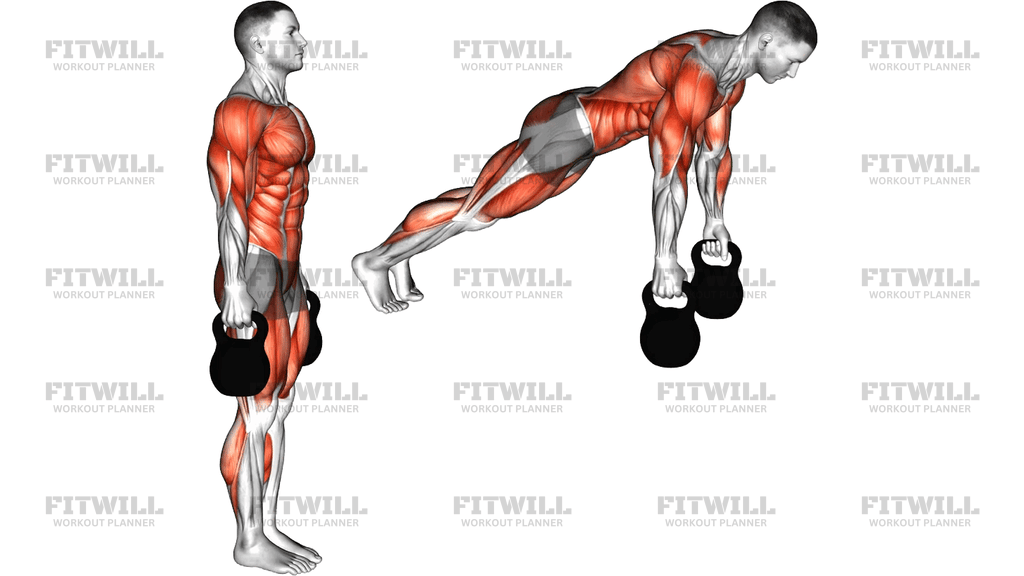
Instructions
- Place two kettlebells on a flat floor about shoulder-width apart, then stand just behind them with enough room to squat down between the handles.
- Lower into a squat by bending your hips and knees, keeping your chest over the bells and your back long as your hands reach the handles.
- Grip the kettlebell handles firmly, plant your feet, and brace your core before you shift your weight forward.
- Step or hop both feet back into a high plank, stacking your shoulders over your wrists and keeping your body in one straight line.
- Hold the plank briefly with your glutes tight and your ribs pulled in so the kettlebells stay steady under your hands.
- Step or hop both feet back toward the bells and land in a low squat with your feet under your hips or just outside the handles.
- Drive through your heels to stand tall and finish the rep; add a small jump only if you can keep the landing quiet and balanced.
- Reset your stance, breathe, and repeat with the same tempo for the next repetition.
Tips & Tricks
- Keep the kettlebells on a non-slip surface so they do not shift when you kick your feet back.
- Use the handles, not the bell bodies, so your wrists stay neutral and the setup is more predictable.
- If your shoulders drift behind the bells in plank, set the kettlebells a little wider before the next rep.
- Step back instead of hopping if your low back sags or your landing feels loud.
- Keep your squat shallow enough that you can still grip the handles without rounding your spine.
- Exhale as you stand so your ribs do not flare and your torso stays stacked over your hips.
- Choose a pair of bells you can control for every rep; grip fatigue shows up fast in Kettlebell Burpee.
- Stop the set if the bells tip, your knees cave inward, or your plank turns into a pike.
Frequently Asked Questions
What muscles does Kettlebell Burpee train most?
It hits the quads, glutes, core, shoulders, and upper body support muscles while also driving conditioning.
Is Kettlebell Burpee easier on the wrists than a floor burpee?
Usually yes, because the handles keep your hands elevated and your wrists in a more neutral position.
Should I step back or jump back in Kettlebell Burpee?
Step back if you want more control or if your plank tends to sag; jump back only if you can land quietly and stay braced.
Do I need a push-up in Kettlebell Burpee?
Not necessarily. Many versions are just a squat-thrust to plank and back; add a push-up only if the workout calls for it and you can keep the bells steady.
How far apart should the kettlebells be?
About shoulder-width or slightly wider is usually best so your hands land comfortably and your chest has room between the bells.
What is the most common mistake in Kettlebell Burpee?
Letting the hips sag or piking too high in plank, which takes tension away from the core and shoulders.
Can beginners do Kettlebell Burpee?
Yes, but start with step-backs and step-ins and use light bells that stay planted when you shift your weight.
How can I make Kettlebell Burpee harder?
Add reps, speed up only if the transitions stay clean, or include a push-up once you can hold a solid plank between the bells.