Kettlebell Split Snatch
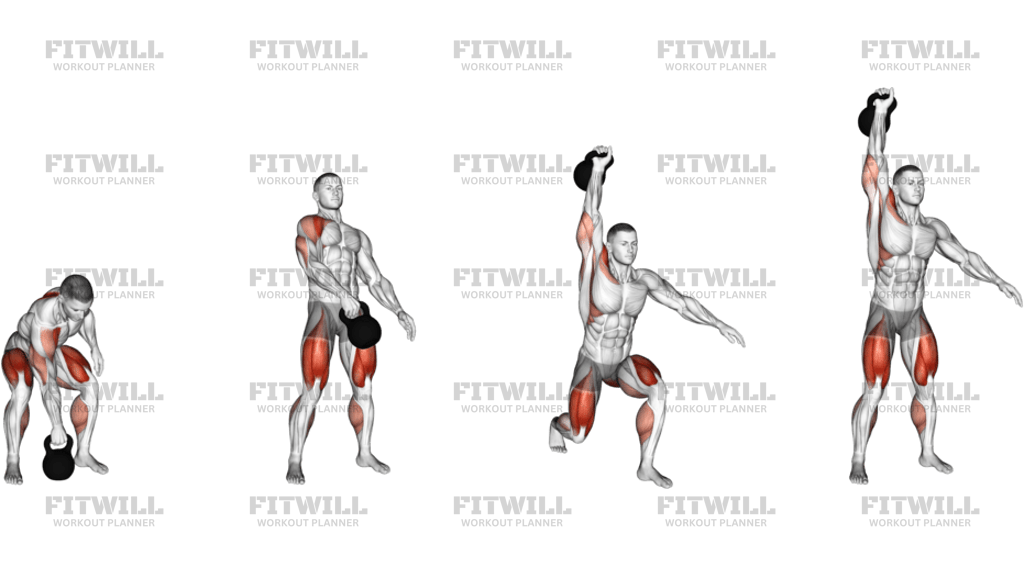
Kettlebell Split Snatch is an explosive one-arm kettlebell lift that combines a powerful hip drive with a split-stance catch overhead. The bell starts on the floor between the feet, travels close to the body, and finishes locked out overhead while the legs absorb the load in a split position. That makes it useful for power, coordination, overhead stability, and the ability to stay organized when the rep moves quickly.
This is not a curl or a loose swing to overhead. The hips create most of the force, the arm guides the bell, and the finish should look stacked: wrist over elbow, elbow over shoulder, shoulder over hip. In the split catch, the front foot steps forward and the back foot steps behind so the body can receive the bell without a hard landing or a wobbling torso.
Setup matters because the start position controls the whole rep. Grip the handle with the bell centered between the feet, hinge to load the hips, and keep the free arm available for balance. As you stand and extend, keep the bell close to the line of the body so it can turn over smoothly instead of swinging away from you. The overhead lockout should feel secure enough to pause before recovering to standing.
This movement fits well in strength, conditioning, or athletic sessions when you want a single rep to train power and control together. Keep the load light enough that the catch stays crisp, the split stance stays quiet, and the overhead position stays stacked. If the bell drifts forward, the catch becomes a jump, or the back stays arched, the set is too heavy or too fast for clean execution.
Fitwill
Log Workouts, Track Progress & Build Strength.
Achieve more with Fitwill: explore over 9600 exercises with images and videos, access built-in and custom workouts, perfect for both gym and home sessions, and see real results.
Start your journey. Download today!




Instructions
- Stand with the kettlebell on the floor between your feet, feet about hip-width apart, and place your working hand on the handle while the free arm stays open for balance.
- Hinge at the hips and bend the knees just enough to grip the bell with a flat back, a long neck, and your chest slightly in front of the handle.
- Pack the shoulder and keep the bell centered under you before the first pull so the weight does not start drifting forward.
- Drive through the floor to stand up, letting the kettlebell rise close to your body instead of swinging out in front of you.
- Use a sharp hip snap to accelerate the bell, then pull high and punch your hand to the ceiling as the kettlebell turns over.
- As the bell locks out overhead, step into a split stance with one foot forward and the opposite foot back to absorb the catch.
- Finish with the arm straight, wrist neutral, ribs down, front knee stacked over the ankle, and the back heel lifted.
- Hold the overhead split briefly, recover the feet under you, and lower the bell back down under control before the next rep or reset.
Tips & Tricks
- Keep the bell close to your shin and thigh on the way up; if it arcs forward, you are muscling the lift instead of snapping the hips.
- Think punch to the ceiling, not a biceps curl, so the kettlebell turns over smoothly instead of looping around the hand.
- The split catch should feel quiet and controlled; if you are hopping to find balance, the rep is too aggressive.
- Do not overstride in the split stance. The front foot should land far enough forward to absorb force, but not so far that the front knee collapses.
- Keep the ribs stacked over the pelvis in the overhead lockout so the lower back does not take over the finish.
- Use the free arm as a counterbalance, but avoid twisting the torso to chase the bell overhead.
- Finish with the bell directly above the shoulder and midfoot, not behind your head or drifting out in front of you.
- Lower the bell with the same control you used to lift it; sloppy drops usually show up first in the shoulder and grip.
- Choose a load that lets every rep look identical. This movement is about crisp power, not grinding through fatigue.
Frequently Asked Questions
What muscles does the kettlebell split snatch work?
It mainly trains the glutes, hamstrings, shoulders, and core, with the split catch adding extra demand on the quads and stabilizers.
Is the split catch part of the rep or just a transition?
It is part of the rep. The overhead lockout is received in a split stance, then you recover to standing after the bell is stable.
Where should the kettlebell travel during the swing and snatch?
The bell should stay close to the body, rising from the floor and turning over without looping far in front of the shins or chest.
What is the biggest mistake with the split snatch catch?
Overstriding or jumping into the split stance usually makes the landing noisy and unstable, which takes tension out of the overhead position.
Can beginners do this exercise?
Yes, but they should start very light and master the hip drive, overhead punch, and split landing before adding speed or load.
How should the overhead lockout feel?
The bell should be stacked over the shoulder with the ribs down and the elbow fully straight, not pressed behind the head.
Do I need to keep the rear heel down in the split stance?
No. The rear heel stays lifted so you can absorb the catch and keep the split position balanced.
What can I use instead if the overhead position bothers my shoulder?
Use a kettlebell clean, high pull, or push press progression until you can lock the bell out overhead without pain.