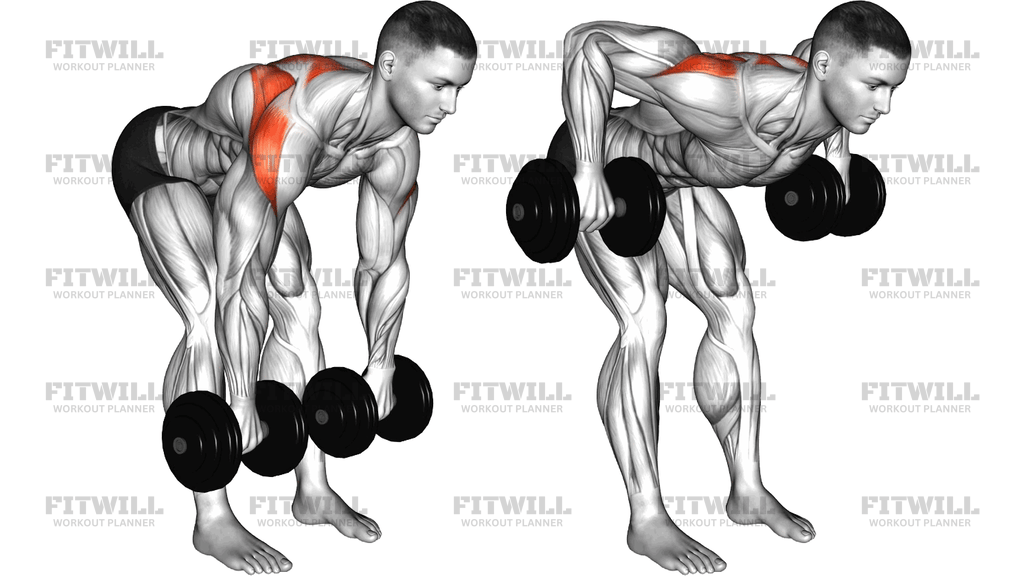
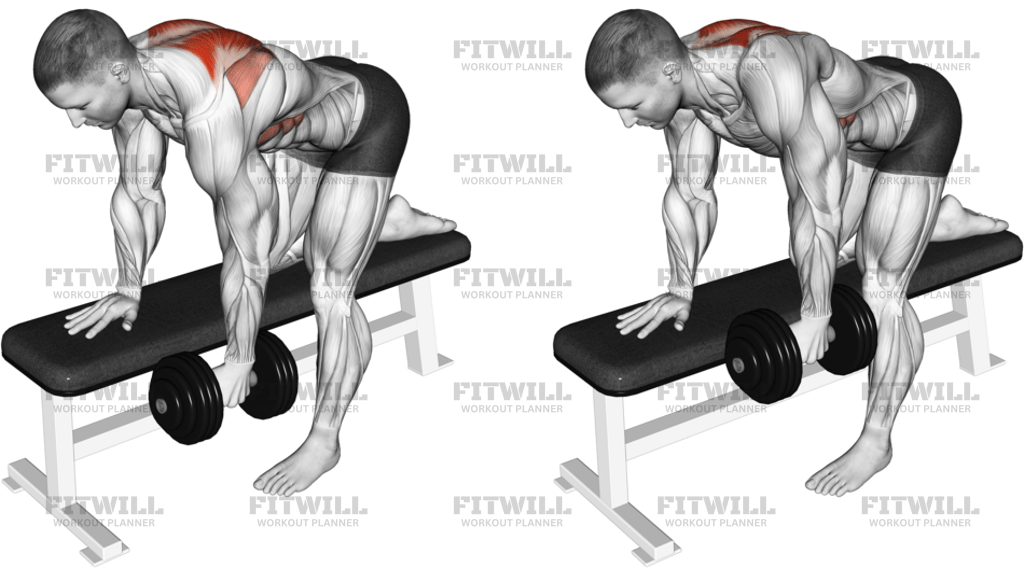
Dumbbell Stiff Leg Deadlift
Dumbbell Stiff Leg Deadlift is a hip-hinge exercise performed with dumbbells held at your sides. It trains the back side of the body by loading the hamstrings and glutes through a long, controlled lowering phase, while the spinal erectors and upper back work to keep the torso braced and the shoulders organized. Because the legs stay nearly straight, the movement puts a strong stretch on the hamstrings and rewards careful control more than speed.
The setup matters more here than in many other lower-body lifts. You start tall with the dumbbells hanging close to the thighs, feet about hip-width apart, and only a small bend in the knees. From there, the torso tips forward at the hips while the hips move back, keeping the dumbbells close to the legs and the spine neutral. If the weights drift away from the body or the back rounds early, the load shifts away from the hamstrings and glutes and into the lower back.
A well-executed Dumbbell Stiff Leg Deadlift should feel like a hinge, not a squat. The descent is slow and deliberate until you reach the deepest position you can hold without losing your back position or the soft-knee angle. At the bottom, the hamstrings should be stretched, but there should be no sharp pull in the back or behind the knees. On the way up, drive the hips forward and stand tall without leaning back or snapping into lockout.
This exercise is useful for building posterior-chain strength, improving hamstring length under load, and teaching a clean hinge pattern that carries over to other deadlift variations, sprint work, jumping, and general athletic preparation. It also works well as accessory work after squats or heavier pulls because the dumbbells allow a simpler setup and a more forgiving range of motion than a barbell.
Use Dumbbell Stiff Leg Deadlift when you want targeted hamstring and glute work with minimal equipment, or when you need a technical hinge variation that is easier to load incrementally. Keep the reps smooth, stop the set if the spine starts to round, and treat the bottom position as a controlled stretch rather than a bounce. The best result comes from repeatable reps that keep the dumbbells close, the knees softly bent, and the hips doing the work.
Fitwill
Log Workouts, Track Progress & Build Strength.
Achieve more with Fitwill: explore over 9600 exercises with images and videos, access built-in and custom workouts, perfect for both gym and home sessions, and see real results.
Start your journey. Download today!




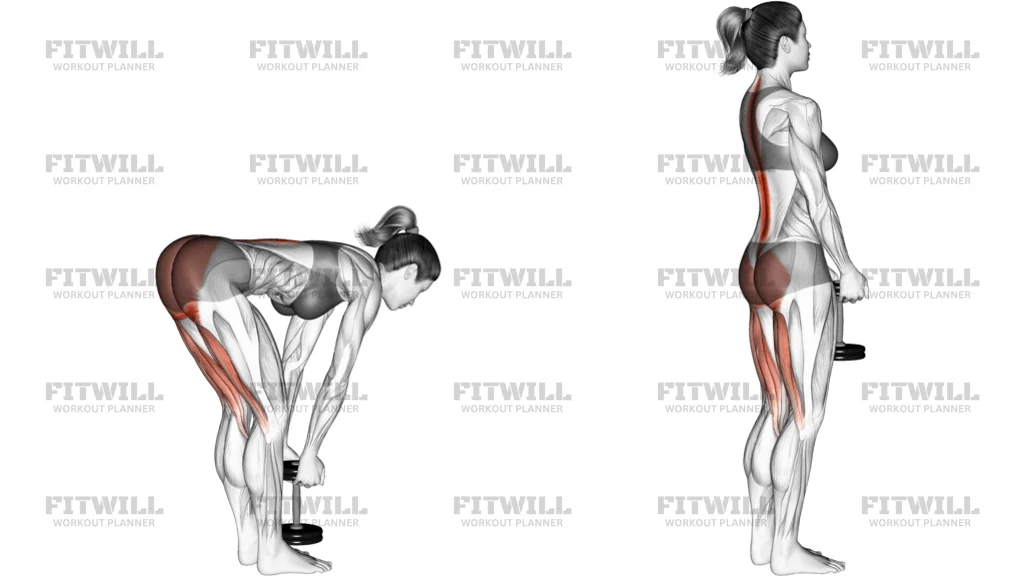
Instructions
- Stand tall holding a dumbbell in each hand with your palms facing your thighs and your feet about hip-width apart.
- Keep a soft bend in your knees, then set your shoulders down and brace your torso before you start the first rep.
- Let the dumbbells rest close to the front of your thighs and keep them touching or nearly touching your legs as you hinge.
- Push your hips straight back and tip your torso forward until you feel a deep stretch in the hamstrings.
- Keep your back flat and your neck long while your knees stay only slightly bent, not locked or squatting.
- Lower the dumbbells to about mid-shin or as far as you can go without rounding your lower back.
- Reverse the motion by driving your hips forward and standing up tall, squeezing the glutes at the top without leaning back.
- Inhale on the way down and exhale as you come back up, keeping the dumbbells under control the entire rep.
- Reset at the top with the weights hanging still by your sides before starting the next repetition.
Tips & Tricks
- Keep the dumbbells brushing the front of your legs so the load stays on the hamstrings instead of pulling your shoulders forward.
- Think about sending your hips back to the wall behind you; if your knees keep drifting forward, the movement is turning into a squat.
- Stop the descent the moment your lower back starts to round, even if the weights have not reached mid-shin.
- A slight knee bend is enough here; fully locking the knees usually makes the hamstring stretch harsher and the hinge harder to control.
- Let the stretch build in the backs of the thighs, but avoid bouncing out of the bottom position.
- Use straps if your grip gives out before your hamstrings do, especially with longer sets.
- Finish each rep by squeezing the glutes and standing tall, not by leaning your torso back past neutral.
- Choose a slower lowering phase than lifting phase so the hamstrings stay loaded and the torso stays organized.
Frequently Asked Questions
What muscles does Dumbbell Stiff Leg Deadlift work?
It mainly works the hamstrings and glutes, with the lower back, upper back, and grip helping you keep the hinge position.
How is Dumbbell Stiff Leg Deadlift different from a regular deadlift?
The knees stay much straighter and the hips travel farther back, so the hamstrings get a bigger stretch and the lift feels more like a hinge than a floor pull.
How low should the dumbbells go in Dumbbell Stiff Leg Deadlift?
Lower them only until your back stays neutral and your hamstrings are stretched hard, which is often around mid-shin but may be higher or lower depending on flexibility.
Should my knees be locked during Dumbbell Stiff Leg Deadlift?
No. Keep a small, soft bend in the knees so the hips can hinge back and the hamstrings can load without putting extra strain on the joints.
Why do the dumbbells need to stay close to my legs?
Keeping them close shortens the lever arm and keeps the work on the posterior chain instead of turning the lift into a rounded-back reach.
Can beginners do Dumbbell Stiff Leg Deadlift safely?
Yes, if they start light and learn to hinge with a neutral spine first. The dumbbells make it easier to scale than a barbell, but the back position still has to stay controlled.
What should I do if I feel this mostly in my lower back?
Reduce the range of motion, keep the dumbbells closer to your thighs and shins, and make sure the movement starts by pushing the hips back instead of bending the torso first.
Is Dumbbell Stiff Leg Deadlift the same as a Romanian deadlift?
They are very similar in most gyms. In practice, this version usually keeps the knees a little straighter, while a Romanian deadlift allows a slightly softer knee bend.