Front To Side Plank
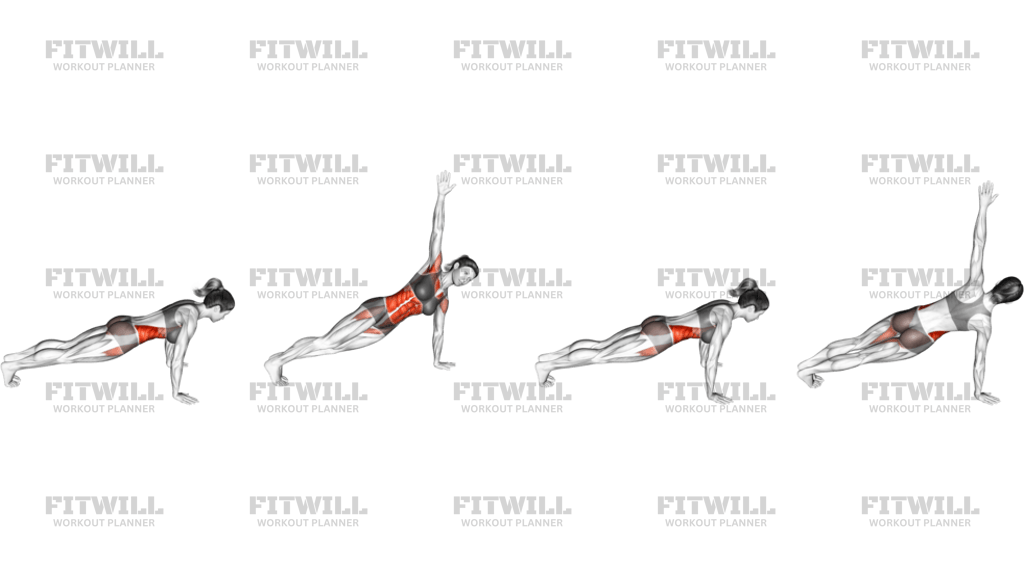
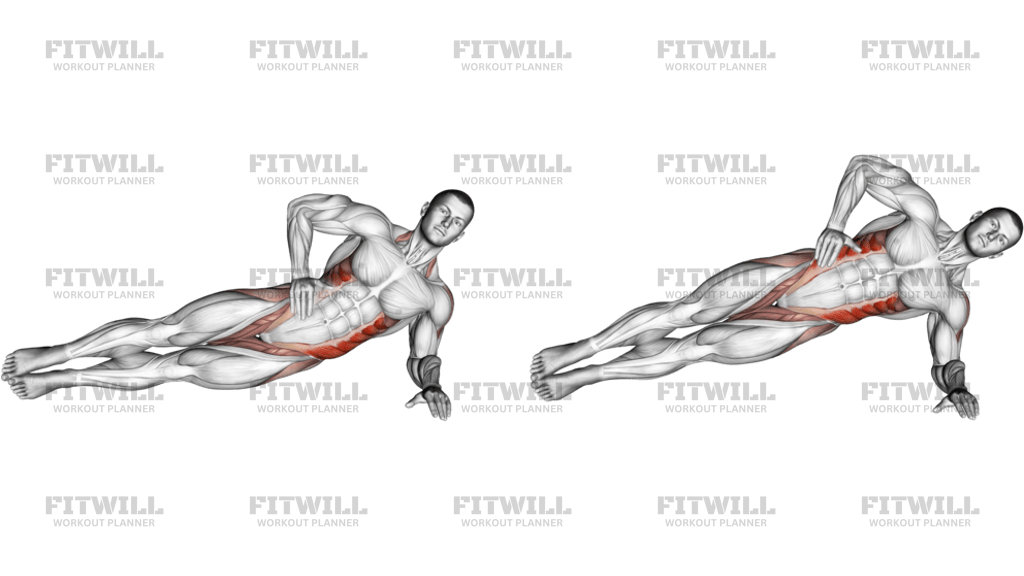
Front To Side Plank is a bodyweight core and shoulder-stability exercise that moves from a straight-arm front plank into a side plank, then back again. It is designed to challenge the obliques, deep abdominal wall, glutes, and the supporting shoulder while the rest of the body stays in one long line. The image shows a high-plank start, a rotation onto one hand and the outside edge of one foot, and a free arm reaching straight toward the ceiling at the top of the side plank.
Because the exercise combines anti-extension, anti-rotation, and lateral stability, the setup matters as much as the transition. Your hands need to be under the shoulders in the front plank, your feet need enough width to let the body roll without wobbling, and the hips need to stay high enough that the torso rotates as one unit instead of collapsing at the waist. If the shoulders are not stacked cleanly over the wrists and the rib cage is not controlled, the movement turns into a shaky balance drill instead of a useful trunk-strength exercise.
Each repetition should feel deliberate: brace hard in the front plank, shift the weight into one supporting arm, rotate the chest open, and stack the hips for a clean side plank. The top arm should stay vertical and active rather than drifting forward, and the neck should stay long so the eyes do not lead the rotation. When you return to the front plank, move slowly enough that the abs and obliques control the turn instead of the feet swinging the body around.
Front To Side Plank fits well in a warm-up, core block, athletic prep session, or accessory circuit when the goal is better trunk control rather than raw load. It is useful for beginners if the holds are short and the feet are staggered or widened, and it is equally useful for advanced lifters who need better anti-rotation strength for pressing, carrying, sprinting, or overhead work. Stop the set if the hips sag, the lower back takes over, or the supporting shoulder loses position, because those are the signs that the quality of the plank is gone.
Fitwill
Log Workouts, Track Progress & Build Strength.
Achieve more with Fitwill: explore over 9600 exercises with images and videos, access built-in and custom workouts, perfect for both gym and home sessions, and see real results.
Start your journey. Download today!




Instructions
- Start in a straight-arm high plank with your hands under your shoulders, legs straight, and feet set about hip-width apart or a little wider for balance.
- Press through the floor, squeeze your glutes, and brace your abs so your body forms one firm line from head to heels before you rotate.
- Shift your weight onto one hand and the outside edge of the same-side foot, keeping the opposite hand ready to leave the floor.
- Rotate your chest open into a side plank, stacking your shoulders and hips as the feet roll or stagger for support.
- Reach the free arm straight up toward the ceiling and keep the supporting shoulder directly over the wrist or palm.
- Hold the side plank briefly without letting the hips drift backward, forward, or down toward the floor.
- Rotate back through the front plank under control, then repeat to the other side or continue with the planned alternating pattern.
- Keep breathing through every rep and lower to the knees or end the set if you can no longer keep the torso rigid.
Tips & Tricks
- Set your feet a little wider if your hips wobble; a wider base makes the rotation much easier to control.
- Keep the supporting shoulder packed instead of shrugging toward the ear at the top of the side plank.
- Think about rotating the ribs and pelvis together; if the hips lag behind the shoulders, the low back usually starts to twist.
- Keep the top arm stacked over the shoulder so the reach helps balance the plank instead of pulling you forward.
- Exhale as you rotate open to help the obliques tighten and keep the rib cage from flaring.
- If the wrists are sensitive, use push-up handles or shift to a forearm version rather than letting the hands collapse.
- Short, clean holds are better than long shaky ones, especially if the goal is trunk control rather than endurance.
- Stop each rep before the lower hip drops; once that happens, the working side is no longer doing the job.
Frequently Asked Questions
What does Front To Side Plank work most?
It mainly trains the obliques and deep core while also challenging the shoulders, glutes, and stabilizers that keep the body from twisting or sagging.
Can beginners perform this exercise?
Yes, but beginners should keep the holds short, widen the feet, and use a staggered stance if the full side plank feels unstable.
Do my feet need to stay stacked in the side plank?
Stacked feet are ideal if you can keep balance, but a staggered or slightly split stance is often more stable and still gives a strong core challenge.
Why does my supporting shoulder feel so much work?
That shoulder has to support body weight while the body rotates, so it is doing a lot of stabilizing. It should feel active, not painful or pinchy.
Should I rotate all the way through each rep?
Rotate until you reach a clean side plank and then return under control. Forcing extra range usually makes the hips drop or the low back twist.
What is the biggest form mistake in this movement?
Letting the hips collapse or the ribs flare while you turn. The torso should stay braced so the rotation comes from control, not from losing position.
How long should I hold the side plank part?
Long enough to show control, usually just a brief pause. If you can hold longer without shaking, you can extend the pause gradually.
What if my wrists hurt in the front plank position?
Use push-up handles, fists, or a forearm-plank version. The goal is the trunk rotation, so the hand position can be adjusted for comfort.