Finger Push-Up
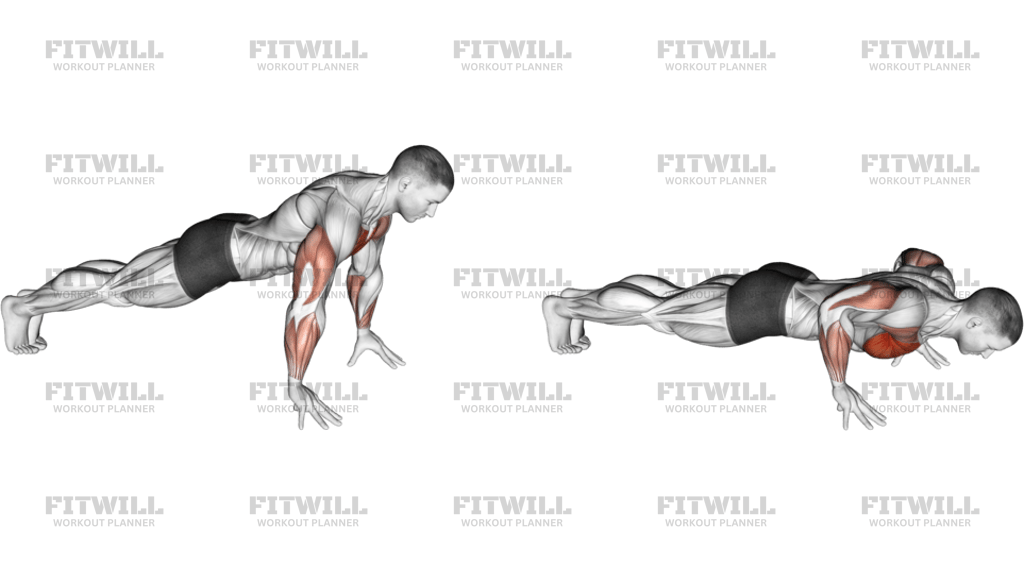
Finger Push-Up is a bodyweight pressing exercise performed on the fingertips instead of the palms. It asks you to keep the entire body long and rigid while the fingers, hands, shoulders, chest, and triceps coordinate to lower and press under control. Because the support surface is small, setup and hand position matter more than they do in a standard push-up.
The main training value comes from the pressing pattern itself, but the fingertip support adds a strong demand on hand strength, wrist control, and shoulder stability. In this variation the Pectoralis major is the primary mover, with help from the anterior deltoid, triceps brachii, and Rectus abdominis. That makes the exercise useful for chest-focused strength work, upper-body control, and advanced bodyweight conditioning.
The setup should feel deliberate before the first rep begins. Place the fingertips on the floor under or just outside the shoulders, spread the fingers enough to create a stable base, and set the feet back so the body forms one straight line from head to heels. The shoulders should be stacked and the torso braced before you lower. If the hand position feels unstable, reset before continuing; a rushed start usually turns into sloppy reps or irritated finger joints.
On the descent, bend the elbows and lower the chest toward the floor with the elbows tracking slightly back from the body. Keep the head and neck neutral, avoid sagging through the hips, and resist the urge to collapse into the shoulders. At the bottom, reverse direction by pressing the floor away through the fingertips and driving the chest and triceps together to return to full extension.
This is a demanding variation, so clean range matters more than speed or rep count. It is best used by lifters who already own a solid push-up and want a harder bodyweight press without adding external load. If your fingers, wrists, or elbows feel stressed instead of challenged, shorten the set, reduce the range, or regress the movement. The goal is a strong press with crisp body alignment, not a fight to survive each repetition.
[ Workout Log & Planner ]
Put your next workout in Fitwill
Keep your plan and training log ready when you are.


Instructions
- Place your fingertips on the floor slightly wider than shoulder width, with the fingers spread and the wrists stacked over the support points.
- Walk your feet back until your body forms a straight line from head to heels and your weight is balanced between the fingertips and toes.
- Brace your abs and glutes, then set the shoulders so they stay firm instead of sinking toward the floor.
- Inhale as you lower your chest toward the floor by bending the elbows under control.
- Keep the elbows angled slightly back and the neck neutral as you descend to your deepest stable position.
- Pause briefly near the bottom without relaxing the torso or dumping weight into the fingers.
- Exhale as you press the floor away through the fingertips and drive back to straight arms.
- Reset the body between reps if the hips rise, the shoulders shrug, or the finger position slips.
Tips & Tricks
- Spread the fingers enough to create a stable base, but do not let the hand collapse so the finger joints take all the load.
- Keep the fingertips under or just outside the shoulders; placing them too far forward turns the rep into a shoulder-dominant grind.
- Use a floor that gives traction without being slick, because any hand slide makes fingertip support much harder to control.
- Lower with the chest and shoulders moving together instead of letting the head dive first.
- Stop the set when the fingertips start to buckle or the knuckles feel sharp pressure, even if the chest still feels strong.
- Keep the elbows from flaring straight out to the sides; a slightly tucked path is usually friendlier on the shoulders.
- Use shorter sets than a normal push-up because fingertip fatigue usually appears in the hands before the chest is fully challenged.
- If your wrists feel crowded, rotate the hands a few degrees outward and recheck the line from shoulders through fingertips.
- Treat every rep like a skill rep: a clean body line matters more than adding speed or chasing a big count.
Frequently Asked Questions
What muscle does Finger Push-Up target most?
The chest is the primary mover, especially the pectoralis major, with the triceps and front shoulders helping on every rep.
Can beginners perform this exercise?
Not usually as a first push-up variation. Most people should build a solid standard push-up or use an incline version before loading the fingertips.
How should my fingers be placed on the floor?
Spread the fingers and place the fingertips slightly wider than shoulder width so the pressure is shared across the hand instead of dumped into one joint.
How low should I go on each rep?
Lower until the chest is near the floor or until the shoulder position starts to break down. Do not chase depth if the fingers or wrists lose stability.
Is this harder on the wrists or fingers?
The fingers usually take the bigger load because the support surface is so small, but the wrists and shoulders still need to stay stacked and stable.
What is a common mistake to avoid?
Letting the hips sag or the shoulders collapse is the biggest problem, because that shifts stress away from the chest and into the joints.
How can I make Finger Push-Up easier?
Use an incline surface, shorten the range, or perform the same pressing pattern on a wall or bench before returning to the floor.
Should I use this for high reps?
Usually no. Fingertip work is more about crisp, controlled sets than chasing fatigue with sloppy repetition counts.
When should I stop the set?
Stop when the fingers start to cave, the hands shift position, or the torso line breaks, even if your chest still has energy left.