One-Arm Front Plank
One-Arm Front Plank is a bodyweight anti-rotation core exercise performed from a forearm plank with one arm removed from the support base. It challenges the obliques, deep abdominal wall, glutes, and shoulder stabilizers to keep the trunk from twisting while the body stays long and level.
In the shown setup, one forearm is planted directly under the shoulder and the other arm is taken off the floor and held against the torso or across the low back. The goal is to keep the ribs stacked over the pelvis, the hips square to the floor, and the neck relaxed while the body makes one straight line from head to heels.
This version is harder than a standard two-arm front plank because the support is narrower and the torso has to resist side bending and rotation at the same time. That makes it useful for athletes and general trainees who need stronger brace control, cleaner plank mechanics, and better transfer to pressing, carrying, sprinting, and unilateral lower-body work.
The hold should feel deliberate, not rushed. Breathe behind the brace: expand the lower ribs on the inhale without letting the lower back sag, then exhale to tighten the abdominal wall and keep the pelvis from opening. If the free side starts to rotate up or the hips drop, shorten the hold and rebuild position rather than grinding through sloppy reps.
Use One-Arm Front Plank as a short accessory hold, a core finisher, or part of a warmup when you want trunk stiffness without spinal motion. Clean holds with level hips, quiet shoulders, and controlled breathing matter more than long holds that break down. Beginners can regress by widening the feet, touching the free hand lightly to the floor, or dropping to a knee while keeping the same anti-rotation focus.
[ Workout Log & Planner ]
Put your next workout in Fitwill
Keep your plan and training log ready when you are.


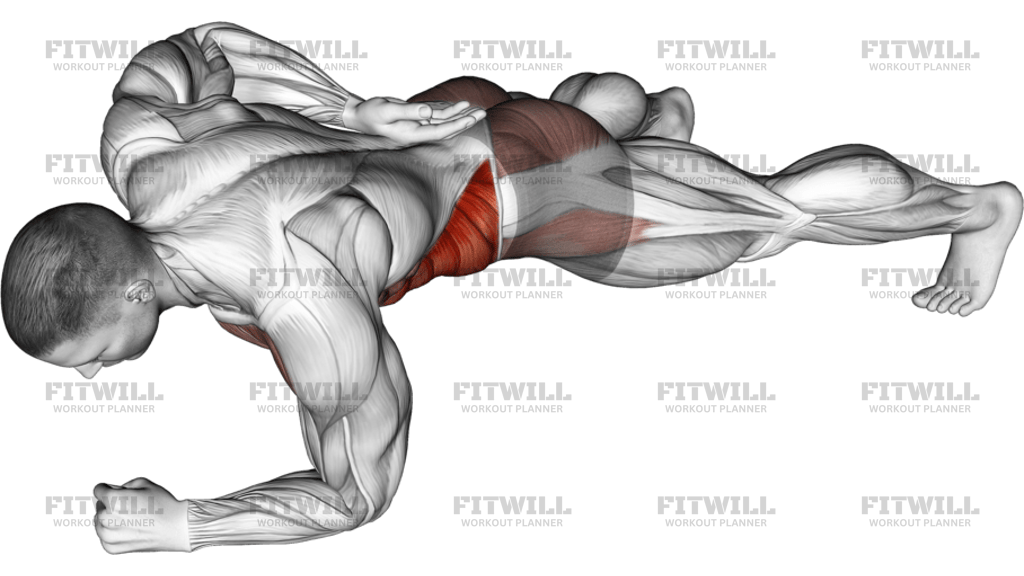
Instructions
- Set one forearm on the floor directly under the shoulder and extend both legs straight behind you with the toes tucked under.
- Place the free hand across your low back or along your side so it is not helping support your weight.
- Press the forearm and both toes into the floor, then lift into a straight line from head to heels.
- Square your hips to the floor and keep both hip points facing down instead of letting the free side open up.
- Squeeze your glutes and pull your ribs down so your lower back does not sag.
- Keep the supporting shoulder stacked over the elbow and avoid shrugging up toward your ear.
- Breathe slowly while you hold the position, using each exhale to keep the trunk tight and level.
- Hold for the prescribed time, then lower with control and repeat on the other side.
Tips & Tricks
- Widen your feet a little if your hips keep wanting to twist open.
- Think about pushing the floor away through the forearm instead of sinking into the shoulder.
- Keep the free hand in the same place for the whole hold so it does not become a hidden support.
- A short, perfect hold is better than a long hold with a sagging low back.
- Exhale fully to help keep the lower ribs from flaring and the pelvis from tipping forward.
- If your elbow drifts in front of the shoulder, reset before continuing the set.
- Watch for the body rotating toward the support side, which usually means the obliques are giving out first.
- Use a mat or towel under the forearm if the pressure on the elbow becomes distracting.
Frequently Asked Questions
What muscle does One Arm Front Plank target most?
The obliques are the main target, with the deep abs and shoulder stabilizers working hard to keep the body from rotating.
Can beginners perform this exercise?
Yes, but beginners should start with short holds, a wider foot stance, or a regression such as touching the free hand lightly to the floor.
Where should the supporting elbow be?
Stack the elbow directly under the shoulder so the forearm can bear weight without forcing the shoulder forward.
Where should the free hand go in this plank?
Keep it off the floor and place it across the low back or along the side so it cannot help you balance.
Should my hips stay level during the hold?
Yes. The hips should face the floor the whole time; rotating open usually means the core tension is leaking.
How long should I hold One-Arm Front Plank?
Use a hold length that lets you keep a straight line and steady breathing, often around 10 to 20 seconds per side.
What is the most common mistake with this plank?
Letting the trunk twist or the lower back sag is the biggest problem, because both reduce the anti-rotation challenge and increase strain.
How can I make the exercise easier without changing the movement pattern?
Widen your feet, shorten the hold, or lightly tap the free hand to the floor for balance while keeping the forearm plank position.