Standing Abs Rotation Stretch
Standing Abs Rotation Stretch is a standing trunk mobility drill that opens the waist, obliques, and the muscles around the ribs and low back while teaching you to rotate without twisting the knees or collapsing the torso. The exercise is done with body weight, so the value comes from clean positioning and a smooth, pain-free range rather than from load. It is most useful when you want to loosen the midsection before training, restore motion after sitting, or cool down after work that has kept the trunk stiff.
The setup matters because the pelvis should stay quiet while the rib cage turns over it. Stand tall with a stable base, feet planted, knees soft, and the hips stacked under the shoulders. In the image the hands rest on the waist to help you feel the trunk move as a unit. That hand position is useful because it gives you feedback: if the hips drift or the lower back arches, you will feel the compensation immediately. The stretch should come from the torso rotating and lengthening, not from leaning backward or yanking the arms across the body.
As you move, rotate slowly to one side until you feel a controlled stretch through the side of the waist and abdominal wall, then hold briefly while breathing out. Come back through center with the same control and repeat to the other side. The best repetitions are small enough that the feet stay grounded and the knees point in the same direction throughout the set. If the motion starts to come from momentum, shorten the range and slow the tempo before you continue.
This is a mobility and recovery exercise, so the goal is a clear stretch and a relaxed breath pattern, not a hard contraction. It fits well in warmups, cooldowns, or corrective sessions when the trunk feels stiff from desk work, lifting, or sports that involve repeated rotation. Use it only in a comfortable range and stop before any pinching in the spine, hips, or ribs. When performed well, the movement leaves the waist feeling freer without making the low back feel compressed.
Fitwill
Log Workouts, Track Progress & Build Strength.
Achieve more with Fitwill: explore over 9600 exercises with images and videos, access built-in and custom workouts, perfect for both gym and home sessions, and see real results.
Start your journey. Download today!




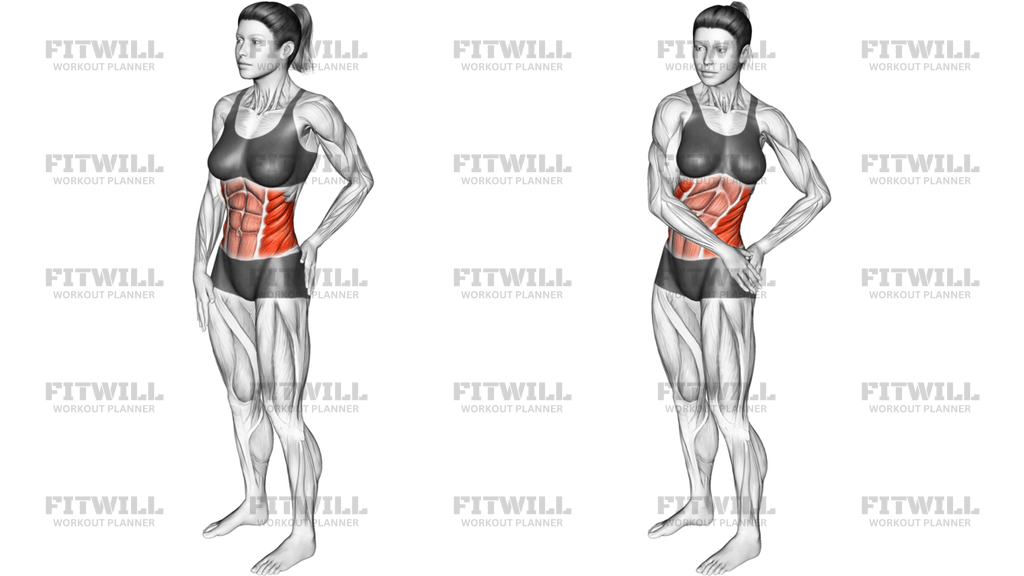
Instructions
- Stand tall with your feet about hip-width apart and your knees softly unlocked.
- Place your hands on your waist so you can feel whether the pelvis stays level while you move.
- Brace lightly through the abdomen and keep your chest tall before you start rotating.
- Rotate your torso slowly to one side until you feel a stretch through the waist and side abs.
- Keep both feet planted and avoid letting the knees or hips spin with the shoulders.
- Pause briefly in the end range and breathe out into the stretch without forcing it deeper.
- Return through center under control, then rotate to the opposite side.
- Match both sides with the same range and tempo, keeping the motion smooth rather than jerky.
- Reset to center after each rep if you lose posture or feel the movement coming from momentum.
Tips & Tricks
- Think of rotating the ribs over a quiet pelvis instead of swinging the whole body.
- Keep the stretch in the side of the waist; if your low back feels pinched, reduce the range.
- A small exhale at the end of the turn usually lets the obliques and intercostals relax more easily.
- Do not let the heels lift or the toes pivot aggressively just to get farther around.
- If one side feels much tighter, spend extra time there with a shorter hold rather than forcing symmetry.
- Hands on the waist are a useful cue here because they make hip drift easier to notice.
- Use a slow tempo and avoid bouncing back to center, which turns a mobility drill into a twist.
- Stop the set if rotation creates pain in the lumbar spine, ribs, or hips instead of a stretch.
Frequently Asked Questions
What does Standing Abs Rotation Stretch work most?
It mainly stretches the obliques, waist, and the muscles around the ribs while also involving the hips and low back in a gentle way.
Should my hips turn with my torso?
A small amount of natural hip movement is fine, but the goal is to keep the pelvis mostly stable while the rib cage rotates over it.
Why are my hands placed on my waist?
That hand position helps you feel whether the hips stay stacked and makes it easier to notice if you are twisting from momentum.
Can I do this as a warmup exercise?
Yes. It works well before lifting, running, or sport practice when your trunk feels stiff and you want smoother torso rotation.
How far should I rotate on each rep?
Rotate only until you feel a clear, comfortable stretch through the side of the abdomen. Bigger range is not better if the knees, hips, or low back start compensating.
What should I feel if I am doing it correctly?
You should feel length through the waist and a gentle stretch across the side body, not a sharp pull in the spine.
Is this exercise beginner friendly?
Yes. It is a low-risk mobility drill for beginners as long as they keep the stance stable and the rotation small and controlled.
What is the most common mistake?
The biggest mistake is turning it into a fast full-body twist, which usually comes from the hips, knees, or arms instead of the torso.