Standing Side Bend Bent Arm
Standing Side Bend Bent Arm is a bodyweight side-bending drill for the trunk, waist, and hips. The bent overhead arm creates a long line through the side body while the torso arcs laterally, so the exercise is useful for training ribcage control, side-body length, and the ability to keep the pelvis steady while the spine moves in one plane.
The movement is less about force and more about positioning. When the feet are planted, the hips stay level, and the shoulders do not twist, the side bend becomes a clean test of oblique control, quadratus lumborum engagement, and the ability to move without collapsing into the low back. That makes the exercise useful in warm-ups, mobility blocks, and core sessions where you want a controlled lateral flexion pattern instead of a loaded crunch.
The bent arm overhead changes the feel of the rep because it gives the torso a clearer line to follow. Keep the elbow softly bent, reach long through the hand, and let the ribcage slide sideways rather than crumple forward. The opposite arm should stay relaxed so it does not pull the body out of position. If the chest starts rotating or the pelvis hikes, the range is too big.
Because this is a bodyweight exercise, the quality of the stance matters more than the amount of effort. Stand tall with your weight evenly distributed through both feet, keep the neck long, and make each repetition slow enough that you can feel the side body shorten on one side and lengthen on the other. A smooth return to upright is just as important as the bend itself.
Standing Side Bend Bent Arm fits well as a prep drill before carries, overhead lifting, or any session that needs better trunk organization in standing positions. It can also be used as a low-intensity accessory movement when you want to reinforce posture and breathing without adding external load. For beginners, the safest version is a small, controlled range with no twisting and no bouncing at the bottom.
Fitwill
Log Workouts, Track Progress & Build Strength.
Achieve more with Fitwill: explore over 9600 exercises with images and videos, access built-in and custom workouts, perfect for both gym and home sessions, and see real results.
Start your journey. Download today!




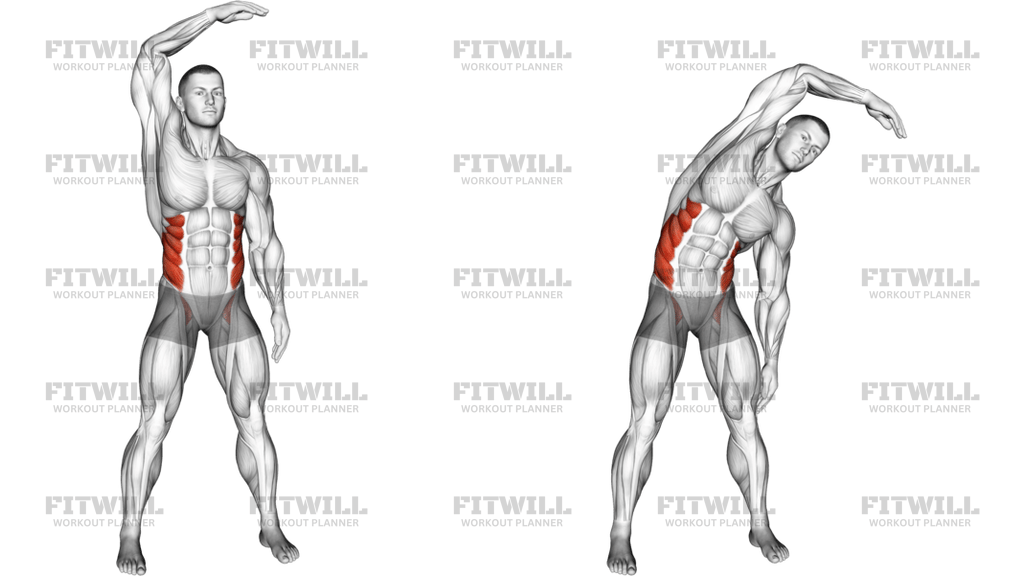
Instructions
- Stand tall with your feet about hip-width apart and place one arm bent overhead, keeping the elbow softly bent and the hand reaching up.
- Let the other arm hang relaxed by your side and keep your chest facing forward before you start the rep.
- Brace your midsection lightly so your ribs stay stacked over your pelvis.
- Exhale and bend your torso sideways in a smooth arc without twisting your shoulders or hips.
- Keep the overhead arm long as the side of your trunk shortens and the opposite side lengthens.
- Pause briefly at the end of the bend without bouncing into the bottom position.
- Inhale as you return to standing, bringing your torso back to center under control.
- Repeat for the planned reps, then switch sides and keep the same range and tempo.
Tips & Tricks
- Keep both feet planted evenly so the bend comes from the torso, not from shifting your weight onto one hip.
- Think about sliding the ribs sideways instead of folding forward at the waist.
- If your shoulders rotate toward the floor, reduce the range and keep the chest square to the front.
- A smaller side bend with clean alignment is better than a deeper bend that collapses the low back.
- Let the non-working arm stay loose; if it tenses hard, it often means you are fighting balance instead of controlling the trunk.
- Move slowly enough that you can feel the working side of the waist contract and the opposite side open.
- Stop before the top hand loses its line overhead or the elbow starts drifting in front of the face.
- Breathe out on the bend and breathe in on the return so the trunk does not stay braced stiffly through the whole rep.
Frequently Asked Questions
What muscle does Standing Side Bend (bent arm) target most?
It mainly targets the side body, especially the obliques and quadratus lumborum, with help from the hips and trunk stabilizers.
Is the bent arm overhead position important?
Yes. The bent overhead arm creates a clear line for the torso to follow and helps keep the side bend controlled instead of turning it into a twist.
Should I bend to the same side as the raised arm or the opposite side?
Either side can be used depending on the version you are doing, but the important part is to keep the torso moving laterally without twisting.
Can beginners do Standing Side Bend Bent Arm?
Yes. Beginners should use a small, slow range and focus on keeping the chest square and the hips level.
What are the most common mistakes with this movement?
The biggest errors are twisting the torso, shifting the hips, and bending so far that the lower back takes over.
What should I feel during the rep?
You should feel one side of the waist shorten and the other side lengthen, with the hips staying stable underneath you.
Is this exercise more of a stretch or a strength drill?
It can serve as both, but in this version it is best treated as a controlled strength and mobility drill for the side body.
When is Standing Side Bend Bent Arm useful in a workout?
It fits well in a warm-up, core block, mobility sequence, or before exercises that demand good standing trunk control.