Hanging Deadbug
Hanging Deadbug is a bodyweight hanging core drill performed from a pull-up bar. The body stays suspended while one knee drives up and the opposite leg lengthens, then the pattern alternates with as little swing as possible. The exercise trains the front of the trunk, hip flexors, grip, and shoulder stability while also teaching the pelvis and ribcage to stay stacked under load.
The setup matters because the bar hang is part of the challenge. If the shoulders shrug, the lower back arches, or the body starts to swing, the core loses the job and the hips simply take over. A clean rep begins with an active hang, ribs pulled down, and a slight tuck of the pelvis so the torso stays quiet while the legs move.
This movement is useful when you want a strict abdominal exercise that also exposes control errors quickly. It works well in warmups, accessory blocks, and core-focused sessions because the load is your own body weight and the limiting factor is usually position, not brute force. The better the rhythm, the more the abs stay on and the less the motion turns into a sloppy hanging knee raise.
Use a smaller knee drive, a slower tempo, or a bent-knee version if you cannot keep the torso from rocking. Stop the set if the lower back starts to arch or the grip begins to fail before the core does. The best repetitions are smooth, quiet, and repeatable, with each leg movement controlled all the way back to a still hang.
[ Workout Log & Planner ]
Put your next workout in Fitwill
Keep your plan and training log ready when you are.


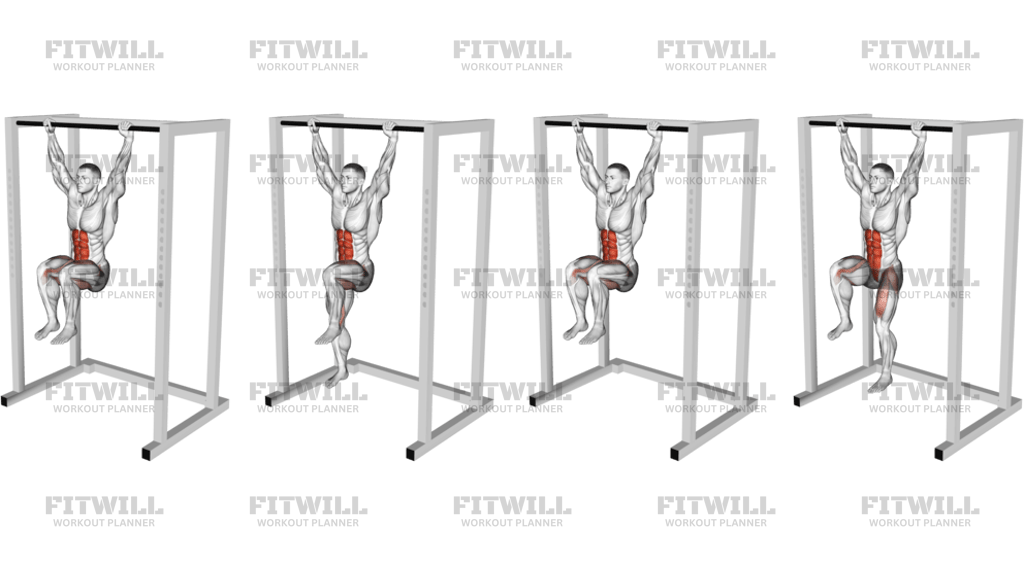
Instructions
- Grip the pull-up bar shoulder-width apart and hang with straight arms.
- Set your shoulders down away from your ears and keep your chest quiet.
- Tighten your abs, tuck your pelvis slightly, and bring your legs together.
- Start from a still hang with no swing before you begin the first rep.
- Drive one knee toward your lower ribs while the opposite leg lengthens downward.
- Keep your hips level and avoid twisting or arching through the lower back.
- Exhale as the knee rises, then inhale as you lower back under control.
- Return to a dead hang with the legs quiet, then alternate sides for the next rep.
- Step down only after the swing has settled and the bar hang is under control.
Tips & Tricks
- Think about pulling your ribs toward your pelvis before each knee drive.
- If the lower back arches, shorten the range and raise the knee a little less.
- A slight bend in the lowering leg is fine if straightening it breaks your position.
- Keep the shoulders packed down; shrugging turns the hang into a shoulder test.
- Move slowly enough that each rep starts and ends without momentum.
- If you start swinging, pause until the body is still again before the next rep.
- Use the grip as a stabilizer, not a way to yank the body upward.
- Stop the set when the hip flexors take over and the abs stop controlling the pelvis.
- A smaller, cleaner rep is better than forcing a high knee with a loose torso.
Frequently Asked Questions
What muscles does Hanging Deadbug work?
It mainly trains the abs and hip flexors, with the grip, lats, and shoulders working to keep you hanging still.
How is this different from a regular hanging knee raise?
The deadbug version emphasizes alternating leg control and a quiet torso, rather than simply chasing the knees as high as possible.
Can beginners do Hanging Deadbug?
Yes, but they should use a short range, a slow tempo, and a bent-knee version if they cannot keep the swing under control.
What is the biggest mistake with the bar hang?
Letting the shoulders shrug and the body swing usually turns the movement into momentum instead of core work.
Should my lower back move during the rep?
No. The pelvis should stay tucked enough that the lower back does not arch as the knees alternate.
How high should I raise the knee?
Raise it only as far as you can without twisting the hips or losing the dead-hang control.
What can I use if the full hanging version is too hard?
Use a captain's chair knee raise, a bent-knee hanging hold, or a floor deadbug until your hanging control improves.
Where should I place this in a workout?
It fits well after your main lifts or in a core block, when you can focus on control instead of speed.
What should I do if my grip gives out first?
Reduce the set length, slow the tempo, or use fewer reps so the abs finish the work before the hands fail.