Bar Band Bent-Over Row
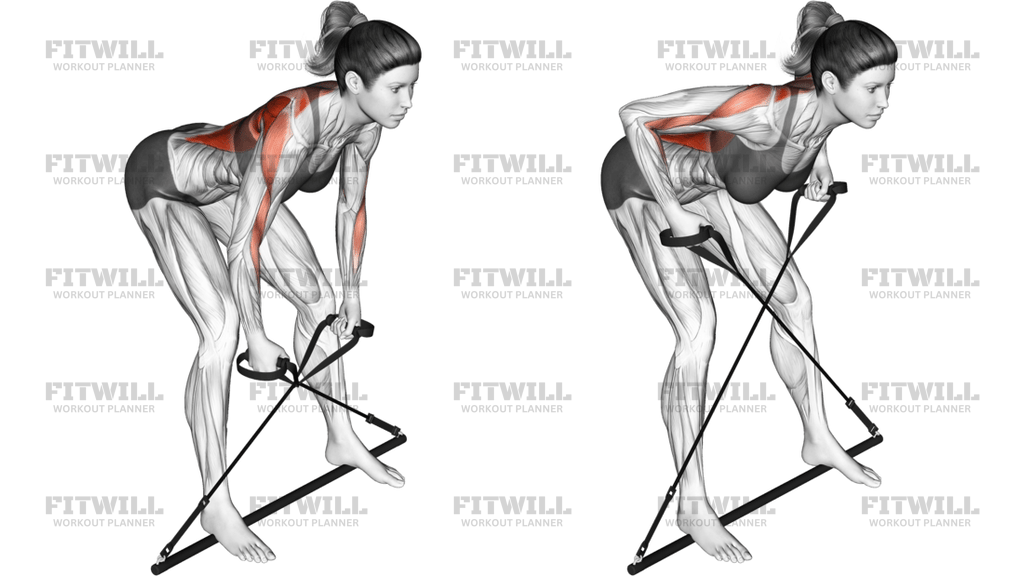
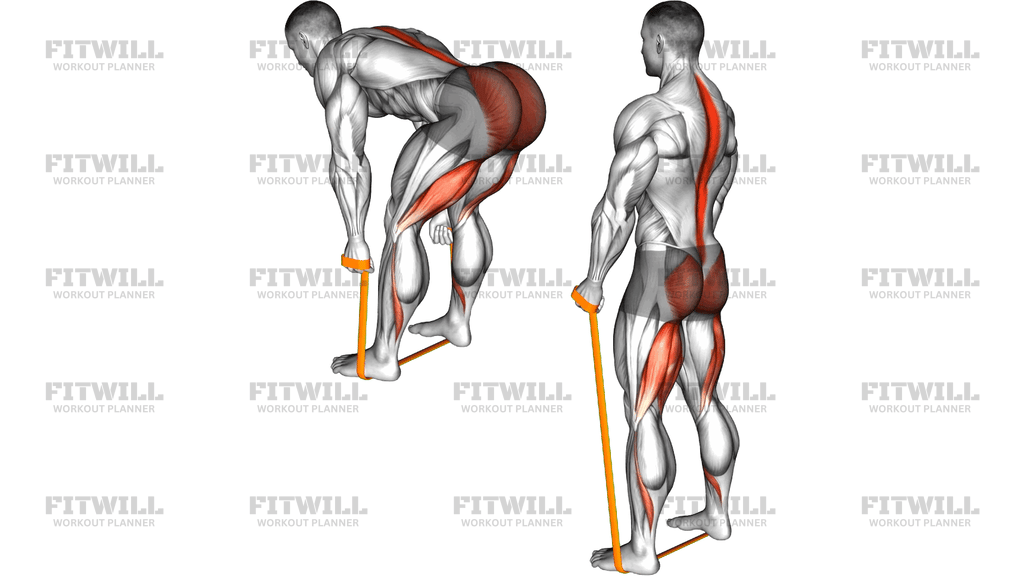
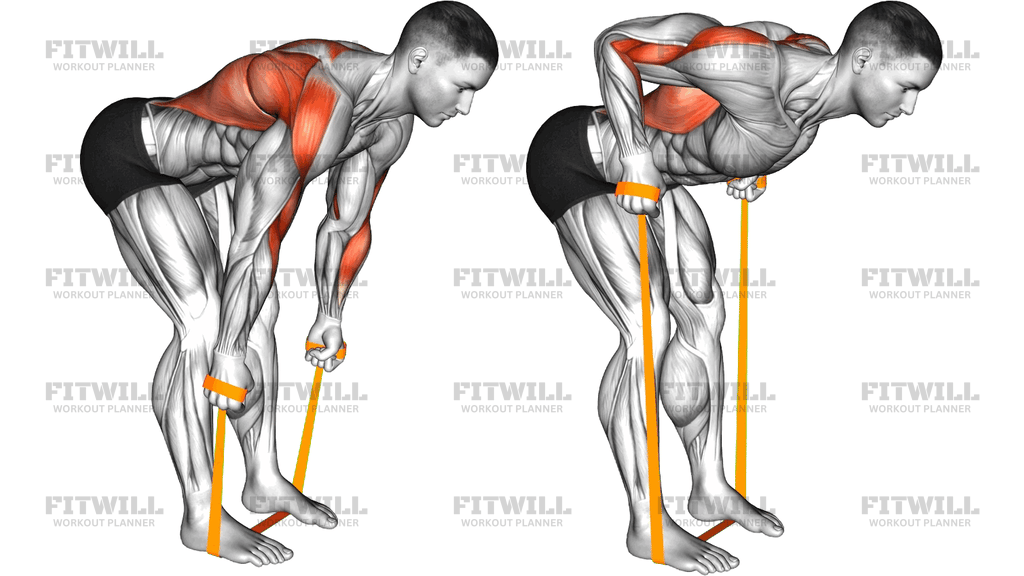
Bar Band Bent-Over Row is a hip-hinged band row built to train the lats and the rest of the upper back while also asking the biceps and forearms to hold the line. The setup keeps your torso fixed in a forward hinge, so each rep starts from a stretched position and finishes with the elbows driving back beside the body. That makes the exercise useful when you want back work without loading the spine the way a heavy free-weight row can.
The start position matters because the band tension and your hinge angle decide how hard the row feels. Stand on the band, grip the handles, and lean forward until your chest is long and your back stays flat, with a soft bend in the knees and your weight centered through the feet. If you stand too tall, the resistance drops; if you fold too far and round, the lower back takes over.
Each repetition should feel like an elbow drive rather than a shrug. Pull the handles toward your lower ribs or front pockets, keep the shoulders away from the ears, and let the shoulder blades move together without collapsing the torso. Pause for a beat at the top, then lower the handles slowly until the arms are long and the band is still under control.
Bar Band Bent-Over Row works well as accessory back volume in a home gym, warm-up circuit, or higher-rep strength session. It is also a practical option when you want to reinforce the hip hinge and back tension without needing a bench or machine. Because the movement is standing and self-limiting, it fits easily into full-body training, split routines, or travel workouts.
Keep the set honest by choosing a band that lets you hold the hinge from the first rep to the last. If the handles yank you upright, shorten the stance or use less resistance so the lats can do the work. Done well, Bar Band Bent-Over Row builds repeatable pulling strength, teaches cleaner rowing mechanics, and gives the upper back steady time under tension without turning the set into a body-English exercise.
Fitwill
Log Workouts, Track Progress & Build Strength.
Achieve more with Fitwill: explore over 9600 exercises with images and videos, access built-in and custom workouts, perfect for both gym and home sessions, and see real results.
Start your journey. Download today!




Instructions
- Stand on the middle of the band with feet about hip-width apart, then hinge forward at the hips until your torso is angled down and your back stays flat.
- Hold a handle in each hand with palms facing in and let the band travel straight from your hands to the floor.
- Soften your knees, keep your weight through the mid-foot and heels, and lengthen your neck so your head stays in line with your spine.
- Brace your trunk before the first pull so your torso stays fixed instead of rising as you row.
- Pull both elbows back toward your lower ribs and keep them close to your sides as the handles travel upward.
- Squeeze your shoulder blades together at the top without shrugging your shoulders toward your ears.
- Lower the handles slowly until your arms are straight again and the band still feels controlled at the bottom.
- Keep the hinge, breathing, and torso angle steady for each rep, then step off the band and stand up when the set is finished.
Tips & Tricks
- If the band goes slack at the bottom, stand a little narrower or choke up on the handles so the first inch of the row still has tension.
- Aim the handles toward your lower ribs or front pockets; pulling higher usually turns the row into a shrug.
- Keep a soft knee bend, but do not turn the movement into a squat as you row.
- Hold the chest long and the lower back neutral; if your upper back rounds, reduce the hinge angle before adding resistance.
- Let the shoulder blades glide together, but do not jam them hard together at the top and lose arm drive.
- Use a slower lowering phase of about two to three seconds to keep the lats loaded between reps.
- Keep the wrists stacked over the forearms so the handles do not bend the hands back.
- If the band snaps your torso upward, the resistance is too high for a strict bent-over row.
- Exhale as the handles come toward you and inhale as they return to the start position.
Frequently Asked Questions
What muscles does Bar Band Bent-Over Row train most?
It mainly trains the lats and upper back, with the biceps, rear shoulders, and forearms helping on every rep.
Is Bar Band Bent-Over Row beginner friendly?
Yes. A light band and a shorter hinge angle make it easy to learn the row path without losing posture.
Where should the handles travel in Bar Band Bent-Over Row?
Pull them toward your lower ribs or front pockets. That keeps the elbows driving back instead of flaring up into a shrug.
How bent over should I be for Bar Band Bent-Over Row?
Lean far enough to feel your lats and upper back work, but not so far that your low back rounds. A strong hip hinge with a flat back is the goal.
Why do I feel Bar Band Bent-Over Row in my lower back?
Usually the band is too heavy, the hinge is too deep, or the torso is drifting upward. Reduce resistance and keep the ribs down.
Can I do Bar Band Bent-Over Row one arm at a time?
Yes, a single-arm version can help if you want to clean up the row path or work around a grip imbalance.
What is the biggest mistake in Bar Band Bent-Over Row?
Letting the torso stand up as the handles rise. The hinge should stay locked so the back, not momentum, finishes the rep.
Where does Bar Band Bent-Over Row fit in a workout?
It works well as accessory back work, a warm-up pull, or higher-rep volume after your main lifts.