Dumbbell Staggered Stance Romanian Deadlift
Dumbbell Staggered Stance Romanian Deadlift is a hip-hinge exercise that trains the back side of the body while giving you a little extra balance support from the rear foot. It is useful when you want the hamstrings and glutes to do the work without the full balance demand of a single-leg variation. The staggered stance also makes it easier to keep the dumbbells close to the legs and feel a clean hinge instead of turning the movement into a squat.
The main training effect comes from loading the front hip as it moves back, then driving it forward again under control. That makes Dumbbell Staggered Stance Romanian Deadlift a good choice for building posterior-chain strength, improving hinge mechanics, and teaching you to keep the torso long while the hips travel backward. The rear leg should only help with balance; it should not become a second working leg that pushes the weight up.
Set the front foot flat and the back foot lightly on the ball of the foot, with the stance long enough that you can hinge without crowding the knees. Keep most of your weight on the front leg, soften that knee, and square the hips toward the floor. The dumbbells should hang in front of the thighs with straight arms, shoulders pulled down, and the ribs stacked over the pelvis before you start each repetition.
As you descend, send the hips back first and let the torso tip forward as one unit. The dumbbells should travel close to the front leg, usually past the knee and toward mid-shin, while the spine stays neutral and the neck stays in line with the torso. The rep ends when the hamstrings are clearly loaded and the back position is still solid, not when the dumbbells touch the floor or the torso goes as low as possible.
On the way up, press the front foot into the ground, keep the dumbbells close, and stand by extending the front hip rather than leaning back at the top. A clean lockout looks tall and braced, with the glute finishing the rep and the shoulders still controlled. This exercise works well in lower-body strength sessions, accessory work, or warmups before deadlifts and squats, especially when you want unilateral hip loading with less joint stress than a full split squat or lunge.
[ Workout Log & Planner ]
Put your next workout in Fitwill
Keep your plan and training log ready when you are.


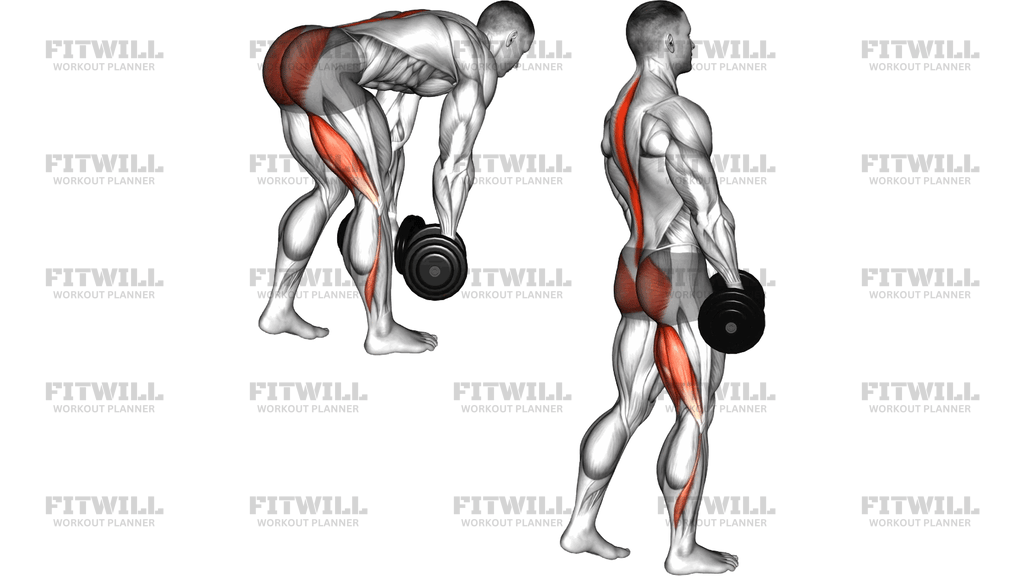
Instructions
- Stand with one foot forward and the other foot back on the ball of the foot, then hold a dumbbell in each hand with the arms hanging in front of the thighs.
- Keep most of your weight on the front foot, soften the front knee slightly, and square your hips so they face straight ahead.
- Set your shoulders down, brace your torso, and let the dumbbells hang close to the front leg before the first rep.
- Inhale and push your hips back while your torso leans forward as one piece, keeping the spine long and neutral.
- Lower the dumbbells along the front leg until you feel the hamstrings stretch and the torso reaches your deepest controlled hinge.
- Pause briefly at the bottom without rounding your back or letting the dumbbells drift away from the shin.
- Drive through the front heel and midfoot to stand back up, bringing the hips forward until you are tall again.
- Finish each rep by squeezing the front glute, then reset the hinge before the next repetition or switch legs after the set.
Tips & Tricks
- Keep the back foot light. If you can push hard through the rear toes, your stance is too narrow or too short for a true staggered hinge.
- Let the dumbbells skim the front thigh and shin instead of drifting out in front of you; that keeps the load on the hips instead of the low back.
- Think about moving the hips straight back, not dropping the chest toward the floor. The movement should feel like a hinge, not a squat.
- Stop the descent when the hamstrings stop the motion. Going lower by rounding the spine is usually a sign the stance is too long or the load is too heavy.
- Keep the front knee softly bent throughout the rep. Locking it out turns the exercise into a stiff-leg deadlift and makes balance harder.
- Use a slower lowering phase if you want more hamstring tension and less momentum from the dumbbells.
- If your pelvis opens toward the rear leg, shorten the stance and square the hips before the next rep.
- Start with the weaker or less stable side so both legs get the same quality of work and the same range of motion.
Frequently Asked Questions
What muscles does Dumbbell Staggered Stance Romanian Deadlift work?
It mainly trains the hamstrings and glutes, with the core and back muscles working hard to keep the torso and pelvis stable.
Is Dumbbell Staggered Stance Romanian Deadlift easier than a single-leg Romanian deadlift?
Yes. The rear foot gives you a small balance assist, so it is usually easier to learn while still challenging the front leg and hip hinge.
How should my feet be set for Dumbbell Staggered Stance Romanian Deadlift?
Keep the front foot flat and the rear foot on the ball of the foot, with most of your weight on the front leg. The stance should be long enough to hinge comfortably without crowding the knees.
How low should the dumbbells go in Dumbbell Staggered Stance Romanian Deadlift?
Lower them until the hamstrings are stretched and your back position is still neutral, usually around the knee or mid-shin. The depth is controlled by your hinge, not by reaching the floor.
Should I feel Dumbbell Staggered Stance Romanian Deadlift in my lower back?
A small amount of spinal effort is normal, but the main sensation should be in the hamstrings and glutes. If the low back takes over, shorten the range and keep the dumbbells closer to the legs.
Can beginners do Dumbbell Staggered Stance Romanian Deadlift?
Yes, beginners can learn it with light dumbbells and a short range of motion. It is a good stepping stone before harder single-leg hinge work.
What is the biggest form mistake in Dumbbell Staggered Stance Romanian Deadlift?
Letting the rear leg drive the rep or turning the movement into a squat. Keep the rear foot light and let the front hip do the work.
What is a good substitute if Dumbbell Staggered Stance Romanian Deadlift feels unstable?
A two-foot Romanian deadlift, a kickstand Romanian deadlift with a shorter stance, or a supported single-leg hinge can all help you build the same pattern with less balance demand.