Bodyweight Standing Oblique Twist
Bodyweight Standing Oblique Twist is a standing core drill that trains the waist to rotate cleanly while the pelvis stays mostly quiet. It is a useful choice for beginners learning trunk control, for athletes who need better rotational coordination, and for anyone who wants a low-load warm-up before heavier lower-body or upper-body work. Because the movement is simple, the quality of each repetition matters more than the number of reps you can rush through.
The exercise puts most of its emphasis on the obliques, with help from the deeper core muscles, spinal stabilizers, and the hips. That support is important because the goal is not to fling the torso side to side; it is to create a controlled twist through the ribcage while the feet, knees, and pelvis stay organized. When the setup is solid, the working side of the waist can contract hard without the low back doing all the work.
Start in a tall stance with your feet about hip width apart, knees soft, ribs stacked over the pelvis, and hands resting on your hips or lower ribs. From there, rotate the chest and shoulders to one side while keeping the head, neck, and standing base calm. The twist should feel like the upper body is turning over a stable lower body, not like the entire body is swinging as one piece. A small pivot through the feet is fine if it helps you keep the knees and hips comfortable.
On each rep, move into the twist under control, pause briefly at the end range, and come back to center without bouncing. Exhale as you rotate and inhale as you return so the trunk stays braced but not rigid. If one side feels much tighter, reduce the range instead of forcing the turn, especially if you feel the low back arching or the hips drifting with the motion. The best reps look smooth and repeatable from start to finish.
Bodyweight Standing Oblique Twist fits well in a warm-up, mobility block, or core circuit because it teaches the body how to rotate without collapsing posture. It is also useful between strength sets when you want light trunk work that will not drain the legs or shoulders. Keep the motion crisp, keep the pelvis honest, and stop the set once you have to use momentum to reach the twist.
[ Workout Log & Planner ]
Put your next workout in Fitwill
Keep your plan and training log ready when you are.


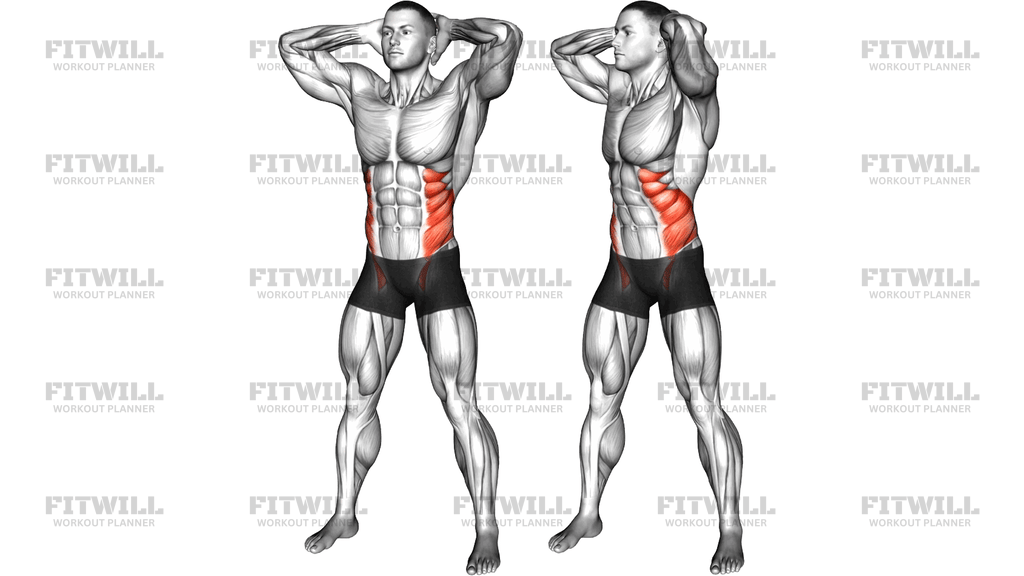
Instructions
- Stand tall with your feet about hip width apart, knees soft, and weight spread evenly across both feet.
- Rest your hands on your hips or lower ribs so you can feel the torso turn without losing your balance.
- Stack your ribs over your pelvis and lightly brace your abdomen before the first twist.
- Rotate your chest and shoulders to one side while keeping your hips mostly facing forward.
- Allow a small pivot through the feet only if you need it to keep the knees and lower back comfortable.
- Pause for a beat at the end of the twist and feel the oblique on the turning side contract.
- Return to center slowly and resist the urge to bounce back with momentum.
- Repeat to the opposite side with the same range, tempo, and posture.
- Keep your breathing steady by exhaling as you turn and inhaling as you come back to center.
- Finish the set by standing tall again and releasing the tension before walking away.
Tips & Tricks
- Think about turning the ribcage over the pelvis instead of swinging the whole body as one block.
- Keep the twist smaller if your lower back starts to arch or if the knees begin to drift inward.
- A slight heel pivot is better than forcing the spine to rotate past a comfortable end range.
- Exhale into the turn so the obliques can shorten without the torso popping forward.
- If your shoulders are moving but your waist feels almost nothing, slow the rep down and reduce the range.
- Keep the chin level and the neck relaxed so the head does not lead the rotation.
- Use a mirror or film from the front to check that your hips stay mostly square as you twist.
- For warm-ups, keep the motion smooth and moderate; for core work, pause briefly at the end of each side.
- Stop the set when the movement turns into a sway from side to side instead of a controlled twist.
Frequently Asked Questions
What muscles does Bodyweight Standing Oblique Twist work?
It mainly trains the obliques and other deep core stabilizers, with the hips and spinal muscles helping keep the torso organized.
Should my hips turn during Bodyweight Standing Oblique Twist?
Keep the hips mostly forward and let the ribcage do most of the turning. A tiny foot pivot is fine, but the pelvis should not swing side to side.
Is Bodyweight Standing Oblique Twist good for beginners?
Yes. It is a simple way to learn controlled trunk rotation, as long as the range stays small and the movement stays smooth.
How far should I twist on each rep?
Twist only as far as you can while keeping your knees, hips, and lower back calm. The end position should feel controlled, not forced.
Do I need to keep my feet completely planted?
You should keep the feet grounded, but a light pivot through the heel or forefoot can help if it keeps the twist comfortable and clean.
Is Bodyweight Standing Oblique Twist a warm-up or a strength exercise?
It can work as either, but it is most often used as a warm-up, mobility drill, or light core accessory rather than a heavy strength movement.
Why do I feel Bodyweight Standing Oblique Twist in my lower back?
That usually means the twist is coming from the lumbar spine instead of the ribs and obliques. Reduce the range and keep the pelvis steadier.
How can I make Bodyweight Standing Oblique Twist harder?
Slow the tempo, add a brief pause at end range, or hold a light plate or medicine ball near your chest once the bodyweight version feels crisp.
What is the most common mistake in Bodyweight Standing Oblique Twist?
The biggest mistake is letting the whole body sway instead of rotating the torso under control.