Reverse Plank Version 2
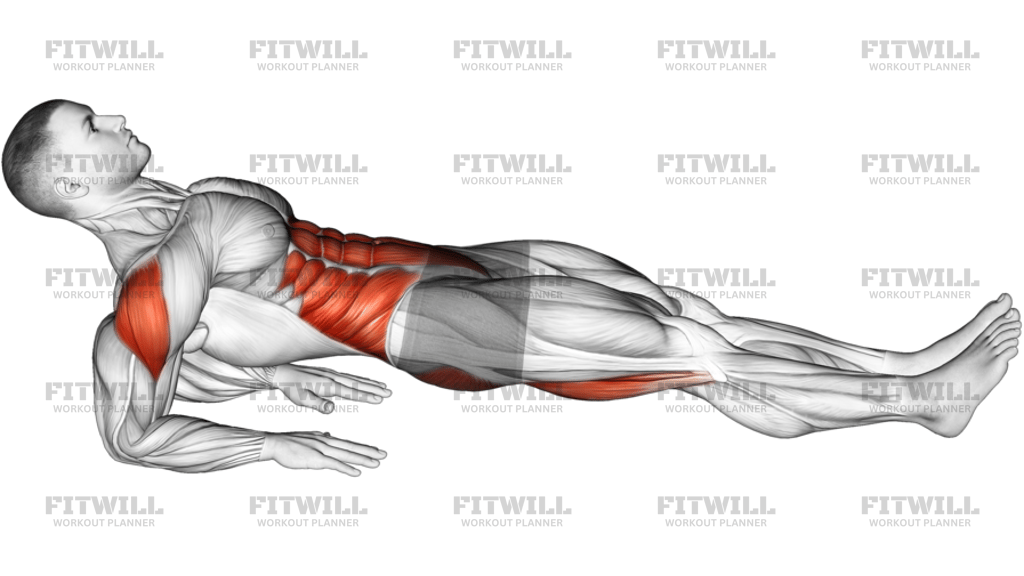
Reverse Plank Version 2 is a face-up isometric hold where you support your body on the forearms and heels while keeping the hips lifted off the floor. It trains the posterior chain and trunk as one unit, asking the glutes, hamstrings, abs, spinal erectors, and shoulder stabilizers to stay active while the body holds a long, rigid line.
The setup matters because this movement is only as good as the position you build before you lift. Place the forearms flat on the floor, keep the elbows under or just behind the shoulders, extend the legs straight, and press down through the forearms and hands before the hips leave the ground. If the elbows drift too far forward or the feet slide out of line, the hold becomes unstable and the low back usually takes over.
At the top, the chest should stay open, the ribs controlled, and the neck long. Squeeze the glutes to keep the pelvis from tipping forward, tighten the thighs so the knees stay straight, and reach the heels away from the body so the line from shoulders to ankles stays clean. The goal is not to arch higher; it is to keep the whole body working together without letting one joint collapse.
This version is useful for core and posterior-chain conditioning, warm-ups, and accessory work when you want anti-extension and hip extension in the same drill. It also fits well as a progression for anyone who can already hold a basic bridge or reverse plank but needs more full-body tension and shoulder control. The hold should feel organized and deliberate, not like a struggle to stay off the floor.
Stop the set if the hips start sagging, the shoulders shrug, or the low back begins to pinch. A clean reverse plank should leave you feeling steady tension through the back of the legs, glutes, and trunk, with the forearms providing a stable base rather than the neck or lower back doing the work.
Fitwill
Log Workouts, Track Progress & Build Strength.
Achieve more with Fitwill: explore over 9600 exercises with images and videos, access built-in and custom workouts, perfect for both gym and home sessions, and see real results.
Start your journey. Download today!




Instructions
- Lie face up on the floor with your forearms flat and parallel, elbows under or slightly behind the shoulders, and your legs extended straight.
- Set your palms down if that helps you brace through the forearms and hands, then keep the fingers spread for a stable base.
- Press the forearms into the floor, lift the chest, and tighten the glutes before the hips leave the ground.
- Drive the heels away from your body and raise the hips until the shoulders, hips, knees, and ankles form one straight line.
- Keep the ribs down and the neck long instead of letting the chest flare or the low back arch.
- Squeeze the glutes and quads to hold the legs straight and level.
- Breathe in short controlled breaths while you hold the top position, then lower with control when the set is finished.
- Lower the hips smoothly, reset the forearm position, and repeat for the planned hold time or reps.
Tips & Tricks
- Set the elbows first; if they drift forward, the shoulders usually end up overloaded.
- Think 'hips high, ribs down' so the hold does not turn into a low-back arch.
- Keep the thighs active so the knees do not soften as the set gets harder.
- Press the floor away through the forearms to keep pressure out of the neck.
- If the shoulders pinch, shorten the hold and bring the elbows a little closer under the body.
- A shorter, cleaner hold is better than letting the hips sag for extra seconds.
- Keep the glutes on from the first second; they should not switch on only after the set starts shaking.
- Reach the heels long so the legs stay straight and the torso stays rigid.
Frequently Asked Questions
What muscles does Reverse Plank Version 2 work?
It mainly hits the glutes, hamstrings, abs, spinal erectors, and shoulder stabilizers while the forearms and hands support the body.
Is this the same as a normal reverse plank?
It is the forearm-supported version shown here, which can feel more stable for the shoulders and wrists than a straight-arm version.
How should my body look at the top?
From shoulders to ankles, the body should form one straight line with the hips lifted, ribs controlled, and no bend at the waist.
Where should I feel the exercise?
You should feel steady tension through the back of the legs, glutes, core, and upper back rather than strain in the lower back.
Can beginners do this version?
Yes, but start with short holds and stop as soon as the hips start dropping or the shoulders shrug.
What is the most common mistake?
Letting the hips sink or the ribs flare turns the hold into a back-extension pattern instead of a clean plank.
How can I make it easier?
Shorten the hold, bend the knees slightly, or elevate the upper body on a bench or box to reduce the lever arm.
How do I progress it?
Hold longer with the same clean line, then move to harder variations only after the basic forearm reverse plank stays solid.