Plank On Hands
Plank On Hands is a straight-arm plank held on the hands and toes, with the shoulders stacked over the wrists and the body held in one rigid line from head to heels. It is an isometric anti-extension exercise, so the goal is not to move through a range of motion but to keep the trunk, shoulders, and hips locked together under steady tension.
The main training effect is core stiffness. Rectus abdominis, external obliques, and transversus abdominis work to stop the lower back from sagging, while the shoulders, serratus, glutes, and quads help maintain position. That makes this a useful drill for building bracing strength that carries over to pressing, carrying, running, and any lift where the torso has to stay organized.
Setup matters more than duration. Place the hands directly under the shoulders, spread the fingers, and press the floor away so the upper back stays active instead of collapsing. Step the feet back, squeeze the glutes, and bring the ribs down before you fully settle into the hold. If the pelvis tips forward or the low back starts to arch, the plank has already turned into a compensation pattern.
Breathing should stay controlled and quiet enough that you can keep the brace without losing position. Short inhales and forceful exhales through the mouth or nose can help maintain tension, but do not hold your breath so hard that the neck, jaw, or shoulders tense up. The best reps, or in this case the best holds, look calm on the outside even though the trunk is working hard underneath.
Plank On Hands fits well in warmups, core blocks, finishers, or circuits where you want posture, shoulder stability, and trunk endurance. It is also easy to scale: raise the hands on a bench for a regression, widen the feet for more stability, or bring the feet closer together for a harder anti-rotation challenge. Stop the set when the ribs flare, the hips sag, or the shoulders can no longer stay stacked over the wrists.
[ Workout Log & Planner ]
Put your next workout in Fitwill
Keep your plan and training log ready when you are.


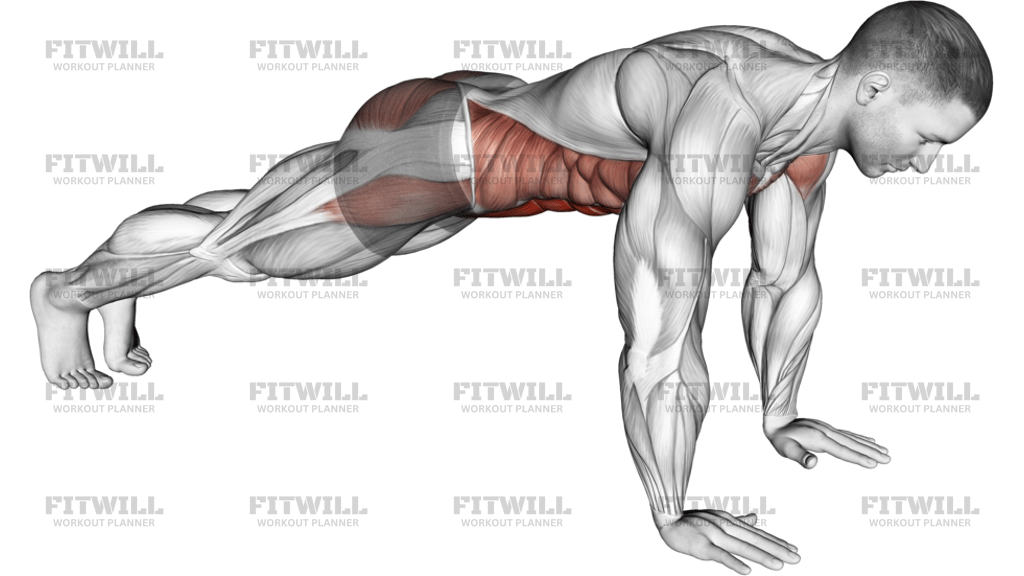
Instructions
- Place your hands on the floor directly under your shoulders, spread your fingers, and step both feet back into a high plank on your toes.
- Set your feet about hip-width apart to start, then lengthen your body so your heels reach back and your head stays in line with your spine.
- Press the floor away so your shoulders stay active and your shoulder blades do not sink between your arms.
- Squeeze your glutes and quads to keep your hips level instead of letting them sag or pike up.
- Draw your ribs toward your pelvis and brace your abs before you settle fully into the hold.
- Keep your neck long and your gaze slightly in front of your hands rather than dropping your head or jamming your chin down.
- Breathe in short, controlled breaths without letting your torso twist or your lower back arch.
- Hold the position for the planned time, then lower one knee at a time or step back out safely when your posture starts to break.
Tips & Tricks
- Stack the shoulders directly over the wrists instead of drifting forward, which makes the hold much harder on the front delts and wrists.
- Spread the fingers and press through the base of the index finger and thumb to take pressure off the heel of the hand.
- Think about pulling the elbows toward your toes even though the arms stay straight; that cue helps the trunk stay tight without moving the body.
- A small posterior pelvic tilt keeps the lower back from taking over the hold.
- Keep the feet a little wider for more stability and bring them closer together only when you can hold the pelvis still.
- If your low back starts to sag, stop the set there rather than chasing extra seconds with a broken line.
- Breathe into the side ribs with quiet, controlled exhales so the neck and jaw do not clamp down.
- Use a bench, box, or other incline if the floor version collapses before you can keep a clean plank.
Frequently Asked Questions
What muscles does Plank On Hands work most?
It mainly trains the abs, especially the rectus abdominis and deep core, with strong help from the obliques, shoulders, glutes, and quads.
Is this different from a forearm plank?
Yes. A hands plank puts the wrists in extension and usually asks more of the shoulders, while a forearm plank shifts more of the support to the elbows and forearms.
How long should I hold the plank?
Hold it only as long as you can keep a straight line from shoulders to heels. For many lifters that means short, high-quality holds of about 10 to 30 seconds.
Why do my wrists hurt in this position?
The hands may be too far forward, your weight may be drifting into the heel of the hand, or the volume may simply be too high. An incline, parallettes, or dumbbells can make the wrist angle friendlier.
Should my hips be high or low?
Neither. Keep the hips level with the shoulders and ribs, with only a slight tuck if you need it to stop the low back from arching.
Can beginners do a Plank On Hands?
Yes. Beginners usually do better with a hands plank on a bench or box first, then progress to the floor once they can keep the trunk still.
What is the most common mistake?
Letting the ribs flare and the lower back sag while the shoulders collapse is the biggest one. That usually means the set is too long.
How can I make the plank harder?
Bring the feet closer together, lengthen the hold, or add controlled shoulder taps only if the hips can stay level the entire time.