Elevated Side Lunge
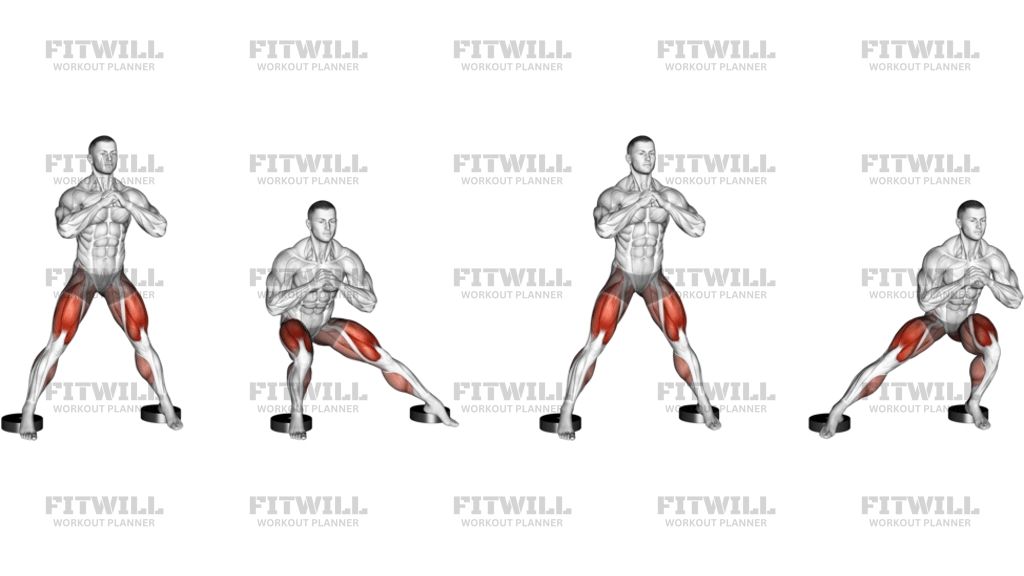
Elevated Side Lunge is a bodyweight lateral lunge variation built around a wider stance, a side-to-side weight shift, and a controlled descent into one hip. The elevation changes the line of movement and lets you work on hip strength, glute drive, and lateral control without needing external load. It is most useful when you want a bodyweight drill that challenges the hips in the frontal plane while still demanding balance and trunk control.
The main emphasis is on the glutes, with the hamstrings, core, and lower back helping stabilize the pelvis and torso as you shift into the side lunge. In anatomy terms, the primary work centers on the Gluteus maximus, with support from Biceps femoris, Rectus abdominis, and Erector spinae. That means the exercise should feel like a controlled hip and leg effort rather than a fast step or a deep stretch-only drill.
The setup matters because a small change in foot placement or step height can turn the movement from smooth and productive into awkward and unstable. Use a low step or plate under the elevated foot, stand wide enough to sit into one hip, and keep the torso tall before you begin. Brace lightly, then shift the hips toward the bent leg while keeping the opposite leg long and the planted foot flat. The goal is to keep both feet anchored and the pelvis organized as the knees and hips open and close.
Each repetition should move in a clear side-to-side pattern: lower with control, settle into the loaded hip, then drive back to the start through the working heel and midfoot. Keep the knee of the bent leg tracking over the toes instead of collapsing inward, and avoid twisting the chest toward the floor. Breathe in on the way down and exhale as you stand. If the elevation is too high or the range becomes pinchy in the groin or hip, shorten the motion and lower the step before adding more depth.
This exercise fits well in warm-ups, accessory blocks, athletic conditioning, or lower-body sessions focused on glute activation and lateral strength. It is also useful for developing single-leg control and cleaner change-of-direction mechanics. Begin with bodyweight only and a very low elevation, then progress by adding depth, tempo control, or light external resistance once the side-to-side pattern stays clean from rep to rep.
[ Workout Log & Planner ]
Put your next workout in Fitwill
Keep your plan and training log ready when you are.


Instructions
- Place one foot on a low step or plate and step the other foot wide onto the floor so you have a stable side-lunge stance.
- Square your chest and hips, keep both feet flat, and set your hands at chest height or in front of your body for balance.
- Brace lightly through the trunk before you move so the pelvis stays level as you shift side to side.
- Bend the knee on the floor-side leg and send the hips toward that side while keeping the elevated leg long.
- Lower until the working hip and knee reach a controlled depth without the torso folding or the knee caving inward.
- Pause briefly in the bottom position with the foot pressure still spread through the whole working foot.
- Drive back to standing through the heel and midfoot of the bent leg while keeping the opposite leg straight and anchored.
- Reset the stance before the next rep, then repeat with smooth breathing and the same range each time.
Tips & Tricks
- Start with the lowest step or plate you have; too much elevation usually turns this into a mobility drill instead of a clean side lunge.
- Keep the working knee tracking over the second or third toe so the hip stays loaded instead of collapsing inward.
- Let the elevated leg stay long and active; do not let that side buckle or twist as you lower.
- Keep your chest tall and between your knees rather than folding forward to chase extra depth.
- Think about sitting the hips back and out toward the loaded side, not just dropping the knee sideways.
- Press the floor away through the heel and midfoot of the bent leg on the way up; avoid pushing off the elevated foot.
- Use a slow, controlled descent so you can feel the glute work instead of bouncing out of the bottom.
- Stop the rep if you feel a pinch in the groin or front of the hip and reduce the depth before you continue.
Frequently Asked Questions
What muscle does Elevated Side Lunge target most?
The glutes are the main target, with the hamstrings, core, and lower back helping stabilize the side-to-side pattern.
Can beginners perform this exercise?
Yes. Beginners should use a very low step or plate and keep the range short enough to stay balanced and pain-free.
Which foot should be on the elevation?
Use the setup shown in the image and mirror it on the other side when you train the opposite leg so both hips get balanced work.
How low should I go in the bottom position?
Go only as low as you can while keeping the torso tall, the working knee tracking over the toes, and the hip free of any pinching.
What is the most common mistake with this movement?
People usually rush the descent and let the bent knee cave inward, which takes tension off the glute and makes the rep unstable.
Can I hold a weight with Elevated Side Lunge?
Yes, but start bodyweight first. Add load only after the side-to-side pattern stays smooth and the pelvis stays level.
Is this the same as a regular side lunge?
It is a side lunge variation with an elevation added to change the range and challenge the hip through a slightly different path.
How do I make the exercise harder without losing form?
Use a slightly slower lowering phase, a deeper but still controlled range, or a small external load before you raise the step height.