Exercise Ball Serratus Wall Slide
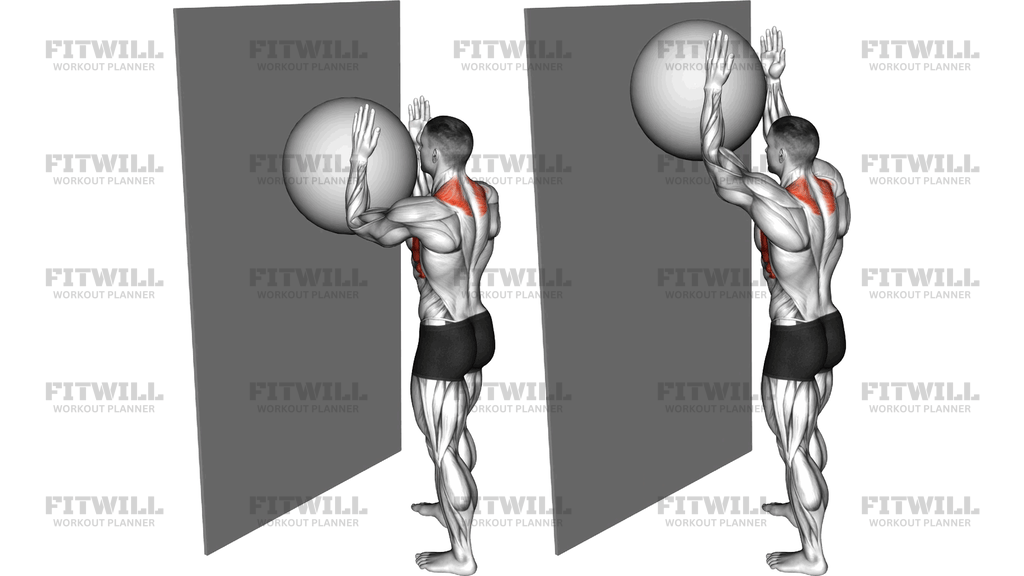
Exercise Ball Serratus Wall Slide is a wall-based shoulder control drill that uses a stability ball as the moving surface. You pin the ball to the wall with your forearms and slide it upward, which asks the shoulder blades to rotate upward and wrap around the rib cage while the torso stays stacked and steady.
This movement is less about pressing hard and more about teaching the shoulder girdle to move cleanly overhead. The main training effect comes from the serratus anterior working with the lower traps, rotator cuff, deltoids, and trunk to keep the ribs down while the arms reach. The ball adds a small stability demand, so even light pressure exposes whether the shoulders, neck, or low back are trying to take over.
The setup matters because the starting position decides whether the rep feels smooth or compensatory. Stand facing the wall, place the ball at upper-chest height, and keep the forearms and hands evenly planted so the ball does not drift. A small forward lean, soft knees, and a neutral pelvis give the shoulders room to slide without turning the rep into a backbend.
On each rep, reach the ball upward by letting the shoulder blades glide and upwardly rotate instead of shrugging aggressively. Keep the neck long, exhale as the ball rises, and stop before the ribs flare or the wrists fold back. The return should be just as controlled as the lift, with the ball rolling back down the wall under steady pressure.
Use this exercise as a warm-up, accessory drill, or shoulder-health movement when you want better overhead reach, serratus activation, and cleaner scapular mechanics. It is especially useful before pressing, throwing, or any work that depends on comfortable arm elevation. Keep the range pain-free and the movement quiet; if the ball slips, the neck tightens, or the lower back arches, shorten the rep and rebuild the position before adding volume.
[ Workout Log & Planner ]
Put your next workout in Fitwill
Keep your plan and training log ready when you are.


Instructions
- Stand facing the wall with the exercise ball pinned between your forearms, hands, and the wall at upper-chest height.
- Place your feet hip-width apart with one small step back so your body has a slight forward lean and your elbows stay bent.
- Press both forearms evenly into the ball, keep your wrists neutral, and set your ribs over your pelvis before you start.
- Exhale gently and reach your shoulder blades forward around the rib cage without letting your low back arch.
- Slide the ball up the wall by lifting your forearms and hands until your arms travel toward an overhead position.
- Keep the neck long and the pressure even on both sides so the ball stays centered on the wall.
- Pause briefly near the top when you can still keep your ribs down and your shoulders free of pinching.
- Lower the ball back to chest height under control, keeping contact with the wall the whole way down.
- Reset your brace before the next rep if the ball slips, your elbows flare, or your torso starts to sway.
Tips & Tricks
- Think of reaching the ball up and away rather than shrugging your shoulders straight toward your ears.
- Keep both forearms pressing evenly into the ball; if one side takes over, the ball will drift and the rep loses its line.
- If your lower back arches, walk your feet a little closer to the wall and shorten the slide.
- A soft bend in the knees helps you keep the ribs stacked instead of turning the rep into a standing back extension.
- Let the shoulder blades glide upward and around the rib cage; do not force them to pinch together at the top.
- Keep your wrists stacked over your forearms instead of letting the hands fold back as the ball rises.
- Use slow, quiet reps with a controlled return so the serratus has to manage both directions of the motion.
- Stop the set if you feel the neck or front of the shoulder taking over, because that usually means the range is too high.
Frequently Asked Questions
What muscles does the Exercise Ball Serratus Wall Slide work most?
It primarily targets the serratus anterior and also involves the lower traps, deltoids, rotator cuff, and trunk stabilizers.
Is this exercise good for shoulder warm-ups?
Yes. It is commonly used to prepare the shoulders for pressing, reaching, or overhead work because it teaches clean upward rotation and reach.
Where should the ball sit on the wall before I start?
Set it around upper-chest height with your forearms already in contact so you can slide upward without reaching too far to begin the rep.
How do I know if I am going too high on the wall?
You are going too high if your ribs flare, your low back arches, or your shoulders feel pinched. Stop where the reach stays smooth and controlled.
Should I feel this in my neck?
No. The neck should stay long and relaxed. If the upper traps dominate, reduce the range and keep the pressure on the ball more even.
Can beginners do the Exercise Ball Serratus Wall Slide?
Yes. It is beginner-friendly when the range stays short and the ball is controlled with light pressure against the wall.
What is the biggest form mistake in this movement?
The most common mistake is turning the slide into a backbend and shoulder shrug instead of keeping the ribs stacked and the reach controlled.
What can I substitute if I do not have an exercise ball?
A foam roller or towel against the wall can work as a simpler wall-slide variation, but the stability ball adds more control demand.
How many reps should I use for this drill?
Use moderate to higher reps with clean technique, especially in warm-ups or accessory blocks. Quality matters more than load.