Bodyweight B Stance Good Morning
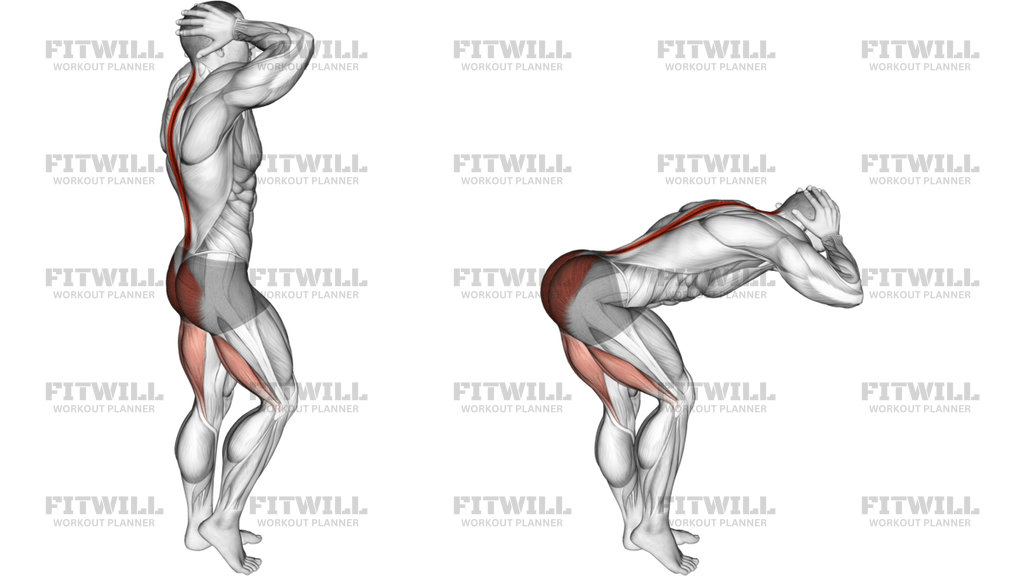
Bodyweight B Stance Good Morning is a staggered-stance hip hinge that teaches you to load one leg while the other leg stays lightly parked behind you for balance. The image shows the hands behind the head, the front foot doing most of the work, and the torso folding forward from the hips with a long spine. That setup makes the exercise useful for learning how to sit the hips back, keep the ribcage stacked over the pelvis, and feel the posterior chain work without needing external load.
This movement is most often used to train the hamstrings, glutes, spinal erectors, and deep core together. Because the stance is split, it also exposes side-to-side differences in balance and hip control more clearly than a two-foot hinge. The rear foot should stay light; it is there to guide position, not to turn the exercise into a lunge or to push most of the bodyweight. The front leg should stay stable from foot to hip, with the knee softly bent rather than locked out.
The key to a good rep is the hinge. Start tall, brace before you move, then send the hips back until the torso leans forward and the hamstrings take the stretch. Keep the chest open, the neck neutral, and the elbows wide so the hands behind the head do not drag you into neck flexion. At the bottom, the torso should be controlled rather than rounded. Drive the hips forward to stand back up, keeping pressure through the front midfoot and heel as you return to the top.
Because the exercise is bodyweight, the challenge comes from position, tempo, and control rather than from adding more resistance. That makes it a strong option for warm-ups, accessory work, or learning a safer hinge pattern before progressing to dumbbells, barbells, or single-leg hinge variations. If you lose balance, feel it mostly in your lower back, or start to twist toward the rear leg, shorten the range and slow the descent until the front leg and hips stay organized.
Use Bodyweight B Stance Good Morning when you want a simple but demanding hinge that builds awareness in the hips and hamstrings while reinforcing bracing and posture. It works well for beginners who need a bodyweight drill and for experienced lifters who want a controlled hinge variation to clean up mechanics, prep for heavier posterior-chain work, or add low-risk volume without spinal loading.
[ Workout Log & Planner ]
Put your next workout in Fitwill
Keep your plan and training log ready when you are.


Instructions
- Stand tall with one foot slightly in front and the other foot set back on the toes, then place your hands behind your head with your elbows wide.
- Keep most of your weight on the front foot and use the back toes only as a light balance point.
- Soften the front knee, brace your torso, and keep your ribs stacked over your pelvis before you move.
- Push your hips straight back to start the hinge while keeping your spine long and your neck neutral.
- Lower your torso until you feel a strong hamstring stretch on the front leg without losing your neutral back position.
- Pause briefly at the bottom only if you can hold the position without twisting or rounding.
- Drive the front foot into the floor and bring your hips forward to stand back up in one smooth line.
- Reset your stance after each rep if needed, then repeat for the planned set with steady breathing.
Tips & Tricks
- Keep the back foot light enough that the front leg still feels like the working leg.
- Think of the move as a hip hinge, not a squat; the hips should travel back more than the knees travel forward.
- If your lower back starts taking over, reduce the depth and re-stack the ribs over the pelvis before going lower again.
- Wide elbows help prevent the head and neck from collapsing forward when the torso lowers.
- Hold the front foot tripod: big toe, little toe, and heel all pressed into the floor.
- A slow 3-second descent makes the hamstring load easier to feel and keeps the torso from dropping too fast.
- Stop the rep when the front hamstring is stretched and the pelvis is still square; do not chase range by rotating.
- Exhale as you drive back to standing so the ribcage does not flare at the top.
Frequently Asked Questions
What does Bodyweight B Stance Good Morning train most?
It mainly trains the hips and posterior chain, especially the front-leg hamstrings and glutes, with the core helping you stay braced.
Why are my hands behind my head?
That position helps you keep the upper body organized and makes it easier to notice when the ribs flare or the neck collapses during the hinge.
How much weight should be on the back foot?
Very little. The back toes are only there for balance; the front leg should do most of the work.
How low should I hinge in this stance?
Go only as low as you can while keeping the spine long, the pelvis square, and the front hamstring under control.
Is this more of a squat or a deadlift pattern?
It is a hinge pattern. The hips move back, the torso leans forward, and the front leg loads like a split-stance Romanian deadlift.
What should I feel if my form is right?
You should feel a stretch and tension in the front hamstring and glute, with your trunk working to keep you from folding or twisting.
Can beginners use this exercise?
Yes. It is a good beginner hinge drill because the staggered stance gives balance support while still teaching hip control.
What are the most common mistakes?
Common mistakes are turning it into a squat, letting the rear foot do too much work, rounding the lower back, and reaching the bottom by collapsing the chest.