Half Squat Side Reach
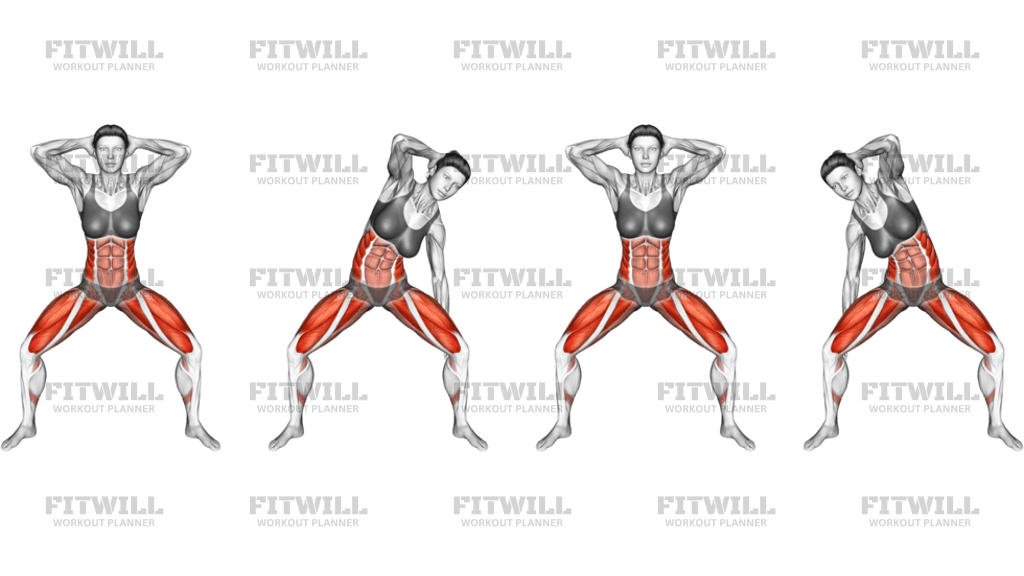
Half Squat Side Reach is a bodyweight squat and side-bend pattern performed from a wide stance with the knees bent and the hands held behind the head. In the image, the torso stays upright while the ribcage shifts laterally over one hip, so the exercise is less about depth and more about controlled trunk motion, hip stability, and clean positioning through each rep.
The setup matters because the wide stance creates room for the hips to load while the elbows stay open and the chest stays lifted. Keeping the feet planted and the knees tracking over the toes helps the lower body stay organized as the torso reaches to one side. That makes the movement useful for training the obliques, lateral core control, and the adductors and glutes that stabilize the squat position.
Each repetition should feel deliberate. From the half-squat position, keep the pelvis steady, brace lightly through the midsection, and bend the torso toward one side without collapsing forward. The reach is a side bend, not a twist and not a full squat pulse. On the return, come back to the center under control, then repeat to the other side if the program calls for alternating reps.
Because this is a bodyweight movement, quality matters more than load. Use it as a warm-up, mobility-strength drill, or accessory core exercise when you want to teach squat posture and lateral trunk control at the same time. It is also useful when a full abdominal crunch is too aggressive but you still want a clear side-body contraction and lower-body isometric demand.
The main coaching priorities are even foot pressure, a steady knee angle, and a neck that stays relaxed behind the hands. If the shoulders hike, the chest folds, or the knees cave inward, the set is too fast or the stance is too narrow. Keep the movement smooth, breathe through the rep, and stop before the hips or trunk start shifting to create fake range.
[ Workout Log & Planner ]
Put your next workout in Fitwill
Keep your plan and training log ready when you are.


Instructions
- Stand with your feet wider than shoulder width, toes slightly turned out, and place your hands lightly behind your head with the elbows open.
- Lower into a half-squat so your hips stay back, your chest stays tall, and your knees track over the middle toes.
- Set your weight evenly across both feet and keep your heels down before you start the side reach.
- Brace your midsection without flattening your posture or pulling your ribs down hard.
- Bend your torso toward one side while keeping the hips and legs steady in the half-squat position.
- Reach only as far as you can without letting the chest collapse forward or the elbows cave in.
- Return to the center with control, then repeat to the opposite side or the same side as programmed.
- Keep breathing steady through the movement and reset your stance if the squat position starts to wobble.
Tips & Tricks
- Keep the hands relaxed behind the head; do not pull on the neck to create a bigger side bend.
- A wider stance usually makes it easier to hold the half-squat while the torso reaches side to side.
- If your knees drift inward during the reach, shorten the range and press the floor apart with both feet.
- Think about sliding the ribs over one hip instead of folding the chest forward.
- The exercise should feel controlled in the obliques and the inner thighs, not rushed in the low back.
- Do not turn the torso into a twist; the image shows a lateral bend with the chest staying mostly square.
- Exhale as you bend to the side, then inhale as you return to the center.
- If your heels lift, reduce the squat depth until you can keep full-foot contact.
- Move slowly enough that each side reach looks symmetrical from rep to rep.
Frequently Asked Questions
What does Half Squat Side Reach train?
It emphasizes the side body and core control while the legs hold a stable half-squat. The hips, inner thighs, and glutes also work hard to keep the stance steady.
Why are my hands behind my head?
That position keeps the chest open and makes the side bend easier to read. It also helps you avoid turning the movement into a forward crunch or reaching with the arms.
How low should I squat?
Only as low as you can stay tall, keep your heels down, and hold the knees aligned over the toes. The image shows a half-squat, not a deep squat.
Should this feel like a twist or a side crunch?
It should feel like a side bend with the torso moving laterally while the hips stay steady. If you are rotating hard, the rep is drifting away from the intended pattern.
Can beginners do this exercise?
Yes. Beginners should use a smaller range, stay upright, and focus on holding the wide squat before increasing speed or depth.
What are the most common form mistakes?
Letting the knees cave in, pulling on the neck, collapsing the chest forward, and reaching so far that the half-squat position breaks down.
Where should I feel the side reach?
You should feel a clear contraction along the obliques and side waist, with the legs and hips working to keep you balanced in the squat.
How can I make it harder without adding weight?
Use a deeper but still controlled half-squat, slow the side reach and return, or pause briefly at the end of each reach before coming back to center.