Bottle Weighted Pullover
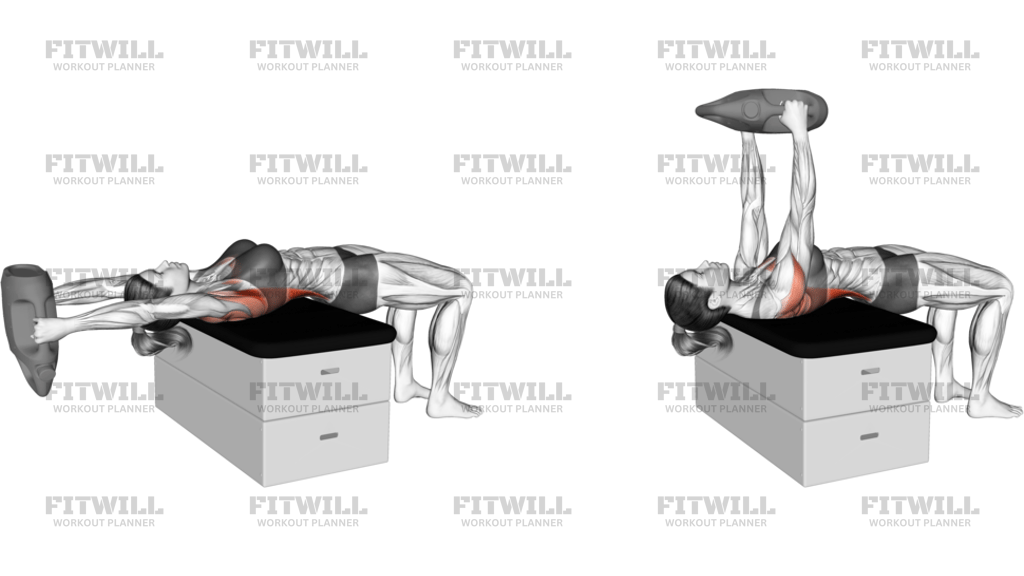
Bottle Weighted Pullover is a bench-based overhead pull performed with a single bottle-style weight held in both hands. Your upper back rests across the bench while your feet stay planted on the floor, so the movement comes from the shoulders and ribcage instead of from swinging the torso. The exercise is commonly used to train the lats, chest, serratus, and long head of the triceps through shoulder extension and a deep overhead stretch.
The setup matters because the bench position changes how much load reaches the shoulders and how much the lower back has to stabilize. In the image, the shoulders are supported on the bench edge, the hips stay lifted in a bridge, and the weight travels in a long arc from behind the head to above the chest. That bridge position helps keep the torso organized and prevents the ribs from flaring as the arms move.
This is not a pressing movement and it should not feel like a shrug or a triceps extension. Each repetition starts with the weight controlled overhead, elbows slightly bent, and the core braced so the ribcage does not dump backward. As the bottle lowers behind the head, the shoulders should open under control; as it returns, the lats and chest should pull the weight back over the chest without bouncing off the bottom.
Bottle Weighted Pullover fits accessory upper-body work, chest and back sessions, or core-stability training when you want a shoulder-dominant movement with a long lever. It is useful for building control in overhead shoulder extension, but it should stay pain-free and measured. If the shoulders pinch, the elbows bend excessively, or the lower back arches hard to finish the rep, reduce the range or the load and keep the motion cleaner.
[ Workout Log & Planner ]
Put your next workout in Fitwill
Keep your plan and training log ready when you are.


Instructions
- Lie across the bench with only your upper back and shoulders supported, plant both feet firmly on the floor, and hold the bottle with both hands above your chest.
- Lift your hips into a strong bridge so your torso stays long and your ribs do not flare as the weight moves.
- Start with the arms nearly straight and the bottle stacked over the chest, keeping a soft bend in the elbows.
- Inhale and lower the bottle in a smooth arc behind your head until you feel a controlled stretch through the lats and chest.
- Keep the elbows pointed mostly upward and avoid turning the movement into a bent-arm press or fly.
- Pause briefly at the deepest comfortable range without losing the bridge or letting the low back overarch.
- Exhale and pull the bottle back along the same arc until it returns over the chest.
- Stop the set if the shoulders shrug, the hips drop, or the weight starts drifting instead of moving in one clean path.
Tips & Tricks
- Keep the bench high enough that your shoulder blades can hang just off the edge while your head stays supported.
- A small elbow bend is ideal; locking the elbows can stress the shoulders, and too much bend turns the movement into a triceps exercise.
- Think about lowering the bottle with your lats, not letting it fall behind you.
- Do not let the ribs pop up as the weight goes overhead; the bridge should stay firm and controlled.
- Use a bottle or light implement that you can stabilize with both hands, especially near the bottom of the arc.
- If the front of the shoulders pinch, shorten the range before the arms go fully behind the head.
- Keep the neck relaxed and look straight up rather than craning to follow the weight.
- The lowering phase should be slower than the return so you own the stretch instead of bouncing through it.
Frequently Asked Questions
What does a Bottle Weighted Pullover train most?
It mainly targets the lats and upper torso, with the chest, serratus, and triceps helping through the arc.
Why are my hips lifted during the rep?
The bridge helps keep the torso organized on the bench and reduces the tendency to over-arch the lower back.
Should the elbows stay straight or bent?
Keep a slight bend in the elbows and hold that angle fairly constant so the shoulders do the work.
How low should the bottle go behind my head?
Lower it only until you feel a strong stretch without shoulder pinching, rib flare, or loss of control.
Is this more of a chest or back exercise?
It trains both, but most people feel the lats and ribcage working hardest while the chest and triceps assist.
Can I do this if I only have a water bottle or light bottle-shaped weight?
Yes, as long as it is secure, easy to grip with both hands, and light enough to control through the full arc.
What is the most common mistake with this movement?
Letting the lower back arch hard or bouncing the weight out of the bottom position.
How should the weight travel?
It should move in one smooth arc from above the chest to behind the head and back, without drifting side to side.