Squat Mobility Twist
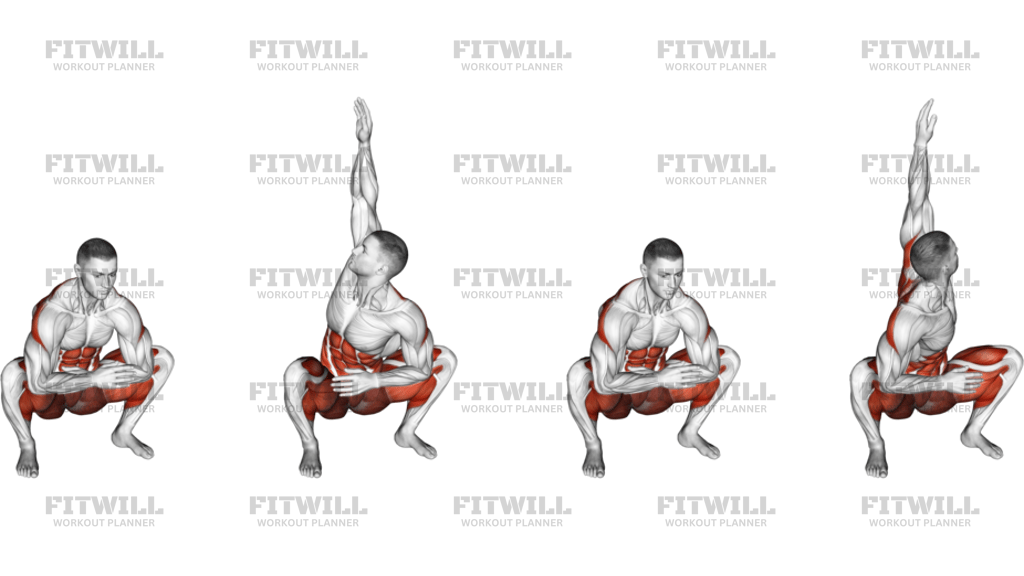
Squat Mobility Twist is a bodyweight mobility drill that combines a deep squat hold with torso rotation and an overhead reach. It is designed to open the hips, ankles, and upper back at the same time while teaching you to keep the chest lifted and the feet rooted. Because you stay in a loaded squat position throughout the movement, the core has to stabilize while the rib cage turns.
This exercise is most useful in a warm-up, between strength sets, or as part of a mobility circuit before squats, lunges, deadlifts, or overhead work. The squat position challenges the ankles, adductors, glutes, and groin, while the twist adds a stronger demand on the obliques and thoracic spine. The reach overhead also reveals whether one side of the rib cage or shoulder opens more easily than the other.
The quality of Squat Mobility Twist depends on depth and control. Sink into a squat that you can hold with flat feet, then use the elbow-inside-knee position to gently create space before you rotate and reach. Keep the knees tracking over the toes and let the twist come from the rib cage rather than from a knee wobble or a collapsing lower back. Move slowly enough that each side feels deliberate instead of rushed.
Treat this as a mobility drill, not a rep-max exercise. A few smooth repetitions per side can improve how a deep squat feels and can also reveal side-to-side stiffness that is easy to miss in faster movements. If your heels lift, your chest folds, or the rotation pulls you off balance, shorten the squat, reduce the reach, or hold onto a sturdy support while you clean up the position. Strong reps should feel centered, controlled, and easy to repeat.
The best sets are the ones that leave you feeling more open, not more compressed. Keep the range pain-free, breathe steadily, and use the pause at the bottom to settle into the position before each twist. Squat Mobility Twist works well as a low-fatigue preparatory drill for people who need better hip depth, better trunk rotation, or a cleaner transition into heavier lower-body training.
[ Workout Log & Planner ]
Put your next workout in Fitwill
Keep your plan and training log ready when you are.


Instructions
- Stand with your feet just wider than shoulder-width apart, turn your toes slightly out, and sink into a deep squat with your heels flat.
- Keep your chest lifted and your ribs stacked over your pelvis, then let your elbows come inside your thighs so the bottom position feels supported.
- Spread your knees gently apart without letting your arches collapse, and settle into a balanced squat before you begin twisting.
- Shift your weight evenly through both feet, then rotate your torso to one side as you keep the hips low and the knees tracking over the toes.
- Reach the top arm straight up toward the ceiling while the opposite elbow stays lightly inside the thigh to help create space in the hip.
- Keep the head and eyes following the reaching hand, but avoid letting the twist pull your knees, feet, or lower back out of position.
- Return the reaching hand to the center under control, re-stack your torso, and repeat the same twist on the other side.
- Breathe in as you come back to center and exhale as you open into each rotation, then stand up slowly when the set is complete.
Tips & Tricks
- If your heels pop up, shorten the squat or widen your stance before you chase more rotation.
- Let the twist happen through your rib cage and upper back, not by cranking the front knee inward.
- Press the elbow into the thigh lightly; it should open space, not jam the knee outward.
- Keep the reaching shoulder away from your ear so the overhead arm feels long instead of shrugged.
- Pause for a breath at the bottom if the first rep feels tight, then rotate from a still base.
- Use a sturdy post or rack for balance if the movement turns into a wobble instead of a controlled twist.
- If your lower back rounds, reduce the depth and keep your chest more upright through the squat.
- Move side to side slowly enough that you can feel both hips open before you switch.
Frequently Asked Questions
What does Squat Mobility Twist work most?
It mainly challenges the hips, adductors, glutes, obliques, and upper back while the squat position keeps the core active.
Can beginners perform this exercise?
Yes. Beginners usually do best with a shallower squat, slower tempo, and a hand support nearby until balance and ankle mobility improve.
Should my heels stay on the floor during Squat Mobility Twist?
Ideally, yes. If your heels lift, reduce the squat depth or widen your stance before forcing more range.
How far should I rotate in Squat Mobility Twist?
Rotate only as far as you can keep both feet grounded, your knees open, and your lower back neutral.
Is Squat Mobility Twist a warm-up or a strength exercise?
It is best used as a mobility warm-up or accessory drill. The goal is cleaner movement and better range, not loading the exercise heavily.
What if I feel this in my lower back?
Back off the twist and keep your ribs stacked over your pelvis. The movement should feel like hip and upper-back opening, not spinal pinching.
What is the difference between Squat Mobility Twist and a regular squat hold?
The twist adds thoracic rotation and an overhead reach, so it asks more of the hips, core, and upper back than a plain squat hold.
How many reps should I do?
Use 5-8 slow twists per side or about 30-60 seconds of controlled work, depending on how tight the position feels.