Faber Test
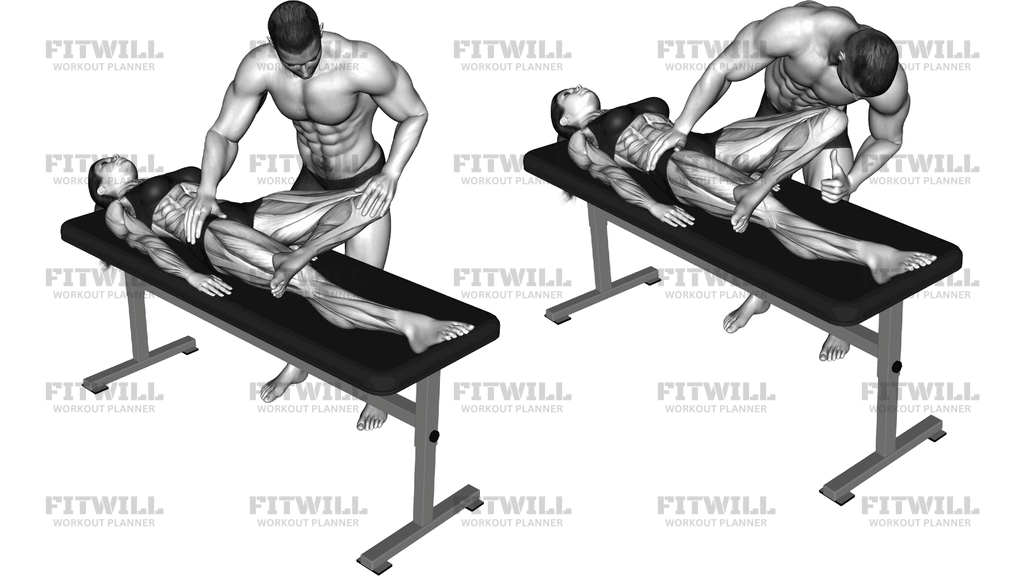
The FABER test, also called the Patrick test, is a hip mobility assessment used to check how comfortably one hip moves into flexion, abduction, and external rotation. In the standard setup, the person lies on a bench or table with one ankle crossed over the opposite thigh to form a figure-four position while the pelvis stays flat and square. The image shows a therapist or coach stabilizing the pelvis and applying gentle downward pressure on the bent knee to see how far the hip opens without the low back or pelvis compensating.
This is not a strength exercise or a rep-driven stretch. Its value comes from a consistent setup, a controlled amount of pressure, and an honest comparison from side to side. A clean FABER position helps reveal whether the limitation is coming from the hip joint, the front of the hip, the groin, the outer hip, or nearby soft tissue. It is commonly used in clinical screening, return-to-training checks, and mobility assessments when a hip feels stiff, pinchy, or uneven.
The setup matters more than force. The crossed ankle should rest comfortably above the opposite knee, the non-working leg stays relaxed and extended, and the pelvis should not roll toward the open side as the knee drops. If the knee opens easily but the pelvis lifts or twists, the result is less useful. The goal is a repeatable end position that can be compared across both sides, not the deepest possible range.
When performed well, the movement should feel like a slow opening at the hip with steady support from the person guiding the knee. A stretch in the outer hip or groin can be normal, but sharp pain, a strong pinch in the front of the hip, or low-back discomfort is a sign to stop and reassess. Because this test is often used to inform programming, the quality of the position is more important than how far the knee travels.
Use FABER when you need a simple, practical hip screen before training, during a mobility check, or as part of a broader assessment of asymmetry. It is especially useful when comparing left and right hips, checking whether a figure-four stretch feels limited, or deciding whether a hip issue may need a more detailed evaluation. Keep it gentle, controlled, and consistent so the result tells you something useful.
[ Workout Log & Planner ]
Put your next workout in Fitwill
Keep your plan and training log ready when you are.


Instructions
- Lie on your back on a flat bench or treatment table with both hips square and your head supported.
- Cross one ankle over the opposite thigh so the leg forms a figure-four shape, with the ankle resting just above the knee.
- Keep the non-working leg relaxed and extended on the bench so the pelvis stays level.
- Let the shoulder blades and sacrum settle into the bench before any pressure is applied.
- Brace lightly through the abdomen so the low back does not arch as the knee opens.
- Hold the outer hip or knee and gently guide the bent knee down and out, keeping the pelvis from rolling.
- Pause at the first firm end range, then note whether the limitation feels like a stretch, pinch, or blocked motion.
- Bring the leg back to the start with control, then repeat on the other side for comparison.
- Stop immediately if the movement creates sharp hip pain, groin pain, or low-back discomfort.
Tips & Tricks
- Keep the pelvis square on the bench; if one side lifts, the test loses value.
- A difference in knee height side to side is often more important than how far the knee drops on one side alone.
- Do not press harder to force range if the front of the hip pinches; that usually points to a poor test position or an irritated hip.
- Relax the non-working leg instead of pulling it into the bench, because tension there can tilt the pelvis.
- The pressure should be gradual and easy to control, not a sudden push on the bent knee.
- Compare the feel of the stretch in the outer hip, groin, and front of the hip rather than chasing a bigger angle.
- If the knee opens well but the pelvis twists, the limitation may be coming from control rather than pure hip range.
- Use the same bench height and same hand placement every time if you are tracking progress.
- This is a test, so consistency matters more than intensity or fatigue.
Frequently Asked Questions
What does the FABER test assess?
It checks hip flexion, abduction, and external rotation while the pelvis stays stable on the bench.
Why is the ankle crossed over the opposite knee?
That figure-four position opens the hip in the exact pattern the test is meant to examine.
Should the pelvis move when the knee is pressed down?
No. The pelvis should stay flat and square; rolling or lifting reduces the reliability of the result.
What does a pinching feeling in the front of the hip mean?
A front-of-hip pinch can suggest the hip is not tolerating the position well, so stop short of forcing the range.
Is this the same as a figure-four stretch?
The setup looks similar, but FABER is a test first and a gentle mobility position second.
Can I use this to compare my left and right hips?
Yes. Side-to-side differences in knee drop, pelvic motion, or pain are one of the main reasons the test is used.
What should I feel in a normal FABER position?
A mild stretch in the outer hip or groin can be normal, but the movement should stay controlled and non-painful.
Can I do this without a partner?
You can set up the position yourself, but the test is more consistent when another person stabilizes the pelvis and guides the knee.
What should I do if the low back arches?
Reduce the range and reset the pelvis flat before continuing, because back arching means the hip is being masked by compensation.