Hip Internal Rotation Test
Hip Internal Rotation Test is a bench-based check of how freely the hip can turn inward when the pelvis is kept still. In the assisted version shown here, you lie face down on a flat bench with one knee bent off the edge while a partner guides the lower leg through the rotation. The purpose is not to chase load or speed; it is to see whether the hip moves smoothly without the low back, pelvis, or thigh cheating for extra range. If the setup is off by even a little, the test can look better or worse than it really is.
This movement is useful when you want a quick look at side-to-side hip symmetry, especially if one hip feels stiffer in squats, lunges, or rotational work. The body weight setup keeps the test simple, while the bench and bent-knee position make it easier to isolate internal rotation at the hip joint. Because the motion is small and specific, a clean result depends on the setup being exact from rep to rep. That makes it a useful warm-up check before lower-body training, as well as a quick way to track whether mobility work is actually changing anything.
A good Hip Internal Rotation Test starts with the thigh fully supported on the bench, the knee bent to about 90 degrees, and the pelvis square to the pad. From there, the lower leg should move while the thigh stays anchored. Keep the abdomen lightly braced and the neck relaxed so the ribcage does not flare or the low back does not take over. If the pelvis rolls, the low back arches, or the movement gets yanked, the test stops being useful because the extra motion is coming from compensation instead of the hip.
The best version is smooth, repeatable, and easy to compare from left to right. Treat the end range as information, not something to force through, and note whether the motion feels blocked, pinchy, or simply tighter on one side. Used this way, Hip Internal Rotation Test can help guide warm-ups, mobility work, or coaching decisions before more demanding lower-body training. When the movement is comfortable, repeat the same position and pressure on both sides so you can trust the comparison and spot trends over time.
[ Workout Log & Planner ]
Put your next workout in Fitwill
Keep your plan and training log ready when you are.


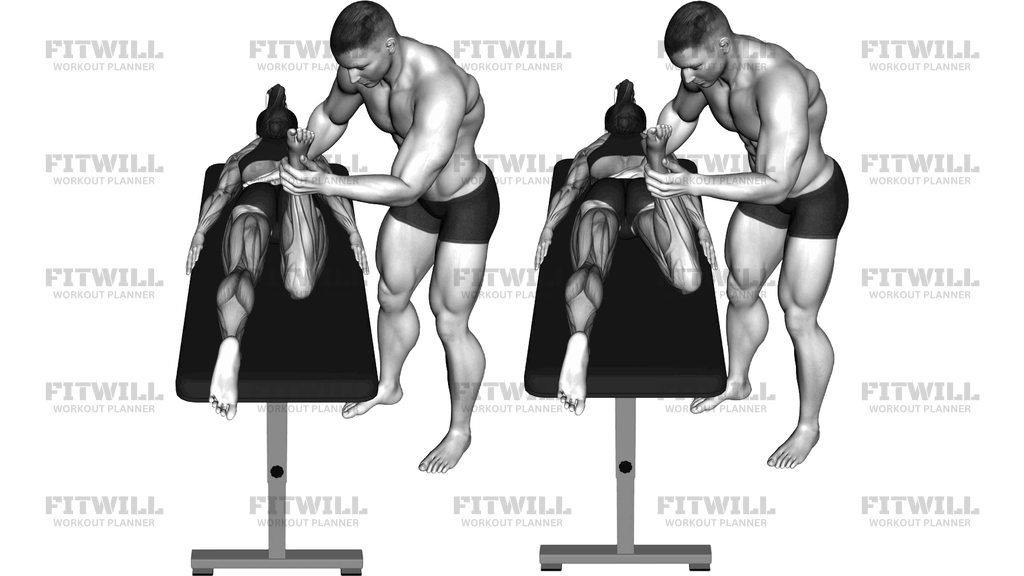
Instructions
- Lie face down on a flat bench with both hips supported and the test leg close to the edge.
- Bend the test knee to about 90 degrees so the lower leg hangs off the side while the thigh stays on the pad.
- Keep the opposite leg long and relaxed on the bench so your pelvis stays square.
- Lightly brace your abs to stop your low back from arching as the leg moves.
- If a partner is helping, let them hold the ankle and lower shin while keeping the knee angle fixed.
- Slowly move the lower leg outward from the midline to create hip internal rotation without lifting the thigh.
- Pause at the comfortable end range for a second and check that the pelvis stays flat on the bench.
- Return the lower leg to the start under control, then repeat for the planned reps or switch sides to compare both hips.
Tips & Tricks
- Keep the front of the pelvis heavy on the bench; if the hip rolls up, the range is no longer clean.
- Let the thigh stay anchored and move only the lower leg so you are measuring hip rotation, not trunk twist.
- Use the same knee bend and same bench position on both sides or the comparison loses value.
- Stop before any groin pinch or front-of-hip pinch and treat that limit as your current range.
- If your low back arches, shorten the motion and reset before taking another rep.
- Use gentle pressure from the partner; a hard pull can create extra motion that the hip did not produce.
- Keep the foot relaxed instead of actively pointing or twisting it, which can blur the result.
- Write down the side-to-side difference, because asymmetry is usually the most useful takeaway from the test.
Frequently Asked Questions
What does Hip Internal Rotation Test measure?
It checks how much the hip can rotate inward while the pelvis stays still, which helps reveal stiffness or side-to-side asymmetry.
Is Hip Internal Rotation Test a strength exercise?
No. It is mainly an assessment and mobility drill, so the goal is clean motion rather than loading.
Why is the knee bent to 90 degrees on the bench?
That position helps isolate hip rotation and makes it easier to compare one side with the other.
Should I feel Hip Internal Rotation Test in my groin?
A mild stretch can show up in the inner or front hip, but sharp groin pinching means the range is too aggressive.
Why does my lower back want to twist during Hip Internal Rotation Test?
The pelvis is probably helping the motion. Keep your abs lightly braced and let the thigh stay heavy on the bench.
Can I do Hip Internal Rotation Test without a partner?
Yes, but the assisted version is easier to standardize. A solo version should still keep the thigh fixed and the motion slow.
What should I do if one side moves less?
Use the tighter side as your current baseline and avoid forcing extra range. The goal is to learn the difference, not to win the test.
Is Hip Internal Rotation Test appropriate for beginners?
Yes, if it stays light and pain-free. Beginners should treat it as a gentle check of hip motion and stop when the range starts to pinch.