Shoulder External Rotation Test
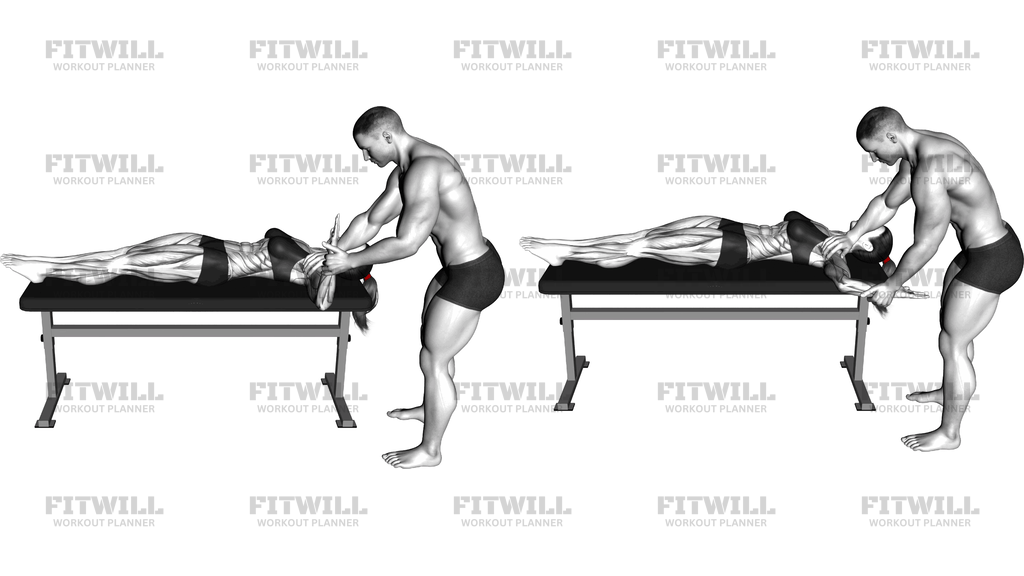
Shoulder External Rotation Test is a prone shoulder assessment performed with the chest supported on a flat bench and the working arm hanging off the edge. The position is meant to isolate external rotation at the shoulder while the torso, ribs, and neck stay quiet. In the image, the lifter lies face down with the elbow bent and the forearm moving upward from below the bench line, which makes the test easy to compare side to side.
This is less about moving a load and more about showing whether the shoulder can rotate outward cleanly without shrugging, twisting, or letting the elbow wander. The main demand falls on the rotator cuff, especially the external rotators, with the rear shoulder and scapular stabilizers helping keep the arm centered. Because the torso is supported, any cheating through trunk rotation or low-back extension becomes easier to spot.
Set the body so the chest and pelvis stay planted on the bench, the head remains neutral, and the working upper arm is lined up with the shoulder. Let the forearm hang freely so the hand can travel through an honest rotation arc. The elbow should stay bent near 90 degrees and stay in roughly the same spot throughout the rep. If the shoulder feels jammed or the chest starts to peel off the bench, the setup is too aggressive.
Rotate the forearm upward by turning the shoulder outward until the forearm reaches level with the bench or slightly above it, then lower it back down slowly. The elbow should feel like a hinge that stays fixed while the humerus rotates in the socket. A clean rep looks smooth and controlled, with no rib flare, no head turn, and no momentum from the hand or wrist.
Use this test when you want a simple screen for external rotation control, a warm-up check before pressing or throwing work, or a rehab-style comparison between the left and right shoulder. Quality matters more than speed or load. If the position creates sharp pain, pinching at the front of the shoulder, or a strong side-to-side mismatch, shorten the range and recheck the setup before continuing.
[ Workout Log & Planner ]
Put your next workout in Fitwill
Keep your plan and training log ready when you are.


Instructions
- Lie face down on a flat bench with your chest and pelvis supported and your head in a neutral position.
- Place the working shoulder at the bench edge so the upper arm can rotate freely without the torso rolling.
- Bend the elbow to about 90 degrees and let the forearm hang below the bench, with the hand relaxed.
- Set the upper arm in line with the shoulder and keep the elbow fixed in place before you begin.
- Rotate the forearm upward by turning the shoulder outward until the forearm is level with the bench or slightly above it.
- Pause briefly at the top without shrugging, arching, or letting the elbow drift backward.
- Lower the forearm slowly back to the starting hang under control.
- Reset the shoulder position before the next rep and repeat with the same range on both sides.
Tips & Tricks
- Keep the chest glued to the bench; if the ribs lift, the test stops measuring pure shoulder rotation.
- Use a small, symmetrical range so both sides can be compared without momentum hiding weakness.
- Keep the elbow stacked under the shoulder instead of letting it drift behind the torso.
- Rotate from the shoulder, not by twisting the wrist or swinging the forearm.
- A neutral neck helps prevent the head from turning to assist the movement.
- Stop if the front of the shoulder pinches at the top range.
- Match the lowering speed on both sides so the comparison stays meaningful.
- If one side feels tighter, do not force the range past the point where the scapula starts to lift.
- Keep the hand relaxed; gripping hard can trigger compensation through the forearm and upper arm.
Frequently Asked Questions
What does Shoulder External Rotation Test assess?
It checks how well the shoulder rotates outward with the elbow bent and the upper arm supported, which is useful for comparing side-to-side control.
What muscles do I feel working?
Mostly the rotator cuff, especially the external rotators, with the rear shoulder and scapular stabilizers helping keep the arm steady.
Why do I lie face down on a bench?
The bench supports the torso so the test focuses on shoulder rotation instead of body English or low-back extension.
How high should the forearm lift?
Lift only until the forearm is level with the bench or slightly above it, as long as the elbow stays fixed and the shoulder stays comfortable.
Should my elbow move during the rep?
No. The elbow should stay bent and nearly still while the humerus rotates in the shoulder socket.
Can I load this exercise with a dumbbell?
This version is usually used as a body-position test, but a very light hand load may be used if the goal is a strength screen and the setup stays strict.
What is a common mistake?
Letting the ribs rise, the shoulder shrug, or the elbow drift backward turns the test into a compensation check instead of a clean rotation screen.
Is this safe if my shoulder is sore?
Only if the movement is pain-free and the soreness is mild; sharp pain, pinching, or instability means you should stop and get the position checked.
Can beginners perform it?
Yes, beginners can use it because the body is supported, but they should keep the range small and the movement slow enough to stay honest.
How do I compare left and right sides?
Use the same bench setup, elbow angle, and tempo on both sides, then compare range, smoothness, and any pain or shoulder hiking.