Thomas Test
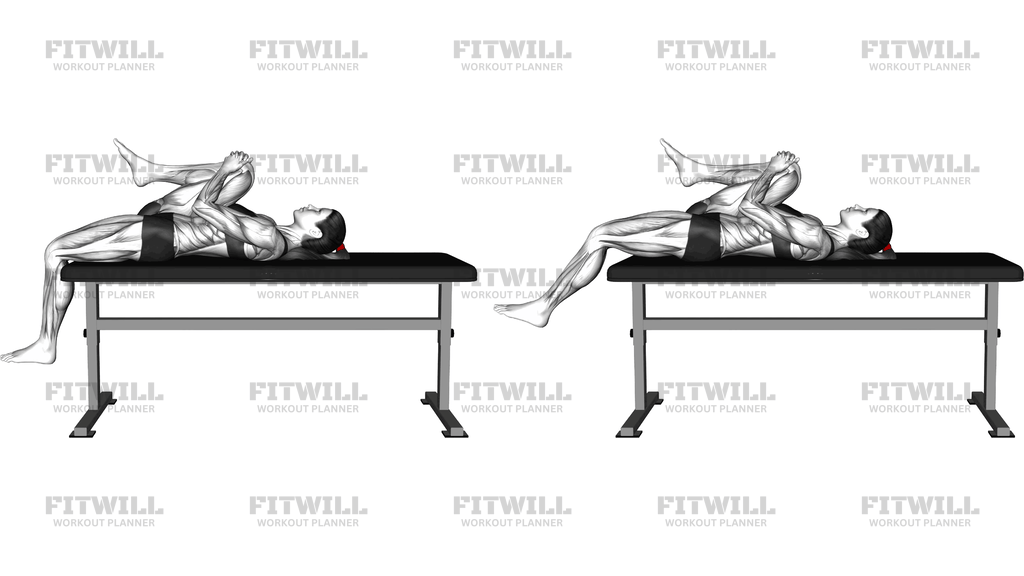
The Thomas Test is a bench-based hip-flexor and quad length assessment that also works well as a controlled mobility drill. You lie back with one knee hugged toward the chest while the other leg hangs freely off the end of the bench. That asymmetrical setup exposes tightness in the hip flexors, rectus femoris, or the tissues around the front of the thigh and pelvis, which is why the position is useful both in screening and in warm-ups.
The value of the Thomas Test is in how clearly it shows what each side can do. If the hanging thigh stays lifted, the pelvis tips, or the knee cannot bend and relax, the position usually points to limited hip extension or quad length rather than a simple strength issue. Stabilizers and the core work to keep the pelvis from rocking, but the goal is still a quiet, honest position rather than an active lift.
Setup matters more here than it would in a standard stretch. The bench needs to support your upper back and hips while leaving enough room for one leg to hang fully off the edge. Pull one knee in only as far as needed to flatten the low back, then let the opposite leg drop without forcing it. If you are testing both sides, keep the torso square and compare the hanging leg angle, knee bend, and any pelvic tilt from one side to the other.
During the hold, breathe slowly and let the hanging thigh settle instead of trying to push the knee lower with momentum. A clean Thomas Test looks quiet: the pelvis stays level, the non-hugged thigh drifts toward the floor, and the bent knee relaxes without twisting outward. If the hip pinches or the low back arches hard, shorten the hold, adjust the bench edge, or reduce how aggressively you pull the opposite knee in.
This movement is commonly used before lower-body training, after prolonged sitting, or whenever a coach wants a quick check on hip mobility. It also helps distinguish a true hip-flexor limitation from general stiffness because the torso and pelvis are fixed while the leg hangs. Thomas Test is most useful when you want a repeatable position, clear side-to-side comparison, and a gentle way to open the front of the hip without loading the joints heavily.
Fitwill
Log Workouts, Track Progress & Build Strength.
Achieve more with Fitwill: explore over 9600 exercises with images and videos, access built-in and custom workouts, perfect for both gym and home sessions, and see real results.
Start your journey. Download today!




Instructions
- Sit on the end of a flat bench and lie back so your hips are close to the edge and your shoulders are supported.
- Pull one knee tightly toward your chest with both hands and keep the opposite leg free to hang off the bench.
- Let the hanging thigh relax toward the floor while keeping your pelvis square and your low back from arching hard.
- Keep the bent knee of the hanging leg relaxed at roughly a right angle instead of letting the thigh rotate outward.
- Hold the top knee in place and inhale slowly through your nose before each longer exhale.
- Stay still in the bottom position and compare both sides if you are using the Thomas Test as an assessment.
- If the hanging thigh rises or the pelvis twists, ease the top knee slightly or reposition closer to the bench edge.
- Release the hug, bring both feet back to the floor, and sit up carefully before repeating on the other side.
Tips & Tricks
- Use a bench with a firm edge; a soft cushion can hide the true hanging-leg position.
- Keep the knee-to-chest leg active enough to flatten the low back, but do not yank so hard that the pelvis posteriorly tilts and masks the result.
- Watch the hanging thigh, not just the knee angle; if the thigh stays above bench level, hip-flexor tightness is usually the limiter.
- Let the hanging foot go loose instead of pointing the toes hard, which can create extra tension through the leg.
- Compare left and right from the same setup height and the same distance from the bench edge.
- If the front of the hip pinches, shorten the hold and avoid forcing the leg lower into pain.
- Use slow exhales to help the hanging leg relax without actively pressing it down.
- For a mobility version, hold the position for a short, calm stretch instead of bouncing or repeatedly dropping the leg.
Frequently Asked Questions
What does the Thomas Test check?
It mainly checks hip-flexor and quad length by seeing whether the hanging thigh can relax toward the floor while the opposite knee stays hugged in.
Which side should hang off the bench in the Thomas Test?
Either side can hang off the bench; the important part is keeping the pelvis square and comparing both sides from the same setup.
Why does my low back arch during the Thomas Test?
That usually means the knee you are holding is not pulled in enough or the bench setup is too far from the edge, so the pelvis cannot stay neutral.
Should the hanging knee be straight in the Thomas Test?
No. The knee usually bends naturally to about 90 degrees or more; if it straightens fully, the setup is too relaxed and no longer looks like the classic test position.
Can I use the Thomas Test as a stretch?
Yes. A short, calm hold in the same position works well as a hip-flexor and quad mobility drill before lower-body work.
What is a common mistake in the Thomas Test?
Pulling the top knee so hard that the pelvis rolls under can hide the real limitation and make the hanging leg look more mobile than it is.
Is the Thomas Test useful after sitting all day?
Yes. It is a practical way to check whether prolonged sitting has tightened the front of the hip and reduced comfortable extension.
What should I compare from one side to the other?
Compare how far the hanging thigh drops, whether the knee stays bent, and whether one side makes the pelvis twist or the low back arch sooner.