Sphinx Push Up
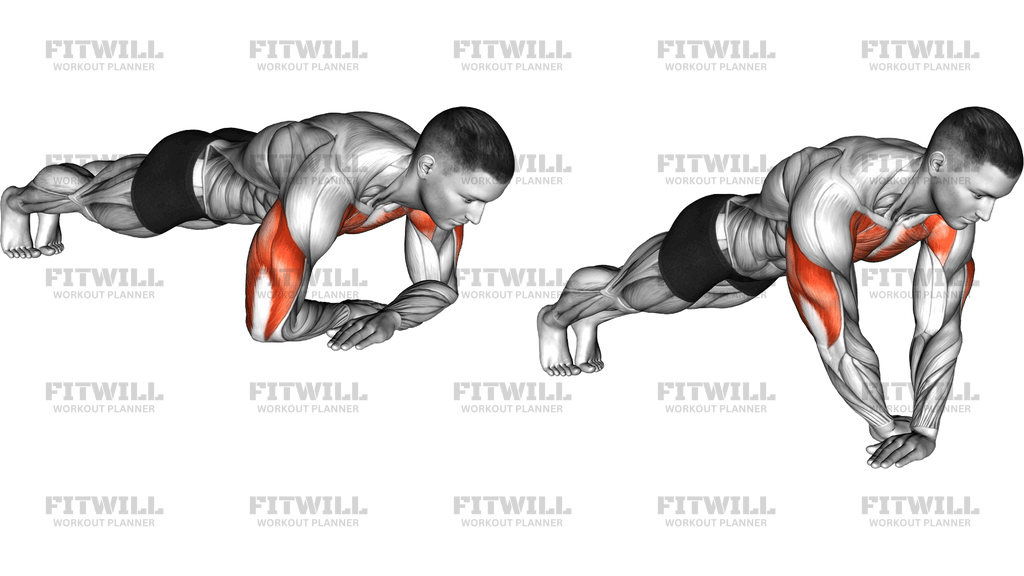
The Sphinx Push Up starts from a prone plank resting on your forearms — the classic sphinx position — and finishes with your arms fully extended, as if you had pressed yourself off the floor from the bottom of a push up. Instead of beginning with straight arms and bending your elbows, you start collapsed onto your forearms and drive the floor away to straighten them. That reverse path changes the feel of the movement completely: your triceps have to generate force from a fully flexed elbow angle, which is exactly where they are weakest, and your torso has to travel up and forward in a slight diagonal rather than straight down and up.
The triceps are the stars here, but they are far from alone. Pressing from the forearms demands real work from the chest and the fronts of the shoulders, and because you are holding a plank the entire time, your abs, obliques, and lower back must stay tight to keep your hips from sagging or piking. If you have ever done a plank and felt your midsection shaking more than your arms, you already understand how much bracing this exercise asks for. The elbows also spend the whole set close to the body, which keeps the emphasis on the pushing muscles rather than letting the shoulders flare into an awkward position.
This is a great movement for anyone who finds full push ups from straight arms hard to progress past, because it overloads the hardest part of the rep — pressing out of the bottom — without needing any equipment. It is also useful in the opposite direction: advanced lifters use slow, controlled Sphinx Push Ups as a finisher to burn out the triceps and reinforce a rigid plank position. You will see it in bodyweight circuits, at-home routines, and warm-ups where the goal is to wake up the pressing muscles and the core at the same time.
Setup matters more than it looks. Place your forearms parallel to each other with your elbows roughly under your shoulders, hands flat on the floor and pointing forward, and your feet about hip-width apart. If your elbows drift ahead of your shoulders or out to the sides, the press becomes clumsy and your shoulders take on stress they do not need. On a smooth floor your forearms may slide, so an exercise mat or a surface with some grip makes a genuine difference.
To execute the rep well, press one hand or both hands into the floor and push your torso up and slightly forward until your arms are straight, keeping the elbows tracking close to the ribs rather than flaring wide. Lower back down with control, placing the forearms back on the floor softly instead of dropping. Two things ruin this exercise: letting the hips sag as you press, and rushing the lowering half. Move slowly enough that you could pause at any point, and breathe out as you press up, in as you lower.
[ Workout Log & Planner ]
Put your next workout in Fitwill
Keep your plan and training log ready when you are.


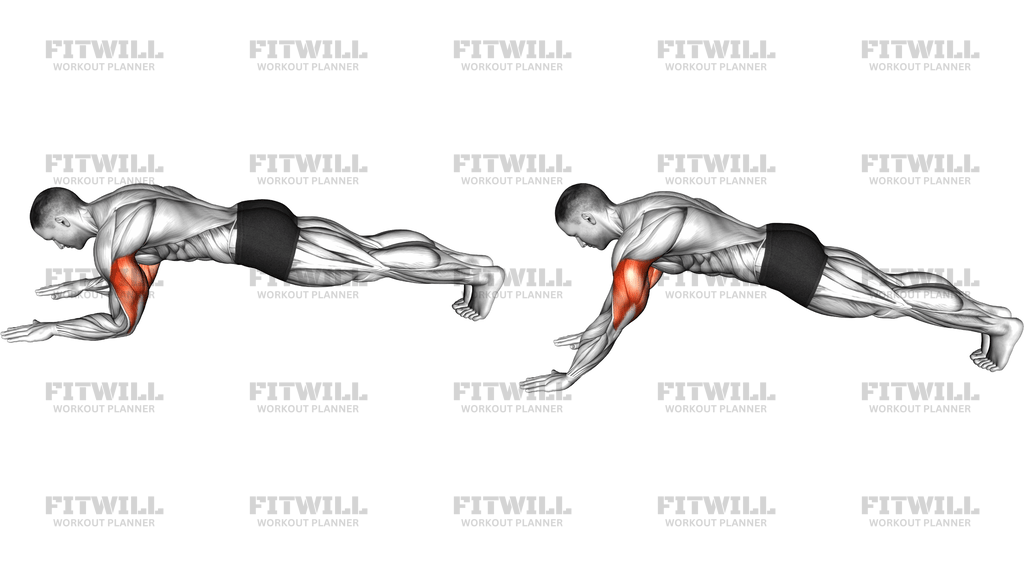
Instructions
- Kneel on an exercise mat, then lower down and place both forearms on the floor with your elbows directly under your shoulders and your hands flat, fingers pointing forward.
- Extend your legs back one at a time until your body forms a straight line from head to heels, feet about hip-width apart with toes tucked under.
- Squeeze your glutes, brace your abs, and pull your shoulder blades down so your neck stays long and your lower back does not sag.
- Inhale, then press both palms firmly into the floor and drive your torso up and slightly forward as you straighten your elbows.
- Finish the press with your arms fully extended, shoulders stacked over your wrists, and your body still in one rigid line — this is the top of a push up position.
- Keep your elbows tracking close to your ribs throughout the press instead of flaring out to the sides.
- Exhale as you press up, then inhale as you bend your elbows and lower your forearms back toward the mat under control.
- Touch the forearms down gently so both elbows return under your shoulders at the same time, and re-brace before starting the next rep.
- Reset your plank position at the bottom of every rep — if your hips drop or your lower back arches, stop the set rather than grinding out sloppy reps.
Tips & Tricks
- The most common mistake is letting the hips sag as you press up, because the arms move while the core checks out. Film yourself from the side once — if your belt line drops during the press, squeeze your glutes harder before each rep.
- Another frequent error is pressing straight up instead of up and forward. Your shoulders should end up over your wrists, and your head should travel slightly ahead of where it started; a purely vertical press usually means the elbows drifted behind the shoulders.
- If your forearms slide outward on the mat, your hands are too close together. Widen them slightly so the forearms stay parallel and the press feels stable.
- Alternate which forearm you lower first if you choose to descend one arm at a time, or lower both together — just do not always drop the same side first or you will build a side-to-side imbalance.
- Do not hold your breath. The press from the floor is a hard few seconds, and exhaling on the way up makes it noticeably easier to keep your trunk rigid.
- Beginners often rush the bottom half. Lowering for two to three seconds turns the Sphinx Push Up into a much stronger triceps and core exercise without adding a single rep.
- If pressing both arms at once is too hard, use a staggered start: press one hand down, then the other, then lower them back in reverse order. This is how most people build toward the full version.
- Watch your elbow position at the bottom. Letting the elbows slide forward past the shoulders turns the movement into a shoulder stretch rather than a press and puts unnecessary strain on the front of the shoulder.
- On a slippery floor, loop a resistance band around both forearms or use a mat with grip — sliding forearms are the main reason people lose balance during this exercise.
Frequently Asked Questions
What muscles does the Sphinx Push Up work?
The triceps do most of the pressing work, since they must extend the elbows from a fully bent position. The chest and front shoulders assist the press, while the abs, obliques, and lower back hold the plank position the entire time.
How is the Sphinx Push Up different from a regular Push Up?
A regular Push Up starts with straight arms and lowers down, while the Sphinx Push Up starts on the forearms and presses up. This removes the easier eccentric phase from the start of the rep and forces the triceps to work from their weakest angle, making the bottom half of the press much harder.
Can beginners do the Sphinx Push Up?
Yes, but most beginners should start by pressing one arm at a time or dropping to the knees between reps. The single-arm press builds the elbow extension strength needed for the full version without letting form break down.
Should my elbows be under my shoulders or behind them at the start?
Directly under the shoulders. If the elbows sit too far forward the press loses leverage, and if they sit too far back your torso will drag along the floor instead of lifting cleanly.
Why does the Sphinx Push Up feel harder on my core than on my arms?
Because the trunk has to stay rigid while the arms press, and the plank position on the forearms already loads the abs heavily. If your core gives out first, that is normal at the start — hold plank positions separately to build the bracing endurance this exercise needs.
What should I do if my forearms slide on the floor?
Use an exercise mat or move to a surface with more friction, and check that your hands are not too close together. A light resistance band looped around both forearms can also prevent them from drifting apart during the press.
Is the Sphinx Push Up safe for my lower back?
It is generally fine as long as you keep the hips and glutes engaged so the lower back does not arch. If you feel pressure in the lumbar area, reset your plank, shorten the set, or perform the kneeling version until your bracing improves.
How can I make the Sphinx Push Up easier or harder?
To make it easier, press one arm at a time, do it from the knees, or shorten the range by pressing only partway up. To make it harder, lower for three to five seconds per rep, pause at the top, or add reps slowly while keeping the plank rigid.
Where should the Sphinx Push Up fit in my workout?
It works well early in a session as a pressing primer and core activator, or at the end as a triceps finisher after regular Push Ups. Pair it with a pulling exercise such as rows to keep your upper body training balanced.