Standing Balance Side To Front Leg Raise
Standing Balance Side To Front Leg Raise is a bodyweight stability exercise where you balance on one leg while the free leg lifts out to the side and then sweeps across to the front, all without the foot touching down between positions. The arms start overhead, and as the leg travels from side to front, the opposite arm reaches forward at shoulder height, creating a cross-body coordination demand that makes this much more than a simple leg lift.
This movement trains three things at once: single-leg balance, controlled hip movement through two different planes, and core stability that has to keep your torso upright while your center of gravity shifts constantly. The standing leg works through the glutes and ankle stabilizers to stop you from wobbling, while the moving leg targets the outer hip muscles on the side lift and the hip flexors on the front raise. Because the leg changes direction mid-air, the obliques and deep core stay engaged the entire time to control rotation through the pelvis and spine.
Setup matters more than most people expect. A narrow, stacked base with your weight spread evenly across the standing foot gives you a stable platform, and raising the arms overhead raises your center of mass, which makes every small shift at the ankle more noticeable. If your torso is set tall and your ribs are stacked over your pelvis before you lift, the leg can travel cleanly. If you start slouched or leaning, the movement turns into a series of compensations that cheat the hips and stress the lower back.
To execute it well, think of the leg path as a smooth arc rather than two separate lifts. Lift the leg out to the side with the toes pointing forward, pause briefly, then sweep it across the front of your body to hip height while the opposite arm reaches forward. The tempo should be slow enough that you could stop the leg at any point and hold it there. Rushing is the fastest way to lose balance and lose the training effect.
This exercise suits anyone who wants better single-leg control: runners looking for hip stability, older adults working on fall-prevention, martial artists building kicking control, or lifters who want a low-impact warm-up that wakes up the glutes and core before squats or lunges. Because it requires no equipment and very little space, it fits easily into home workouts, hotel room training, or the first five minutes of a session.
Practically speaking, expect your balance to be the limiting factor before your strength is. It is normal for one side to feel noticeably steadier than the other, and holding a wall or chair lightly with one hand for the first few sessions is a sensible way to learn the path without sacrificing form. Keep every rep deliberate, and only progress to faster or larger ranges once you can complete all reps on one foot without stepping down.
[ Workout Log & Planner ]
Put your next workout in Fitwill
Keep your plan and training log ready when you are.


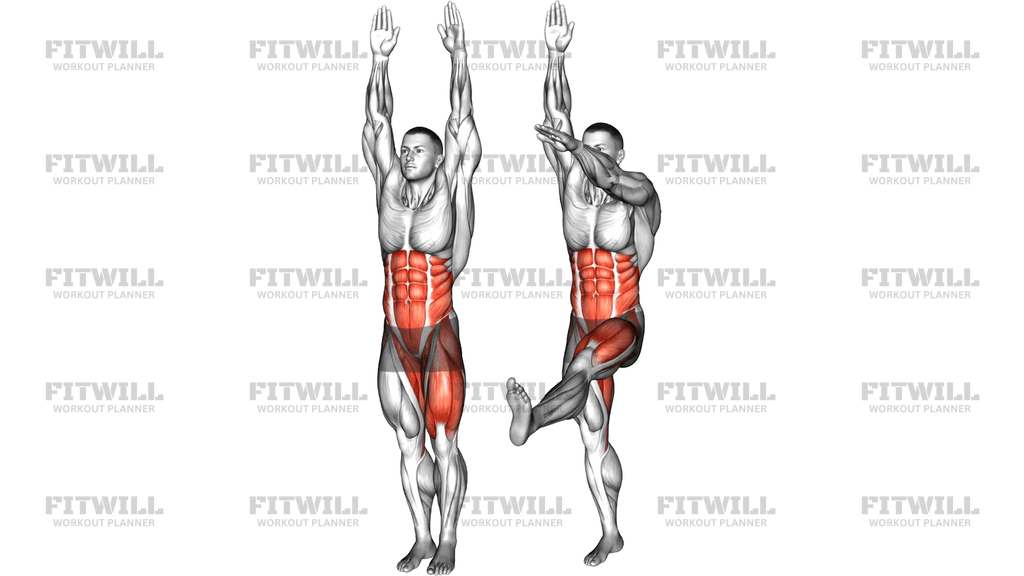
Instructions
- Stand tall with your feet hip-width apart and both arms extended straight overhead, palms facing each other.
- Shift your weight onto one leg so the other foot hovers just off the floor, and spread your toes on the standing foot to grip the ground.
- Brace your core and stack your ribs over your pelvis so your torso is upright before the leg moves.
- Keeping the moving leg nearly straight, lift it out to the side to roughly hip height, letting it rotate slightly open at the hip.
- Without setting the foot down, sweep the same leg across the front of your body toward the opposite side, raising it to hip height in front of you.
- As the leg crosses to the front, bring the arm on the same side as the standing leg forward to shoulder height, while the opposite arm stays overhead or lowers slightly for balance.
- Pause for a beat at the front position with the leg at hip height and the torso tall.
- Reverse the path in a controlled manner, drawing the leg back to the side and then lowering it to the floor beside the standing foot.
- Breathe steadily throughout, inhaling as you set up and exhaling as the leg lifts; avoid holding your breath.
- Complete the desired reps on one side, then reset your stance and repeat on the other leg.
Tips & Tricks
- If you topple toward the standing leg during the side lift, your gluteus medius on the standing leg is switching off. Push the big toe into the floor and think of pressing the standing hip slightly outward rather than letting it jut sideways.
- The most common fault is swinging the leg for momentum. If you have to rock your torso to get the foot to hip height, reduce the height and lift to knee level until you can control the arc.
- Watch that the pelvis stays level during the side lift. Hitching the standing hip up means you are borrowing from the lower back instead of working the outer hip.
- Keep the toes of the moving leg pointing forward on the side lift. Letting the foot rotate open turns the movement into a hip hike rather than a true abduction.
- The arm reach to the front is not decoration; it counterbalances the leg crossing your midline. Skipping it is why many people drift or rotate their shoulders during the sweep.
- If you cannot keep your arms overhead without your shoulders shrugging, lower them to shoulder height for the whole set rather than letting the upper traps take over.
- Do this barefoot or in flat shoes. Thick, soft soles under a single-foot stance make the ankle work harder to find balance and can exaggerate wobbling.
- Practice next to a wall with one fingertip on it only if your form breaks down completely. Rest your hand fully and the balance demand disappears along with the benefit.
- Stop the set the moment you need to hop or step down to recover. Ten clean, wobble-free reps beat twenty sloppy ones for building hip stability.
Frequently Asked Questions
Which muscles does Standing Balance Side To Front Leg Raise work the most?
The primary work comes from the outer hip muscles like the gluteus medius on the side lift and the hip flexors on the front raise, while the standing leg's glutes and ankle stabilizers hold you upright. The obliques and deep core work continuously to stop your torso from rotating as the leg crosses the midline.
Is Standing Balance Side To Front Leg Raise suitable for beginners?
Yes, but most beginners should start with a smaller range, lifting the leg only to knee height, and keep a wall or chair within light fingertip reach. Balance is a skill, and it improves quickly with consistent low-volume practice.
Why does one leg feel much harder than the other in this exercise?
Almost everyone has a dominant balance side, often related to which leg they favor in sport or daily movement. Train both sides with the same number of reps and give the weaker side an extra set rather than avoiding it.
Should the moving leg stay straight during the side-to-front sweep?
Keep it nearly straight with a soft knee rather than locked. A fully straight leg shortens the lever awkwardly and can strain behind the knee, while a heavily bent knee turns it into a knee raise and reduces the hip work.
Why do my arms come forward during the movement?
Reaching the arm forward as the leg crosses to the front counterbalances the weight shift across your midline and trains cross-body coordination. Without it, your shoulders and torso tend to rotate to compensate.
How can I stop wobbling on my standing foot?
Spread your toes, keep your weight centered over the middle of the foot, and fix your eyes on a stationary point at eye level. Also check that you are not rushing; slowing the tempo usually removes half the wobble on its own.
Can I substitute Standing Balance Side To Front Leg Raise if I cannot balance at all?
Perform the same side-to-front leg path lying on your side and back, or hold a sturdy support with one hand while doing the standing version. You lose some core demand but keep the hip training effect.
Is this a good warm-up before squats or lunges?
It works well as a warm-up because it activates the gluteus medius and hip stabilizers that support single-leg positions. Do one or two controlled sets per side before lower-body training rather than working to fatigue.
How many reps should I do per side?
Start with 6 to 10 controlled repetitions per leg, focusing on a smooth side-to-front arc with no stepping down between reps. Once that feels stable, add reps or slow the tempo instead of adding load.
Is it safe for my lower back and knees?
When done with an upright torso and a controlled leg path, the stress stays on the hips and core rather than the spine or knee joints. Keep the range pain-free, avoid swinging the leg, and stop if you feel any pinching at the front of the hip.