Landmine Deadlift
The Landmine Deadlift is a hip-hinge and squat-hybrid pull performed with one end of a barbell anchored in a landmine attachment or wedged into a corner, while you lift the loaded sleeve in front of you. Because the bar travels on a fixed diagonal path rather than straight up and down, the movement sits somewhere between a conventional deadlift and a front squat, with a much more forgiving demand on your lower back and a strong emphasis on the glutes and quads.
The landmine setup changes the physics in your favor. The anchored end acts as a pivot, so the plate you lift follows an arc that naturally shifts some load backward as you stand up. This means less shear stress on the spine, an easier time keeping your chest up, and a bar path that practically coaches you into the right position. Lifters who struggle with conventional deadlifts because of long femurs, tight hips, or a history of back stiffness often find this variation clicks immediately.
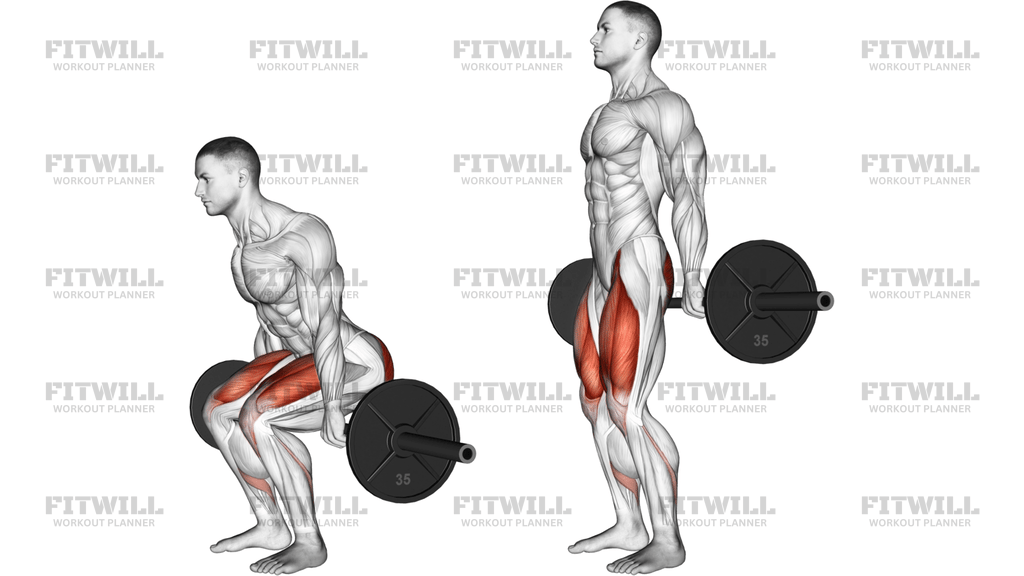
Muscularly, the Landmine Deadlift hits the glutes and quads as the primary drivers, with the hamstrings assisting through the hip extension, the erector spinae working isometrically to hold your trunk rigid, and the upper back and forearms keeping the sleeve under control. The core works hard to resist the offset load, especially as the plate arcs away from your body at the top.
Setup matters more than most people expect. Your stance width, how close you stand to the sleeve, and how deep you drop your hips all determine whether this becomes a smooth, powerful pull or an awkward grind. Stand over or just behind the sleeve with the plate close to your shins, set your hips down into a full squat position, and take a firm overhand or mixed grip on the thick sleeve just inside the collar.
To execute well, brace your trunk before the bar leaves the floor, drive through your whole foot, and let the plate travel back toward you as you rise. Finish tall with your hips and knees locked out, then reverse the path under control, sitting your hips down and letting the plate return to the start. The arc of the bar does much of the steering for you if you stay patient and keep your torso angle consistent.
This lift is a staple for beginners learning the deadlift pattern, for home gyms with limited equipment, and for experienced lifters managing fatigue who still want heavy lower-body work. It also pairs well with landmine presses and rows in a minimal-setup session, since one bar in the corner covers an entire full-body workout.
[ Workout Log & Planner ]
Put your next workout in Fitwill
Keep your plan and training log ready when you are.


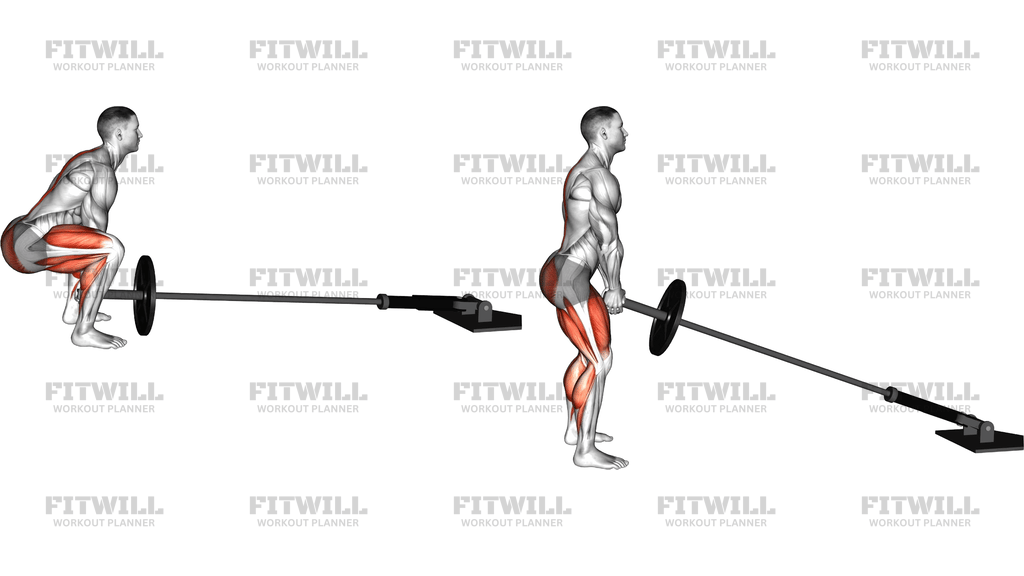
Instructions
- Wedge one end of a barbell into a landmine attachment or a secure corner, and slide a plate onto the free sleeve so it rests on the floor in front of you.
- Stand facing the loaded sleeve with your feet roughly shoulder-width apart, positioned so the plate hangs just in front of your shins and the bar sits over your midfoot.
- Push your hips back and bend your knees until you can grip the sleeve with both hands just inside the collar, using an overhand grip or a mixed grip if the sleeve feels slippery.
- Drop your hips low into a squat position, keep your arms straight, and lift your chest so your spine is long rather than rounded.
- Brace your core as if bracing for a light punch, pull your shoulder blades back, and take a breath in before the bar moves.
- Drive through your heels and midfoot to stand up, keeping the sleeve close to your body and letting the plate travel along its natural arc toward you as your hips extend.
- Finish standing tall with your knees and hips fully extended, glutes squeezed, and the plate resting against or near your thighs.
- Reverse the movement by pushing your hips back first, then bending your knees to lower the plate along the same arc until it touches the floor.
- Exhale at the top of each rep, reset your brace and grip before the next pull, and avoid bouncing the plate off the floor between repetitions.
Tips & Tricks
- Keep the plate close to your shins at the bottom; letting it drift forward turns the pull into a lower-back-dominated strain instead of a leg-driven lift.
- Because the barbell sleeve is thicker than a standard knurling, your grip often fails before your legs do—try a mixed grip or lifting straps if that happens.
- If your hips shoot up before the plate leaves the floor, you started with your hips too high; drop into a deeper squat and reset before pulling.
- The landmine arc means the weight moves toward you as you stand—do not fight it by leaning back at the top; simply finish with tall posture and squeezed glutes.
- Stay barefoot or in flat-soled shoes if possible; the deep squat start rewards a stable, grounded foot position.
- Avoid jerking the sleeve off the floor. Build tension against the plate first, then pull smoothly so your lower back is never shocked at the start.
- Place the anchored end tightly against the wall or in the attachment. Any slack or rotation in the pivot point makes the bar path unpredictable under load.
- Do not hyperextend your lower back at lockout in an effort to feel the glutes more; a tall stand with a glute squeeze is enough.
- Start with one moderate plate rather than loading heavy immediately—the longer lever of the landmine setup makes the same plate weight feel different than a barbell deadlift.
- If you feel the work shifting into your lower back mid-set, shorten the range slightly or reduce the weight until your legs can do the driving again.
Frequently Asked Questions
What muscles does the Landmine Deadlift work?
The glutes and quads do most of the lifting, with the hamstrings assisting hip extension. Your lower back, core, upper back, and forearms work to hold your posture and control the sleeve throughout the pull.
Is the Landmine Deadlift good for beginners?
Yes, it is one of the most beginner-friendly deadlift variations because the anchored pivot guides the bar on a fixed arc and makes it easier to keep the chest up. Many lifters learn the hip-hinge and squat patterns here before moving to a conventional barbell deadlift.
How is the Landmine Deadlift different from a conventional deadlift?
The anchored end of the bar creates a diagonal bar path that shifts load backward as you stand, reducing stress on the lower back and letting you start from a deeper squat. It also allows a more upright torso than a straight-bar pull from the floor.
Why do I start in such a deep squat for this exercise?
The low start matches where the loaded sleeve sits near the floor and lets your legs drive the lift through a long range. From a deep position the glutes and quads, not the lower back, become the main movers as you stand.
Where should I grip the barbell sleeve?
Take hold of the sleeve just inside the collar of the loaded plate, with your arms hanging straight down from your shoulders. Gripping too far out on the bare bar changes the lever length and makes the start position unstable.
My lower back gets sore after Landmine Deadlifts—what am I doing wrong?
The most common causes are letting the plate drift away from your shins, rounding your back at the bottom, or snapping the plate off the floor between reps. Tighten the setup, keep the plate close, and pull each rep from a dead stop with a braced trunk.
Can I do the Landmine Deadlift without a landmine attachment?
Yes. You can wedge the bare end of the barbell securely into a corner, ideally with a towel or pad to protect the wall. Just make sure the end cannot slide or pivot unexpectedly before adding weight.
How heavy should I go on the Landmine Deadlift?
Start with a single moderate plate and master the bar path before adding more. The thick sleeve and the diagonal lever make the load feel different from a regular barbell, so build up gradually rather than matching your conventional deadlift numbers.
What can I substitute if I have no barbell or landmine setup?
A kettlebell or dumbbell goblet deadlift from the floor trains a similar squat-to-stand pattern with an easier position for the torso. A trap bar deadlift is the closest gym alternative if one is available.
Should I reset the plate on the floor between reps?
Yes. Let the plate settle, then re-brace and rebuild tension before each pull. Touch-and-go reps encourage rounding and momentum, which defeats the control this variation is meant to teach.