Bodyweight Seated Single Arm Concentration Curl
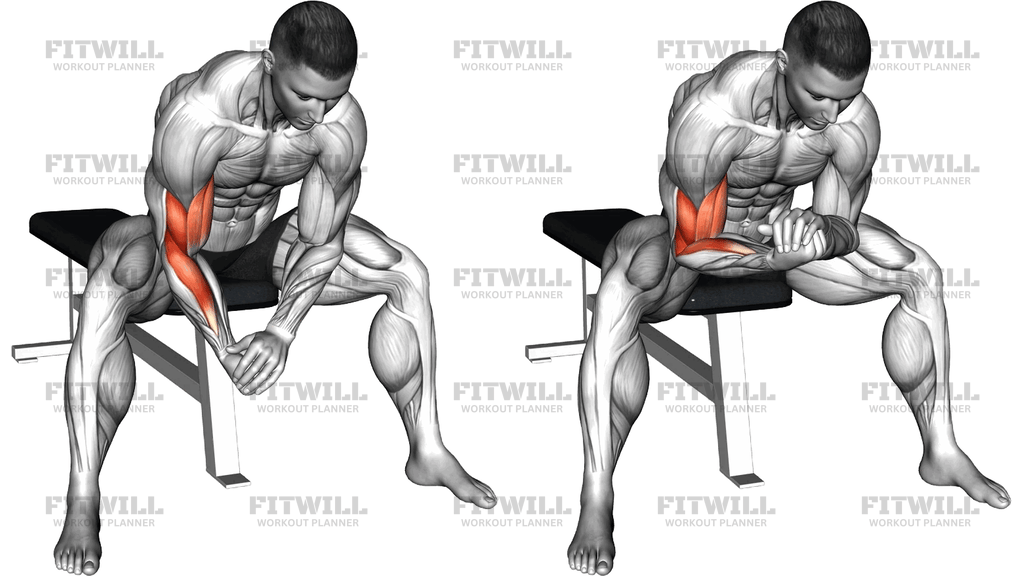
The Bodyweight Seated Single Arm Concentration Curl is a self-resisted biceps exercise performed sitting on a flat bench. Instead of lifting a dumbbell, you curl one arm while the opposite hand grips your working wrist or hand and presses against it, so your own strength supplies the load. The working elbow stays pinned against the inside of your thigh, which locks the upper arm in place and removes nearly all room for swinging or cheating.
This movement is useful when you have no equipment, when you are training in a hotel room or at home, or when you want to finish off the biceps with a high-control contraction after heavier dumbbell work. Because you regulate the resistance with the pressing hand, it also works well for people rehabilitating around the elbow or learning what a true biceps contraction should feel like before adding external weight.
The main muscles trained are the biceps brachii, with solid involvement from the brachialis and the forearm flexors that stabilize the grip and wrist. The braced, seated position also quietly challenges your trunk, since you hold a forward-leaning posture with one side of your body working while the other hand applies opposing force.
Setup matters more here than in most arm exercises. Sit on the edge of the bench with your feet planted wide and flat, then fold your torso forward until the back of your working upper arm can rest firmly against your inner thigh. Your elbow becomes the hinge point, and the thigh becomes the pad that keeps it from drifting. If the elbow is not braced, the resistance hand will win the leverage battle and the curl loses its purpose.
To execute the rep, exhale as you curl your hand up toward your shoulder against the downward pressure of the opposite hand, squeeze hard at the top, then resist slowly on the way down while keeping steady tension through the pressing hand. Match the force of the two arms throughout so the speed stays even and controlled on both the lifting and lowering phases.
Common use cases include bodyweight arm circuits, high-rep finishers, learning proper elbow position for concentration curls, and maintaining arm training during travel. Keep the range pain-free at the elbow, avoid cranking the wrist, and treat the pressing hand as a brake and an accelerator rather than a squeeze that restricts the whole movement.
[ Workout Log & Planner ]
Put your next workout in Fitwill
Keep your plan and training log ready when you are.


Instructions
- Sit on the edge of a flat bench with your feet spread wide and flat on the floor, toes turned slightly outward.
- Lean your torso forward and brace the back of your right upper arm against the inside of your right thigh, letting the arm hang straight down with the elbow fully extended.
- Place your left hand over your right hand or wrist so you can press down against the curling arm.
- Keep your back flat rather than rounded, and keep your head in line with your spine as you look slightly down toward the working arm.
- Exhale and curl your right hand up toward your right shoulder, keeping the elbow glued to your thigh while your left hand presses down to create resistance.
- Pause at the top with the biceps fully contracted and your palm turned toward you, holding the squeeze for a beat.
- Inhale and lower your hand back toward the floor over three to four seconds, resisting the downward pressure so the descent stays slow and even.
- Complete all reps on the right arm, then switch sides so your left elbow is braced against your left thigh and your right hand provides the resistance.
- Between sets, sit upright, shake out the forearms, and reset your foot position before starting the next set.
Tips & Tricks
- Match the pressing force to your strength, not your ego. If the resisting hand pushes harder than the curling arm can lift, the rep stalls halfway and the elbow takes unnecessary strain.
- The most common fault is the elbow sliding off the thigh as the rep gets hard. Once it drifts forward, the shoulder starts helping and the biceps stop doing the work, so recheck the brace every few reps.
- Do not yank the hand up at the start. Because you supply the resistance yourself, an explosive pull just creates slack; begin the curl with deliberate tension already in place.
- Keep the wrist neutral and strong. Letting the working hand flex backward under the pressing hand shifts stress into the wrist and forearm instead of the biceps.
- Control the lowering phase as much as the lift. The eccentric half of this curl is where you can easily apply the most self-resistance, and rushing it wastes that opportunity.
- Use the pad of your fingers or palm across the back of the working hand rather than clamping the fingers, so the working hand can still move through its full arc.
- If your lower back tires before your arms, sit slightly taller and hinge a little less, or place the non-working forearm on the opposite knee for extra support.
- A slow tempo of about one second up, a squeeze at the top, and three seconds down turns this light-looking drill into a genuinely demanding biceps set.
- Do fewer, harder reps with strong pressing resistance for strength, or higher reps with lighter pressure when using this as a burnout finisher.
Frequently Asked Questions
What muscles does the Bodyweight Seated Single Arm Concentration Curl work?
The biceps brachii is the prime mover, with strong support from the brachialis and the forearm flexors. The grip and wrist stabilizers also work throughout because the opposing hand is actively pressing.
How does the resistance work if no dumbbell is used?
Your opposite hand presses down on the working hand or wrist, and the curling arm fights against that pressure. The harder you press, the heavier the curl becomes, so you set the load with your own effort.
Why must the elbow stay braced against the inner thigh in the Bodyweight Seated Single Arm Concentration Curl?
The thigh fixes the elbow so the shoulder cannot swing and momentum cannot assist the lift. Without that brace, the pressing hand can overpower the working arm and the biceps stop receiving consistent tension.
Is the Bodyweight Seated Single Arm Concentration Curl good for beginners?
Yes, it is one of the safest ways to learn the concentration curl position because the resistance is self-adjusted and immediately scalable. Beginners should start with light pressing pressure and focus on a full, smooth arc.
How many reps and sets should I do?
For a bodyweight finisher, aim for 10 to 15 controlled reps per arm for 2 to 3 sets. If you press hard enough to make the last few reps a struggle, fewer reps are enough.
What is the most common mistake in this exercise?
The most common mistake is letting the pressing hand apply inconsistent force, which turns the set into jerky half-reps. A close second is the elbow drifting off the thigh, so keep the upper arm pinned and the torso leaned forward throughout.
Can I substitute this with a regular dumbbell concentration curl?
Yes, a dumbbell concentration curl on a bench is the direct loaded version of the same movement. The bodyweight version is handy when no dumbbell is available or when you want precise, adjustable tension without equipment.
Is it safe for the elbow and wrist?
It is generally joint-friendly because you control the exact resistance and speed, but stop if you feel sharp pain at the elbow or wrist. Keep the wrist firm, avoid twisting the pressing hand, and use a pain-free range of motion.
Should I do both arms in the same set or one arm at a time?
Complete all repetitions on one arm, then switch immediately to the other side so both arms get the same work. Alternating arm by arm shortens rest too much and makes matching the pressing pressure harder.