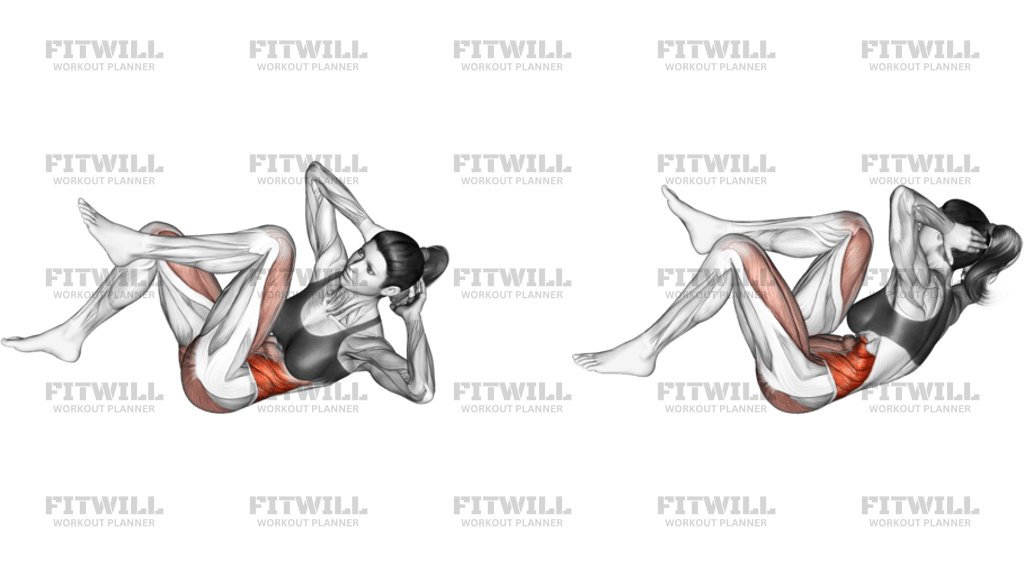
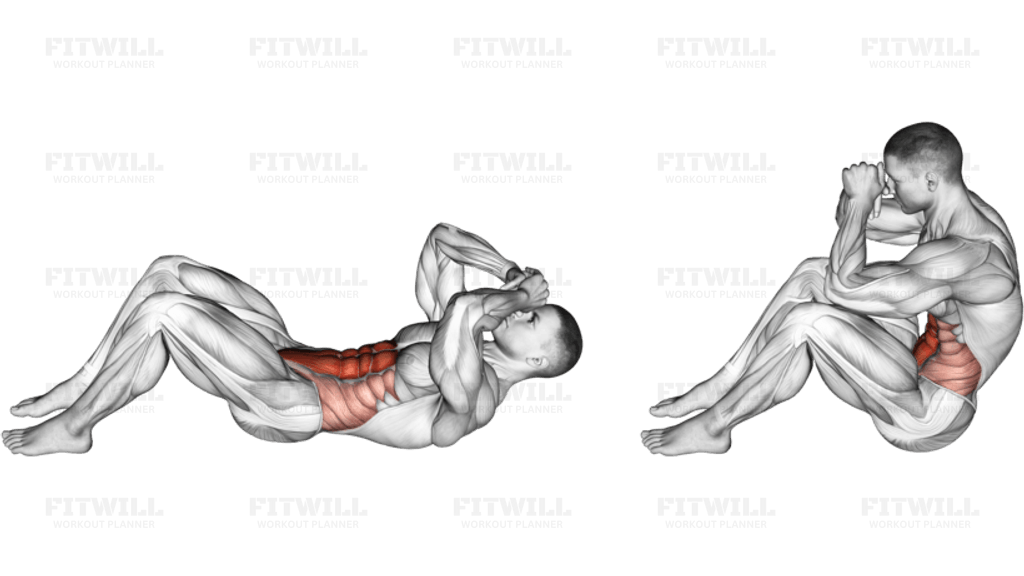
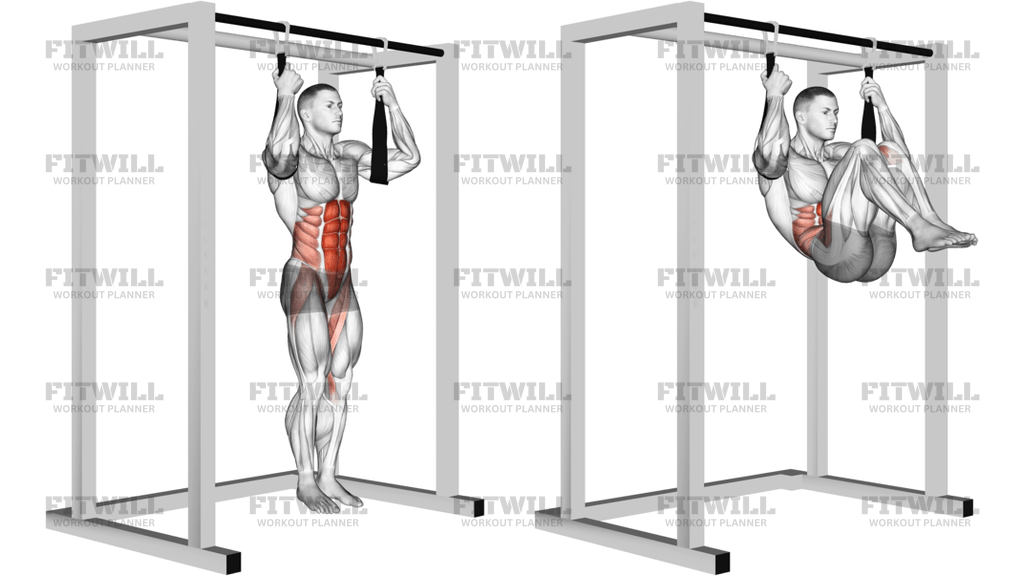
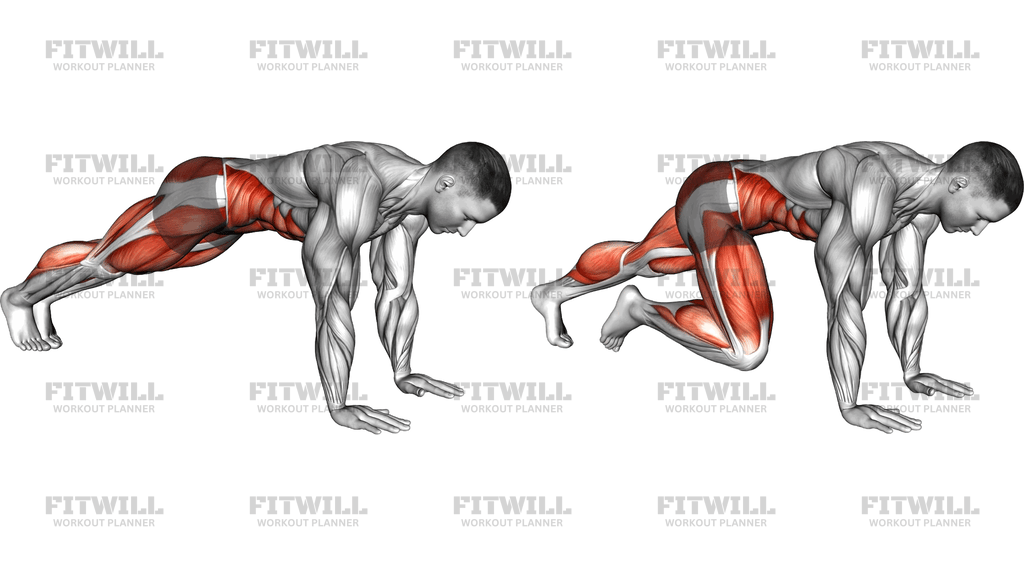
Standing Wide Stance Air Bike
The Standing Wide Stance Air Bike is a body weight conditioning move that takes the classic floor bicycle crunch and puts it on your feet. Instead of lying on your back and pedaling your legs in the air, you stand with your feet spread well outside shoulder width, brace your torso upright, and alternately drive one knee up and across while the opposite elbow folds down to meet it. Your arms and legs trade roles with every rep, mimicking the pedaling and reaching pattern of an air bike, hence the name.
Because you are upright, this version demands more from your core in a functional way. Your abs and obliques have to stabilize your spine while also producing the rotation and knee drive, and your hip flexors work hard to lift each knee. The wide stance lowers your center of gravity and gives you a stable base, so you can focus on crisply rotating through the trunk rather than wobbling around trying not to fall over. It also raises your heart rate quickly, making it a useful low-equipment cardio option.
This movement suits people who want midsection work without getting down on the floor, as well as anyone building a home or hotel-room workout with no equipment. It is a common fixture in circuit training, warm-ups, and fat-loss intervals, and it scales easily: slow it down and squeeze deliberately for core control, or speed it up and extend the set for conditioning.
The setup matters more than it looks like it would. A genuinely wide stance, toes turned slightly out, gives your hips room to drive the knees up without your balance breaking down. If your feet are too close, every knee drive turns into a balancing act and your lower back starts compensating with an arch. Keep your chest tall and the rotation coming from your ribs and waist, not from swinging your shoulders.
A few practical points will keep this safe and effective. Move your elbow to the knee rather than collapsing your whole torso down toward the thigh, and keep some tension in your abs between reps instead of letting everything go slack at the bottom. If you feel it in your neck, shoulders, or lower back rather than your waist, slow down, shorten the range slightly, and reset your posture before continuing.
[ Workout Log & Planner ]
Put your next workout in Fitwill
Keep your plan and training log ready when you are.


Instructions
- Stand tall with your feet spread roughly one and a half times shoulder width apart, toes turned out slightly, and let your arms hang relaxed at your sides.
- Place your hands lightly behind or beside your head without pulling on your neck, or keep fingertips near your ears with elbows wide.
- Brace your abdominal wall as if bracing for a light punch, and keep your chest lifted and gaze forward.
- Shift your weight slightly onto one leg and drive the opposite knee up and across your body toward the midline.
- As the knee rises, rotate your torso and bring the opposite elbow down and in to meet it, crunching the side of your waist rather than rounding your whole back.
- Squeeze briefly at the top where elbow and knee connect, feeling the contraction through the abs and obliques.
- Lower the knee back to the wide stance with control and immediately switch sides, driving the other knee to the opposite elbow.
- Continue alternating in a steady, rhythmic pedal-like pattern, keeping your hips squared and your torso from rocking side to side.
- Exhale as the elbow meets the knee and inhale as you return to the standing position.
- Finish the set by lowering the knee slowly, standing fully upright, and releasing your hands from your head before resting.
Tips & Tricks
- The most common mistake is pulling on the back of your head to force the elbow down; keep your hands light and let the abs do the pulling.
- If your knee drifts outward instead of across your body, the wide stance is doing nothing for you—aim the knee toward the opposite hip each rep.
- Keep the standing leg slightly soft at the knee rather than locked out, especially during longer sets when fatigue makes you stiffen up.
- Speed is not the goal at first; a slower elbow-to-knee touch with a real squeeze beats a fast, sloppy torso swing that trains momentum instead of muscle.
- Watch for the ribs flaring and lower back arching between reps—keep a gentle brace so your waist stays loaded even in the reset position.
- If balance is shaky, widen your stance a little more and slow the tempo before resorting to holding onto a wall, which removes much of the core demand.
- Your shoulders will try to do the rotating; think about twisting from the waist so the obliques, not the arms, drive the elbow across.
- For a conditioning version, extend the set to 30–45 seconds at a brisk pace while keeping the same elbow-to-knee accuracy on every rep.
Frequently Asked Questions
What muscles does the Standing Wide Stance Air Bike work?
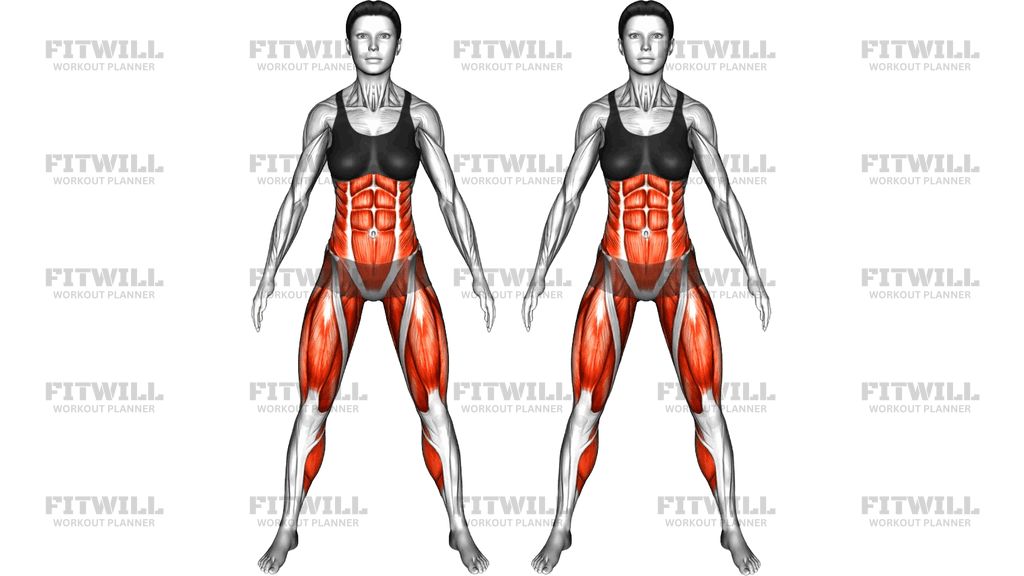
The primary work comes from the abs and obliques, which rotate the torso and stabilize the spine. The hip flexors lift each knee, and the quadriceps and standing-leg muscles assist throughout.
Is the Standing Wide Stance Air Bike good for beginners?
Yes, it is beginner friendly because it uses no equipment and the range can be shortened easily. Start with slow, deliberate elbow-to-knee touches before increasing the pace.
Why use a wide stance instead of a normal standing position?
The wide stance lowers your center of gravity and gives your hips room to drive each knee up and across without losing balance. It lets you rotate harder through the waist while staying stable.
How is this different from a floor bicycle crunch?
You are upright instead of lying down, so your core must stabilize your spine against gravity while also rotating. It also raises your heart rate more, making it better suited to conditioning circuits.
How many reps should I do?
Count each elbow-to-knee touch as one rep, or alternate sides for time, such as 30 seconds per set. Aim for 15–25 controlled reps per set, or longer timed sets for conditioning.
My neck gets tired during the Standing Wide Stance Air Bike—what am I doing wrong?
You are likely pulling your head forward with your hands. Keep your fingertips light against the sides of your head, eyes forward, and let the rotation come from your waist.
Can I use this exercise for fat loss?
It burns calories and raises your heart rate, which helps within a broader routine, but no single exercise targets fat in one area. Pair it with consistent full-body training and a sensible diet.
What can I substitute if standing balance is difficult?
A standard floor bicycle crunch trains the same rotation pattern with more support. Alternatively, stand next to a wall and place one hand on it for light balance assistance while learning the knee drive.
Is it safe for my lower back?
When done with a braced core and rotation from the waist rather than an arched or rounded spine, it is generally well tolerated. If you feel back strain, reduce the knee height and slow the tempo, and stop if discomfort persists.