Standing Knee To Chest Stretch
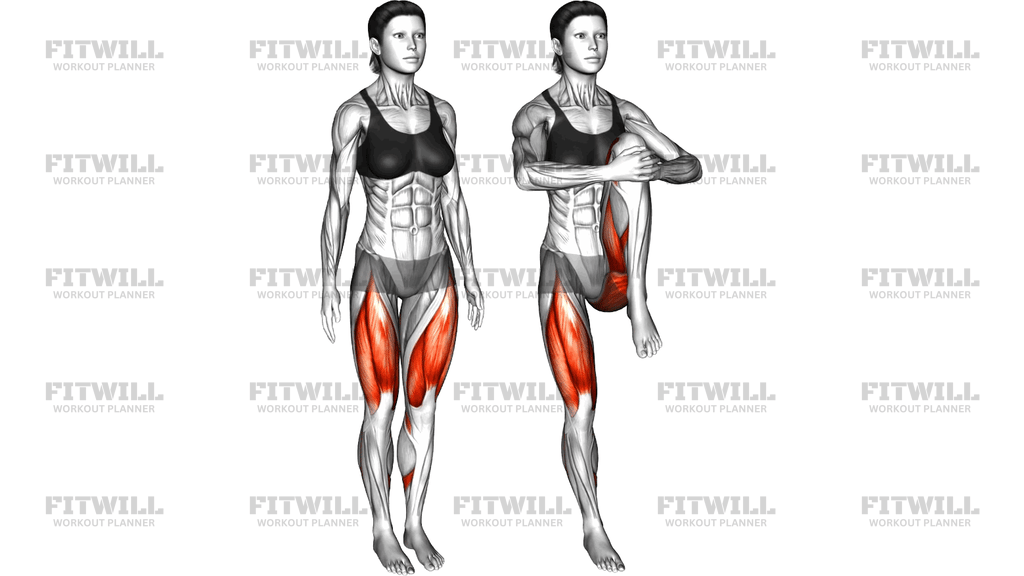
The Standing Knee To Chest Stretch is a simple bodyweight mobility drill where you balance on one leg and draw the opposite knee up toward your chest, clasping your hands around the shin or thigh to pull it in gently. The highlighted areas in the movement are the glutes and thigh of the lifted leg, along with the hip of the standing leg, which has to extend fully while you hold the position. It is one of the quickest ways to open up the back of the hip without getting down on the floor.
This stretch is useful for almost anyone. Runners and cyclists often carry tension in the glutes and outer hips from repetitive forward motion, and desk workers tend to have stiff, shortened hip flexors from long hours of sitting. Pulling one knee toward the chest lengthens the gluteus maximus on the lifted side while the standing hip flexors get a light stretch from being held in extension. The single-leg stance also quietly challenges the ankle and hip stabilizers, which makes it a good warm-up drill before squats, lunges, or running.
Setup matters more than it looks. Stand tall with your feet hip-width apart, weight spread evenly across the standing foot, and ribs stacked over your pelvis before you lift anything. If you start the pull while leaning back or rounding forward, you lose the clean hip flexion the stretch depends on and your lower back takes over the movement. Keep the standing knee soft but not bent into a squat, and keep your gaze fixed on a spot ahead of you for balance.
To execute it well, shift your weight onto one leg, lift the opposite knee, and wrap both hands around just below the kneecap or on the shin. Draw the knee toward your chest using your arms while the thigh stays relaxed, and hold the top position for the desired time without letting your torso slump backward. Lower the foot under control, re-set your stance, and repeat on the other side. A slow, deliberate tempo beats yanking the knee up and bouncing at the top.
You will see this stretch used in warm-ups before lower-body training, in cooldowns after running or cycling, and as a standalone reset during long workdays. It requires no equipment and almost no space, so it travels well. The main safety points are straightforward: move into the range gradually, never force the knee past a comfortable position, and use a wall or sturdy support for balance if you feel wobbly. If pulling the knee in causes pinching in the front of the hip or any knee discomfort, back off the range and hold a position that feels like a stretch rather than a strain.
Fitwill
Log Workouts, Track Progress & Build Strength.
Achieve more with Fitwill: explore over 9600 exercises with images and videos, access built-in and custom workouts, perfect for both gym and home sessions, and see real results.
Start your journey. Download today!




Instructions
- Stand upright with your feet hip-width apart, arms relaxed at your sides, and your weight distributed evenly across both feet.
- Pick a fixed point at eye level in front of you to help with balance, and brace your core lightly to keep your torso tall.
- Shift your weight onto your right leg and let the knee bend slightly, keeping the foot fully planted and pointing straight ahead.
- Lift your left knee and bring both hands up to clasp around the shin just below the kneecap, or hook your hands behind the thigh if that feels more comfortable.
- Draw the knee gently toward your chest while keeping your spine long and your shoulders relaxed; avoid rounding your lower back or leaning away from the lifted leg.
- Hold the top position for 15 to 30 seconds, breathing steadily and letting the glute and hip of the lifted leg lengthen with each exhale.
- Release your grip and lower the left foot back to the floor with control rather than dropping it.
- Re-set your stance, then repeat the same hold on the right leg so both sides get equal time.
- Complete 2 to 3 repetitions per side, or use single short holds as part of a warm-up flow.
- If your balance is shaky, stand next to a wall and rest one hand on it while the opposite arm does the pulling.
Tips & Tricks
- Do not lock the standing knee. A locked knee makes balance harder and shifts tension into the joint instead of keeping the standing hip active in extension.
- Keep your hips level. A common mistake is letting the pelvis on the lifted side drop or tilt, which turns the stretch into a side-bend and reduces the pull on the glute.
- Pull toward the same-side shoulder or slightly across, and experiment a degree or two. A small angle change shifts where you feel it in the glute and outer hip.
- If your lower back rounds as you pull, shorten the range. Hold the knee at a height where your torso stays tall; height is not the goal, position is.
- Point the lifted foot gently and keep the ankle relaxed. Tensing the whole leg works against the stretch you are trying to create.
- Breathe out as you draw the knee in and keep breathing through the hold. Holding your breath raises tension through the hips and defeats the purpose.
- If you cannot clasp your hands behind the thigh, hold under the knee with both hands or use a towel looped behind the thigh to bridge the gap.
- Keep the shoulders down away from your ears. Shrugging while pulling the knee up adds neck and upper-back tension for no extra stretch.
- For a warm-up, use shorter holds of 3 to 5 seconds and repeat several times per side. For a cooldown or flexibility work, settle into longer holds of 20 to 30 seconds.
Frequently Asked Questions
What muscles does the Standing Knee To Chest Stretch target?
It primarily lengthens the gluteus maximus of the lifted leg, with supporting stretch through the outer hip and lower back. The hip flexors of the standing leg also get a mild stretch because that hip is held in extension.
Is the Standing Knee To Chest Stretch good for beginners?
Yes, it is one of the most beginner-friendly hip stretches because it requires no equipment and the range is easy to self-regulate. Newer lifters should simply start beside a wall for balance and use a smaller knee height.
Should I hold my knee to my chest for a long time or do short reps?
For a warm-up, use short holds of 3 to 5 seconds repeated several times per side to prime the hips. For flexibility or cooldown work, hold 20 to 30 seconds and repeat 2 to 3 times per side.
Why do I feel the Standing Knee To Chest Stretch in my standing leg instead of the lifted one?
The standing hip flexors are being held in extension, so mild tension there is normal, especially if you sit a lot during the day. If it dominates, shorten the hold, switch sides sooner, and focus on relaxing the lifted leg so the arms do the work.
My balance wobbles when I pull my knee up. How do I fix that?
Stand next to a wall and rest one hand on it, or lightly touch a chair back with your fingertips. Also fix your eyes on one spot ahead of you and keep the standing knee slightly bent rather than locked.
Can I do the Standing Knee To Chest Stretch every day?
Yes, gentle hip stretching like this is generally fine daily, and many people use it as a morning reset or pre-run ritual. Keep the intensity moderate so you are lengthening the tissue, not straining it.
Should I hold the knee straight up or pull it across my body?
Straight up toward the chest is the standard version and emphasizes the glute and hip. Pulling the knee slightly across toward the opposite shoulder biases the outer hip more, so choose based on where you feel tightest.
Is it safe if I have knee problems?
Clasp behind the thigh instead of on top of the shin so no pressure pushes into the kneecap, and only flex as far as the knee tolerates comfortably. Stop if you feel sharp or pinching pain and consider a supine version instead.
What can I use instead if standing is uncomfortable?
A lying knee-to-chest stretch on the floor gives the same glute and hip benefit with no balance demand, and a seated figure-four stretch is a good alternative for targeting the outer hip.