Standing Balance Diagonal Cross Leg Lift
The Standing Balance Diagonal Cross Leg Lift is a body weight stability exercise that combines a crossed-leg starting position with a controlled diagonal leg lift. You stand on one leg with the free leg crossed in front of your body, then sweep it out and up along a diagonal path behind and to the side while keeping your torso tall and your hands on your hips. The result is a movement that challenges hip strength and whole-body balance at the same time.
The main work comes from the glutes and outer hip of the moving leg, particularly the gluteus medius, which controls the leg as it travels from a crossed, adducted position into abduction. Just as important is the stance leg: its hip, knee, and ankle must constantly make small corrections to keep you upright, which trains the ankle stabilizers and the deep core muscles that tie everything together. Because your hands stay on your hips rather than reaching for support, your obliques and lower abs stay engaged to prevent your trunk from tipping sideways.
The crossed-leg start is what makes this exercise special. Starting with the free leg across the midline of your body stretches the outer hip under load, then asks it to contract through a long diagonal arc. That combination of stretch and contraction is hard to reproduce with standard side leg raises, and it also gives the adductors and inner thigh muscles an active role as they control the leg through the first part of the path.
This movement suits a wide range of people. It is a useful warm-up drill before squats, lunges, or running because it wakes up the hip stabilizers. It is also a practical standalone exercise for anyone who wants better single-leg balance, stronger hips for walking and hiking, or a low-impact core challenge that does not require any equipment or floor work. Older adults and people returning from lower-body lay-offs often benefit from it precisely because it is gentle, slow, and easy to scale.
Setup matters more than speed here. Stand tall with your weight evenly spread across the foot of your standing leg, hands resting lightly on your hips, and cross the free leg in front of your body at a comfortable angle. Keep your hips square and your ribcage stacked over your pelvis; if you lean away from the moving leg or rotate your torso, you steal work from the hip muscles and turn the drill into a wobble. A slow, deliberate lift with a brief pause at the top beats a fast swing every time.
There is no equipment required, but a wall or sturdy chair nearby is a smart safety net when you first learn the pattern. If you touch the support with one fingertip instead of grabbing it, you still get most of the balance benefit while removing the fear of falling. Stop the set when your form drifts, not when your hip burns out, because sloppy reps teach poor movement habits.
[ Workout Log & Planner ]
Put your next workout in Fitwill
Keep your plan and training log ready when you are.


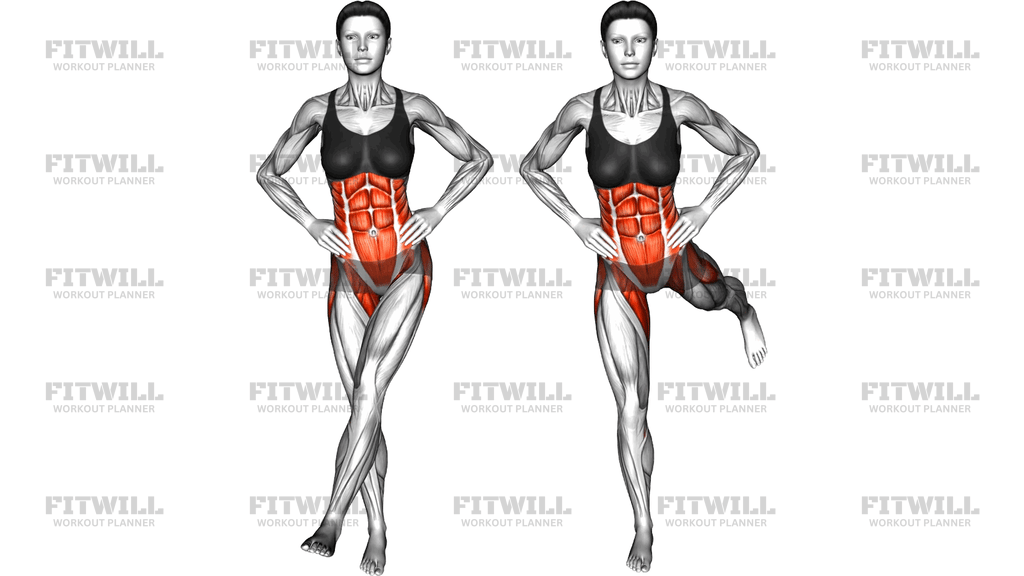
Instructions
- Stand tall with your feet hip-width apart and place your hands lightly on your hips, elbows pointing out to the sides.
- Shift your weight onto your right leg and cross your left leg diagonally in front of your body, toes touching or hovering just off the floor beside your right foot.
- Brace your abs gently, keep your chest lifted, and spread your weight across the whole right foot so your ankle is not rolling inward or outward.
- Sweep the left leg out along a diagonal path, uncrossing it and lifting it back and to the side at roughly a 45-degree angle behind your body.
- Keep both hips facing forward and your torso upright; the lift comes from the hip, not from tilting or rotating your trunk.
- Pause for a second at the highest point you can reach without leaning, feeling the outer hip and glute of the moving leg do the work.
- Slowly lower the leg back along the same diagonal until it crosses in front of the standing leg again, resisting gravity rather than dropping it.
- Exhale as you lift the leg and inhale as you lower it, keeping your breathing steady throughout the set.
- Complete your reps on the left leg, then cross the right leg in front and repeat the same diagonal lift on the other side.
- Reset your stance between sides by standing on both feet briefly, then re-cross and begin the next set with fresh balance.
Tips & Tricks
- The most common mistake is leaning your torso away from the lifting leg to gain height. If your shoulders tilt, the lift is too high; reduce the range and keep your ears, shoulders, and hips stacked.
- Do not let the standing knee lock out or cave inward. A soft knee with the kneecap tracking over your toes keeps the hip muscles in charge of your balance.
- If your toes grip the floor hard or your foot wobbles, imagine pressing through three points: the base of the big toe, the base of the little toe, and the heel.
- Swinging the leg uses momentum and skips the hard part of the range. Count two seconds up and two seconds down so the outer hip stays under tension.
- Keep the lift truly diagonal. Lifting straight out to the side becomes a standard hip abduction; the crossed-to-diagonal path is what stretches and loads the outer hip differently.
- If your lower back arches as the leg goes behind you, shorten the backswing and tighten your abs so the movement stays in the hip rather than the spine.
- Hands on hips should stay light. If you press down hard on your thighs or flare the elbows forward, you usually hide a twisting torso, so check that your elbows stay wide.
- Progress by pausing longer at the top, adding reps, or closing your eyes briefly once you can control the full path without touching a support.
- Practice near a wall the first few sessions. A light fingertip contact is enough to save a stumble without taking the balance work away.
Frequently Asked Questions
What muscles does the Standing Balance Diagonal Cross Leg Lift work?
The moving leg's glutes and outer hip muscles, especially the gluteus medius, do the lifting. The standing leg's ankle stabilizers plus your core and obliques work continuously to keep you upright.
Why does the leg start crossed in front of the body instead of at the side?
Starting crossed places the outer hip in a stretched position and forces it to work through a long diagonal arc. This gives a different and fuller challenge than a plain side leg raise.
Is the Standing Balance Diagonal Cross Leg Lift good for beginners?
Yes, as long as the range is kept modest. Beginners should start with a small lift, keep a wall or chair within fingertip reach, and focus on a steady torso before chasing height.
How high should I lift the leg on the diagonal?
Only as high as you can go without leaning your torso away or rotating your hips forward. For most people that is somewhere between 30 and 45 degrees behind the midline; control matters far more than height.
I wobble a lot on the standing leg. What should I change?
Slow the movement down, spread your weight across the whole foot, and keep a soft bend in the standing knee. Practicing near a wall with light fingertip support also rebuilds confidence quickly.
Can I do this exercise instead of side leg raises or cable hip abduction?
It overlaps with them, but the crossed start and diagonal path load the hip through a range those exercises miss. It works well as a complement or a low-equipment substitute, not necessarily a full replacement for loaded abduction work.
Should I hold onto my hips or let my arms hang?
Hands resting lightly on the hips give you sensory feedback about whether your torso is tipping or twisting. Once your balance is solid, you can extend the arms out for an extra challenge.
Is it safe if I have ankle or hip issues?
The exercise is gentle, but any pre-existing ankle or hip problem deserves caution. Reduce the range, use support, and check with a qualified professional if the movement causes pain rather than normal muscle effort.
How many reps and sets should I do?
Two to three sets of 8 to 12 controlled lifts per leg is a solid starting point. Stop the set when your balance or form drifts, since quality reps build the stabilizers faster than grinding through wobbly ones.