Yoga Squat Dives
Yoga Squat Dives are a flowing body weight movement that takes you from a deep yogi squat (malasana) into a wide-legged forward fold and back again. In the squat position your palms press together at your chest while your elbows wedge against the inner knees, gently pushing them outward. From there you dive the torso down and forward, plant both hands on the floor, and let the head hang heavy between the arms before rising back into the squat. The result is one continuous dive-and-recover rhythm that opens the hips and spine at the same time.
This movement is especially useful for anyone whose hips, groin, or lower back feel locked up from long hours of sitting. It stretches the inner thighs and hip openers in the squat, then lengthens the hamstrings and the entire back line of the body in the fold. Because you repeat the transition between the two shapes, you are also training mobility through a range of motion rather than just holding a static stretch, which tends to carry over better into squats, deadlifts, and everyday bending.
The setup matters more than it looks. A deep squat with the heels down and the toes turned out gives the hip joints room to fold, and the elbow-to-inner-knee contact is what keeps the chest lifted and the spine long. If the heels lift or the knees cave inward, the fold becomes a rounded-back strain instead of a controlled hip hinge. Taking the feet slightly wider than shoulder width, or elevating the heels on a rolled mat if your ankles are tight, keeps the whole pattern honest.
To execute well, sink first and settle second: let your sitting bones drop toward the floor, brace the belly lightly, and only then begin the dive. Lead the fold by tipping the pelvis forward rather than rounding the mid-back, walk the hands out only as far as the hips can stay involved, and let gravity take the head last. On the way up, press the floor away, tuck the tailbone under, and ride the movement back into the squat with control instead of plopping down.
Common use cases include warm-ups before lower body training, cool-downs after leg days, yoga flows, and short desk-break mobility routines. Because it requires no equipment and very little space, it is easy to do at home or in a gym corner. Move slowly, breathe steadily, and treat the depth of the fold as something you earn over weeks, not something you force in the first session.
[ Workout Log & Planner ]
Put your next workout in Fitwill
Keep your plan and training log ready when you are.


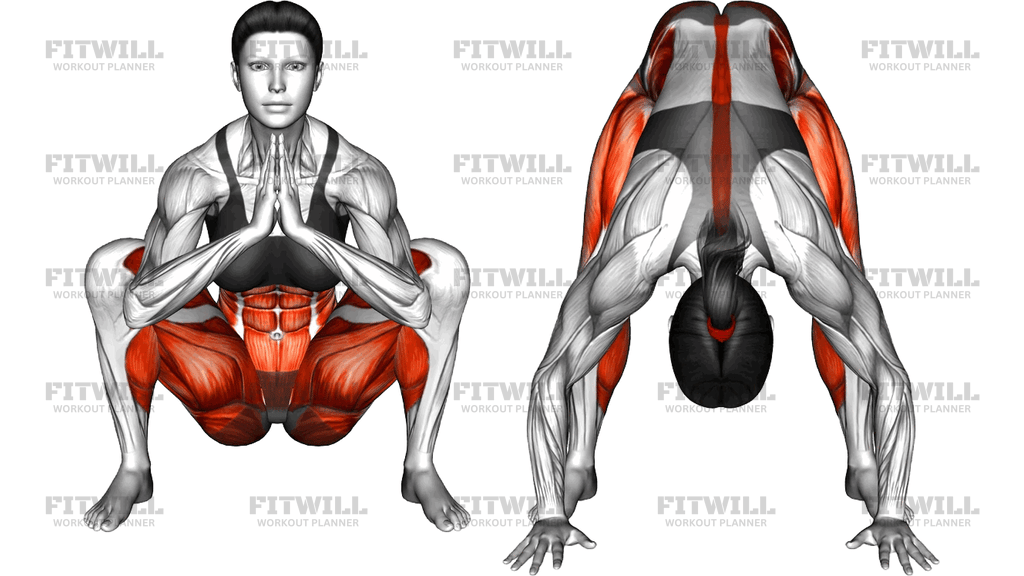
Instructions
- Stand with your feet about one and a half shoulder-widths apart and turn your toes out roughly 30 to 45 degrees.
- Bend the knees and sink straight down into a deep squat, keeping your heels flat on the floor and your sitting bones dropping low.
- Press your palms together at your chest and use your elbows to gently push the inner knees outward so the chest stays tall.
- Brace your abdominal muscles lightly and take a full breath in while holding the squat position.
- Exhale and dive forward: hinge at the hips, place both palms flat on the floor in front of you, and let your head hang down between your arms into a wide-legged forward fold.
- Hold the folded position for two or three relaxed breaths, letting the crown of the head reach toward the floor and the spine lengthen.
- Press the hands into the floor and lift the chest back up, returning to the deep squat with the prayer hands and elbows against the inner knees.
- Inhale as you rise into the squat, exhale as you dive into the fold, keeping the breath paired with the movement.
- Reset your foot position and knee tracking each rep, then repeat the dive for the desired number of slow, controlled repetitions.
- Finish the set by standing up through the squat rather than jumping or snapping out of the folded position.
Tips & Tricks
- If your heels lift off the floor in the squat, roll a small towel or mat edge under them; this is the most common reason the dive turns into a back strain.
- Avoid rounding through the mid-back during the fold — think about tipping the pelvis forward so the stretch comes from the hamstrings and hips instead.
- Do not let the knees collapse inward when you dive down; keep the elbows actively pressing them out the whole time.
- Keep the neck relaxed and the head heavy in the fold. Lifting or craning the head defeats the purpose of the dive position.
- Move slower than feels necessary. Rushing the transition between the squat and the fold is the most common way people lose depth and control.
- If tight ankles keep you from squatting low, widen your stance slightly and turn the toes out a touch more rather than forcing depth.
- Place your hands shoulder-width apart with fingers spread when you dive; narrow or stiff hands make the return to the squat unstable.
- Stop at the first sharp pulling sensation in the groin. A wide stance fold should feel like a stretch, never a pinch at the inner thigh.
- Warm the hips first with a few gentle body weight squats if you are doing this first thing in the morning or before training.
Frequently Asked Questions
What muscles and areas does Yoga Squat Dives work?
The movement primarily stretches and mobilizes the glutes, inner thighs, and hip rotators in the squat, then the hamstrings and lower back in the fold. The quads and core stay active to control the transitions.
Can beginners do Yoga Squat Dives, or do you need to be very flexible?
Beginners can absolutely do it — the depth simply starts lower. Elevating the heels on a rolled mat and allowing a smaller fold lets almost anyone perform the pattern safely while flexibility improves.
Why do my heels lift off the floor when I sink into the squat?
This usually points to limited ankle mobility rather than a hip problem. Place a rolled towel or the edge of a mat under the heels, or widen your stance and turn the toes out slightly more.
Should the back be straight or rounded during the dive portion?
Keep the spine long by hinging from the hips; the lower back can gently round at the very bottom of the fold, but the movement should be led by the pelvis, not by collapsing the chest.
How long should I hold the folded position in Yoga Squat Dives?
Two or three slow breaths per dive works well for mobility work. Longer holds of 20 to 30 seconds are fine as a cool-down stretch, but keep the transitions controlled either way.
What is the most common mistake in this exercise?
Letting the knees cave inward as the torso dives down. This shifts stress into the knee joints and closes off the hips — keep the elbows pressing the inner knees outward throughout the squat portion.
What can I substitute if a deep squat is uncomfortable for my knees?
Sit back onto a low bench or stacked mat in the squat portion and perform the forward fold from there, or use a wide-legged standing forward fold with a soft knee bend instead.
Is Yoga Squat Dives better used as a warm-up or a stretch?
It works well for both. As a warm-up, keep the reps flowing and the holds short; as a cool-down, slow everything down and hold each fold longer to release the hips and hamstrings.
Should I feel a stretch in the groin during this movement?
A mild inner-thigh stretch is expected and useful, but any sharp or pinching sensation is a signal to narrow your stance, reduce the depth, or come out of the position entirely.