Single Split Stretch (Beginner)
The Single Split Stretch (Beginner) is a seated floor stretch performed from a wide straddle position, where you fold your torso toward one extended leg at a time. Instead of dropping straight down the middle like a full middle split stretch, you rotate your chest toward a single leg and hinge over it, which lets you isolate one inner thigh and hamstring line at a time. That makes it a more forgiving entry point for anyone working toward front splits, middle splits, or simply more comfortable hip mobility.
This stretch primarily targets the adductors along the inner thigh and the hamstrings of the leg you fold toward, with additional lengthening through the glutes and the muscles of the lower back as the torso travels forward. Because one side works at a time, you can easily compare left to right and spend extra time on your tighter side, which is one of the main reasons coaches use this variation with beginners.
Setup matters more than depth here. Sitting tall on your sitting bones with both kneecaps pointing toward the ceiling keeps the stretch in the hip and thigh muscles instead of twisting the knee joint. If your pelvis tucks under and your spine rounds from the very first inch of the hinge, simply elevating your hips on a folded towel or low cushion restores the forward tilt you need to actually reach the target muscles.
To perform it, sit with your legs spread into a comfortable V, rotate your torso to line your chest up with one leg, and walk your hands forward along that thigh toward your foot. Let your head follow your spine rather than leading with the chin, breathe steadily, and hold the position where you feel a firm but tolerable pull. Slowly stack your spine back up, reset your posture, and repeat on the other leg.
You will see this stretch used in warm-downs after lower body training, in dance and martial arts flexibility work, in yoga-style straddle sequences, and in split progressions. It suits anyone who sits a lot and feels tight through the inner thighs and hips, as well as lifters whose squats and deadlifts feel restricted by short adductors.
Keep the effort honest but gentle. A beginner stretch should feel like a sustained pull, never sharp pain, and especially never a grabbing sensation at the inner knee or groin. If that happens, shorten the range, soften the knee slightly, and rebuild the position from a taller spine.
[ Workout Log & Planner ]
Put your next workout in Fitwill
Keep your plan and training log ready when you are.


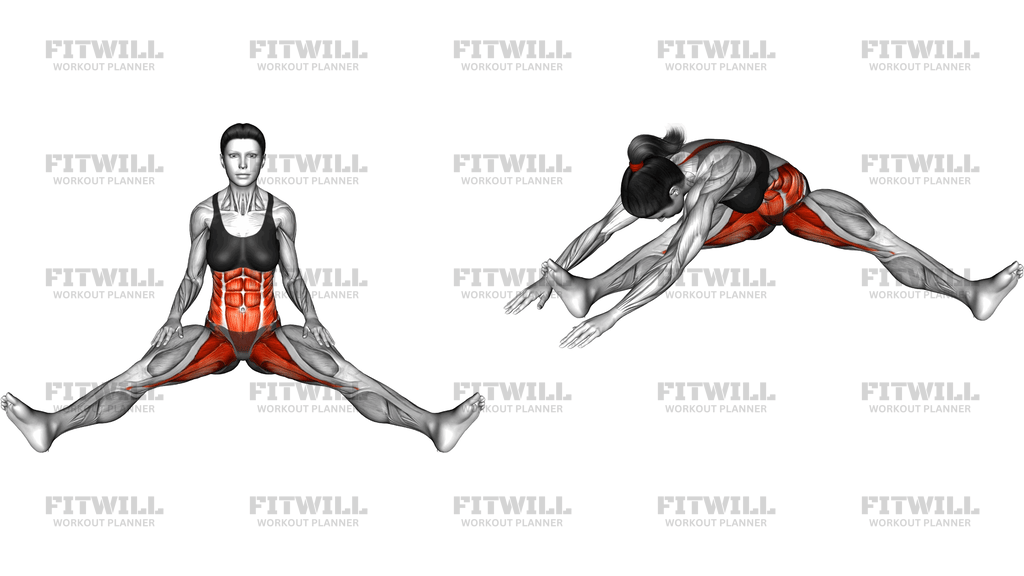
Instructions
- Sit on an exercise mat with your legs spread into a wide V, wide enough to feel a light pull in the inner thighs but not so wide that your pelvis tips backward.
- Point your kneecaps and toes toward the ceiling, press through your heels, and sit up tall on your sitting bones with a long, neutral spine.
- Rotate your torso so your chest faces one extended leg, and place both hands on the mat or rest them on that thigh to start.
- Brace your core lightly and inhale to lengthen your spine before you begin the fold.
- Exhale and hinge forward from the hips, walking your hands along the inside of the target leg toward your foot while keeping your chest rotated toward that leg.
- Continue until you feel a firm stretch through the inner thigh and back of the leg you are folding over, and let your head stay in line with your spine.
- Hold the end position for 20 to 30 seconds, breathing slowly and letting the range deepen slightly on each exhale.
- To come out, press your hands into the mat and slowly stack your spine back up to seated, keeping the fold controlled rather than snapping upright.
- Recheck your seated posture, then rotate toward the opposite leg and repeat the fold for the same hold time.
- Finish both sides, bring your knees together, and gently shake out your legs before standing.
Tips & Tricks
- If your lower back rounds immediately and you cannot feel the inner thighs working, sit on a folded towel or low cushion so your pelvis can tilt forward over the legs.
- A common mistake is leading the fold with the head and reaching for the toes with rounded shoulders. Instead, imagine your chest traveling toward your knee or shin and let your hands follow.
- Watch that the knee of your stretching leg does not roll inward as you fold. Keep the kneecap facing the ceiling so the pull stays in the adductors and hamstring, not the knee joint.
- Do not force your legs wider than the position where your sitting bones stay planted. A narrower straddle with a tall spine stretches more effectively than a wide one with a collapsed back.
- Keep both heels pressing away from you. Letting the back foot go limp shortens the hamstring line on the leg you are not folding toward and reduces the overall benefit.
- If the fold toward one side is much tighter, angle your torso slightly less and build up gradually rather than muscling into the deeper range.
- Avoid bouncing at the end range. In this straddle setup, steady holds with slow exhales release the inner thigh far better than pulsing toward the foot.
- Warm up first with a few minutes of walking or light leg swings. Stretching cold adductors from a deep straddle is uncomfortable and less productive.
Frequently Asked Questions
Which muscles does the Single Split Stretch (Beginner) target?
It primarily lengthens the adductors of the inner thigh and the hamstrings of the leg you fold toward, with supporting stretch through the glutes and lower back.
How is the Single Split Stretch (Beginner) different from a middle split stretch?
Instead of folding straight down the center of your straddle, you rotate your chest toward one leg and hinge over it, so each side of your inner thigh and hamstring works separately and you can address imbalances.
Can beginners do this stretch safely?
Yes, it is designed as a beginner variation. Choose a straddle width where you can sit tall, fold only to the point of a firm pull, and hold for 20 to 30 seconds per side.
Why do I feel this more in my lower back than my inner thighs?
That usually means your pelvis is tipping backward and your spine is rounding. Elevate your hips on a folded towel and focus on tilting your pelvis forward as you hinge from the hips.
Should I hold both knees straight during the Single Split Stretch (Beginner)?
Keep the knees as straight as is comfortable with the kneecaps facing up. If you feel a grabbing sensation behind the knee or in the groin, soften that knee slightly rather than pushing through it.
How often should I practice this stretch?
Two to four sessions per week works well for most people, either after lower body training or on its own, with consistent 20 to 30 second holds on each side.
What can I use if I cannot reach my foot in the fold?
Rest your hands on your shin, calf, or the mat wherever your range ends, or loop a towel around the foot of the stretching leg and hold the ends as you hinge.
Is the Single Split Stretch (Beginner) useful for front splits?
Yes, because it lengthens the hamstring of one leg and the adductors in isolation, which are two of the main flexibility requirements for front and middle split progressions.
Should I stretch before or after my workout?
Use it after training or after a light warm-up when the muscles are warm. Save long static holds like this for the end of your session rather than right before heavy lifting.