Standing Leg Half Circle Against Wall
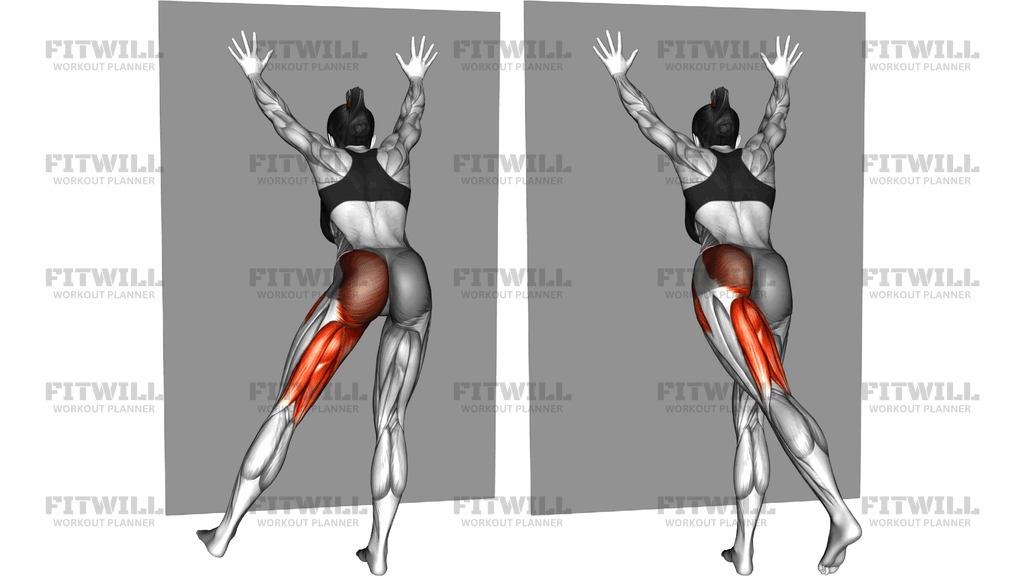
The Standing Leg Half Circle Against Wall is a single-leg hip mobility and control drill performed with your hands braced against a wall for balance. Standing tall on one leg, you sweep the free leg in a smooth half-circle arc, moving it from out to the side, around through the front of your body, and back again without letting the foot touch the floor. Because your hands stay on the wall, you get just enough stability to focus entirely on how the hip moves rather than on fighting to stay upright.
This movement is especially useful for anyone building single-leg stability. The standing leg works hard the whole time: the gluteus medius and other hip stabilizers on that side must hold your pelvis level while the free leg swings. At the same time, the moving leg trains the hip through a wide arc, engaging the adductors as the leg crosses the midline, the hip flexors as it travels forward, and the glutes as it returns out to the side and behind you.
The wall setup is what makes this drill accessible. Balancing fully unsupported while sweeping a straight leg is surprisingly demanding, and most people compensate by tipping the torso or rotating the pelvis, which hides the true control of the hip. With your palms on the wall and a slight forward lean, you can keep the shoulders and hips square and let the leg do the work. Keep wall contact light — think of the wall as a balance reference, not something to lean your weight into.
To perform it well, shift your weight onto one foot and float the other foot just off the floor. Sweep the free leg in a controlled half circle, leading with the inner thigh as it comes across the front of the standing leg, then letting it travel back out to the side. The leg stays relatively straight but not locked, the toes stay relaxed, and the torso stays facing the wall. Speed is the enemy here — a slow, deliberate arc with a level pelvis does far more than a fast swing.
This drill fits well into warm-ups before lower body strength training, running, or single-leg work like lunges and step-ups. It is also a common choice in rehabilitation and prehab settings for hip stability, and for older adults who want balance practice with a safe handhold. Complete all repetitions on one side before switching, and expect the first few sessions to feel uneven from side to side — that difference is useful information about where your hip control needs attention.
Fitwill
Log Workouts, Track Progress & Build Strength.
Achieve more with Fitwill: explore over 9600 exercises with images and videos, access built-in and custom workouts, perfect for both gym and home sessions, and see real results.
Start your journey. Download today!




Instructions
- Stand facing a wall at arm's length and place both palms flat against it at about shoulder height, allowing a slight forward lean from the ankles.
- Shift your weight onto one leg with a soft knee, and float the other foot an inch or two off the floor beside it.
- Brace your abdominals lightly and keep your shoulders and hips squared toward the wall so your torso does not twist.
- Sweep the free leg in a smooth half-circle: start with it out to the side, draw it forward across the front of your body toward or past the standing leg, then continue the arc back out to the starting side.
- Keep the moving leg fairly straight but not locked, and keep the toes facing forward rather than gripping the floor.
- At the far end of the arc, pause briefly with the pelvis still level — avoid letting the hip on the moving-leg side drop or rotate open.
- Reverse the arc at the same slow speed to return the leg to the starting position beside the standing foot.
- Exhale steadily as the leg sweeps through the arc and inhale as it returns; avoid holding your breath.
- Keep wall contact light through your fingertips — press only as hard as you need to stay steady.
- Finish all repetitions on one side, set the foot down, reset your stance, then repeat on the other leg.
Tips & Tricks
- If your torso rotates to help the leg cross the front of your body, reduce the range so the arc stops just short of the standing leg; the pelvis should stay square to the wall the whole time.
- Watch for the standing hip pushing sideways toward the wall — this means the gluteus medius on the stance side is losing its hold. Pull that hip slightly back under your ribs and lighten your grip on the wall.
- Letting the moving foot tap down between arcs is a common crutch. If it happens, make the arc smaller and slower rather than muscling through a bigger sweep.
- Keep the wall pressure in your fingertips and palms, not your forearms or chest. If you are leaning heavily into the wall, step your feet a few inches closer so a light touch is enough.
- Point the toes of the moving leg forward and keep the foot relaxed; curling or turning the toes usually means the hip is rotating instead of the leg arcing cleanly.
- Hold onto a smooth, non-slippery wall surface and stand on a flat, clear floor. Avoid doing this drill in socks on tile or polished wood.
- Move the leg at roughly a two-to-three-second pace per half of the arc. Momentum makes the swing feel easier but removes most of the hip-control benefit.
- If one side is noticeably wobblier, start each session with the weaker leg and do one extra set on that side only.
- A very mild stretch through the inner thigh or outer hip at the edges of the arc is normal; sharp pinching at the front of the hip means shorten the range and keep the pelvis from tilting forward.
Frequently Asked Questions
What muscles does the Standing Leg Half Circle Against Wall work?
The standing leg's hip stabilizers, especially the gluteus medius and gluteus maximus, work isometrically to keep your pelvis level. The moving leg's adductors, hip flexors, and outer hip muscles control the leg through the arc, and your core stays engaged to keep the torso square.
Is this exercise suitable for beginners?
Yes. The wall provides a safe handhold, which makes it one of the more approachable single-leg balance drills. Beginners should use a smaller arc and keep a firm (but not heavy) hand contact until control improves.
How close to the wall should I stand?
Stand at arm's length with your palms flat on the wall at roughly shoulder height, allowing a slight forward lean from the ankles. If you find yourself pressing hard into the wall, step a few inches closer so a light touch is enough.
Why do I wobble more when the leg crosses the front of my body?
Crossing the midline is the hardest point of the arc because your base of support is narrowest and the adductors are working at their longest range. Narrow the arc so you stop just short of the standing leg, then gradually increase the range as your control improves.
Should the moving leg stay straight?
Keep it mostly straight but never locked at the knee. A soft, unlocked knee lets you control the arc smoothly, while a fully straight, rigid leg tends to encourage swinging with momentum.
How is this different from a standing leg swing?
A standard leg swing moves the leg forward and back in a straight line, while the Standing Leg Half Circle Against Wall sweeps the hip through an arc that crosses the midline. That curved path places greater demand on the adductors and outer hip muscles and on keeping the pelvis from rotating.
What can I use if I don't have a clear wall space?
A sturdy countertop, the back of a solid chair, or a railing works the same way as long as it is stable and at about waist-to-chest height. Avoid using anything that can tip or slide.
How many repetitions and sets should I do?
Start with 6 to 10 slow arcs per side for one to two sets, either as a warm-up before lower body training or as standalone hip stability work. Progress by slowing the tempo or enlarging the arc rather than adding many more repetitions.
Is it safe to do this exercise if I have hip pain?
Mild muscle effort is normal, but sharp or pinching pain is a signal to stop. Reduce the range of the arc, keep the pelvis square, and check with a qualified health professional before continuing if pain persists.
Should I do this exercise before or after my workout?
It works best as a warm-up drill before squats, lunges, running, or any single-leg training, because it wakes up the hip stabilizers without fatiguing them heavily. Doing it after training is fine too, but your balance will usually be better when your muscles are fresh.