Ez Barbell Stiff Legged Deadlift
The Ez Barbell Stiff Legged Deadlift is a hip-hinge movement that loads the hamstrings, glutes, and lower back using an EZ bar held in front of the body. Unlike a conventional deadlift, the knees stay mostly straight throughout the set, which shifts the emphasis away from the quads and onto the back of the thighs and hips. The angled grip of the EZ bar also sits more comfortably in the hands for many lifters than a straight bar, which matters when you are holding a moderate weight for higher repetitions.
This lift is useful for almost anyone who wants stronger, more resilient hamstrings and glutes. Sprinters, field sport athletes, and recreational lifters all benefit from training the hinge pattern, since stiff legged deadlifts build the strength needed to absorb force and extend the hip powerfully. They are also a common choice for lifters who find a barbell from the floor aggravates their lower back, because the movement starts and ends at the top rather than requiring a pull from the ground.
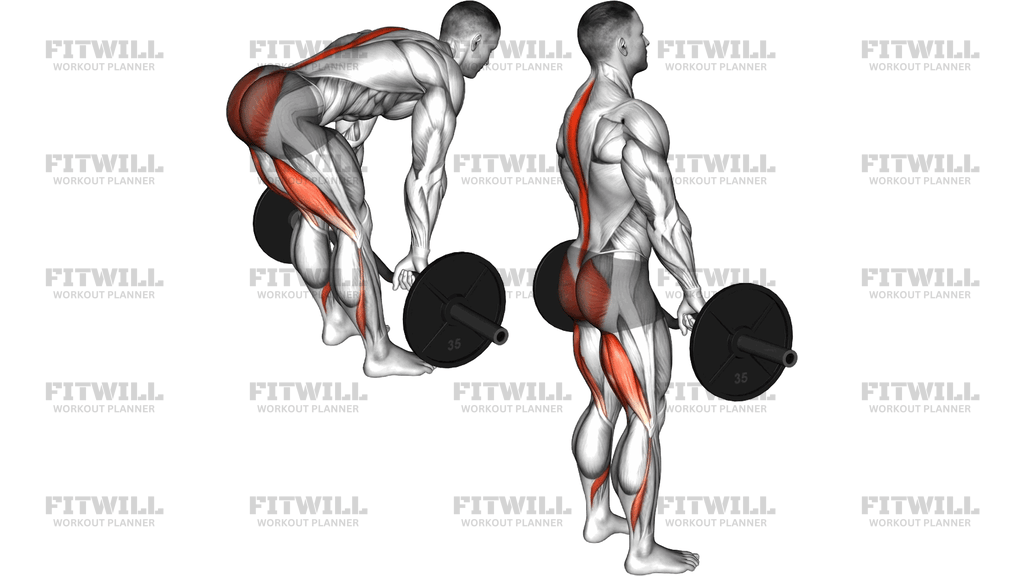
Setup matters more here than in most hinge variations. With the knees nearly straight, any rounding of the lower back puts the load directly on the spine instead of the hips, so the bar must stay close to the legs and the chest must stay proud. The torso travel in this exercise is long: the bar descends from a standing position down toward the floor, gliding along the shins, before the hips drive forward again to stand tall.
Execution is a matter of balance between two positions. At the top you stand upright with the bar hanging at arm's length against your thighs; at the bottom your torso is bent forward, your hips are pushed back, and the bar sits just below the knees or near the shins. The stretch you feel in the hamstrings at the bottom is the point of the exercise, and driving the hips forward at the top completes the rep.
Because the hamstrings work in a lengthened position under load, the key safety consideration is keeping the spine neutral from the first rep to the last. Start with a lighter weight than you would use for a regular deadlift, own the bottom position, and let flexibility determine your depth rather than chasing the plates down to the floor. Progress in small jumps and treat this as a quality movement rather than an ego lift.
[ Workout Log & Planner ]
Put your next workout in Fitwill
Keep your plan and training log ready when you are.


Instructions
- Load an EZ bar with plates on both sides and set it on the floor in front of you, with the angled grip sections facing inward where your hands will land.
- Approach the bar so it sits directly over the middle of your feet, about hip-width apart, with your toes pointing straight ahead.
- Hinge forward with a flat back and grip the bar at shoulder width using the inner angled handles, then stand up to lift the bar and take a tall stance with the bar hanging at arm's length against your thighs.
- Brace your core as if bracing for a light punch, pull your shoulders back, and keep your chest up with your knees softly bent but fixed in place.
- Push your hips straight back and lower the bar by bending at the hips, letting the bar slide down the front of your thighs toward your shins while your knees stay nearly straight.
- Stop when you feel a deep stretch in your hamstrings, usually with the bar just below the knees or at the shins, and only lower further if you can keep your back flat.
- Drive your hips forward and squeeze your glutes to pull your torso back upright until you are standing tall with the bar back at your thighs.
- Exhale as you stand up, take a fresh breath at the top, and re-brace before each rep.
- Finish the set by lowering the bar under control back to the floor rather than dropping it, then reset your grip and stance for the next set.
Tips & Tricks
- If you feel the work in your lower back instead of your hamstrings, you are most likely rounding your spine or letting the bar drift away from your legs; film yourself from the side and check that your back stays flat and the bar grazes your shins.
- Do not bounce the plates off the floor. This version starts from a standing position, so touch-and-go contact at the bottom robs the hamstrings of the stretched position that makes the exercise effective.
- If your hamstrings are tight, set the plates on a low box or stop the descent at just below knee height instead of forcing the bar to the floor with a rounded back.
- Grip tends to fail before the hamstrings on higher-rep sets. Use a slightly slower tempo and lighter load rather than switching to straps too early, since the grip work is part of the benefit.
- Keep a small bend in the knees and lock it in before you start descending. Fully straight, locked-out knees can strain the back of the knee joint, while deeply bent knees turn the lift into a regular deadlift.
- The EZ bar's angled grips are most comfortable with a double-overhand hold; avoid a mixed grip on this lift unless the weight is heavy enough to require it.
- Push the hips back rather than bending the chest down first. If your torso drops without your hips moving backward, the bar will travel forward and the lower back will take over.
- Squeeze the glutes hard at the top and stand fully tall, but do not lean back and hyperextend; the rep ends when your hips are over your heels, not when you arch.
Frequently Asked Questions
Which muscles does the Ez Barbell Stiff Legged Deadlift work?
The hamstrings are the primary movers, with the glutes working hard on the hip extension and the erector spinae of the lower back stabilizing the spine. Your grip and upper back also work isometrically to hold the bar close to the legs.
How is the Ez Barbell Stiff Legged Deadlift different from a conventional deadlift?
A conventional deadlift uses significant knee bend and pulls the bar from the floor with a more upright torso. The stiff legged version keeps the knees nearly straight and starts from a standing position, which places far more stretch and load on the hamstrings and less on the quads.
Why use an EZ bar instead of a straight barbell for this exercise?
The angled grips of an EZ bar place the wrists in a more neutral position, which many lifters find more comfortable during long descents and higher-rep sets. The bar is also typically lighter and shorter, making it easier to control on a demanding hinge.
Should the bar touch the floor during the Ez Barbell Stiff Legged Deadlift?
Not necessarily. Descend until you feel a strong hamstring stretch while keeping your back flat, which for most people is just below the knees or at the shins; if your flexibility runs out before the plates reach the floor, stop there.
Can beginners do the Ez Barbell Stiff Legged Deadlift?
Yes, and the EZ bar is actually a good teaching tool because the light bar allows slow, controlled reps. Beginners should start with very light weight and prioritize a flat back and the hip-hinge pattern over depth and load.
Why do I feel the Ez Barbell Stiff Legged Deadlift in my lower back instead of my hamstrings?
This usually means your spine is rounding as you descend or the bar is drifting forward away from your legs. Keep your chest up, push the hips back rather than reaching the bar down, and shorten the range of motion until the hamstrings take over.
What can I substitute if I don't have an EZ bar?
A straight barbell, dumbbells, or a kettlebell all work for stiff legged deadlifts with the same hip-hinge pattern. Dumbbells are a good alternative because each arm can hang naturally beside the leg, which can feel easier on the lower back.
How heavy should I go on this exercise?
Use noticeably less weight than you would for a conventional deadlift, since the hamstrings are working in a stretched position and the lower back has less help from the legs. A load you can control for 8 to 12 clean reps with a flat back is a good starting point.
Is it safe for the lower back if I keep my knees straight?
Keeping the knees nearly straight is what targets the hamstrings, and it is safe as long as the spine stays neutral and the bar stays close to the legs. Problems arise when the back rounds under load, so keep a slight fixed knee bend, control the descent, and stop at your hamstring flexibility limit.