Standing Side Leg Lift Jack
The Standing Side Leg Lift Jack is a bodyweight movement that pairs a straight-leg lift out to the side with a jumping-jack style arm arc overhead. Instead of hopping both feet out like a traditional jack, you balance on one leg, sweep the other leg away from your body, and raise both arms up in the same rhythm. You then bring everything back to the center and repeat on the same side or alternate legs, depending on how you program it.
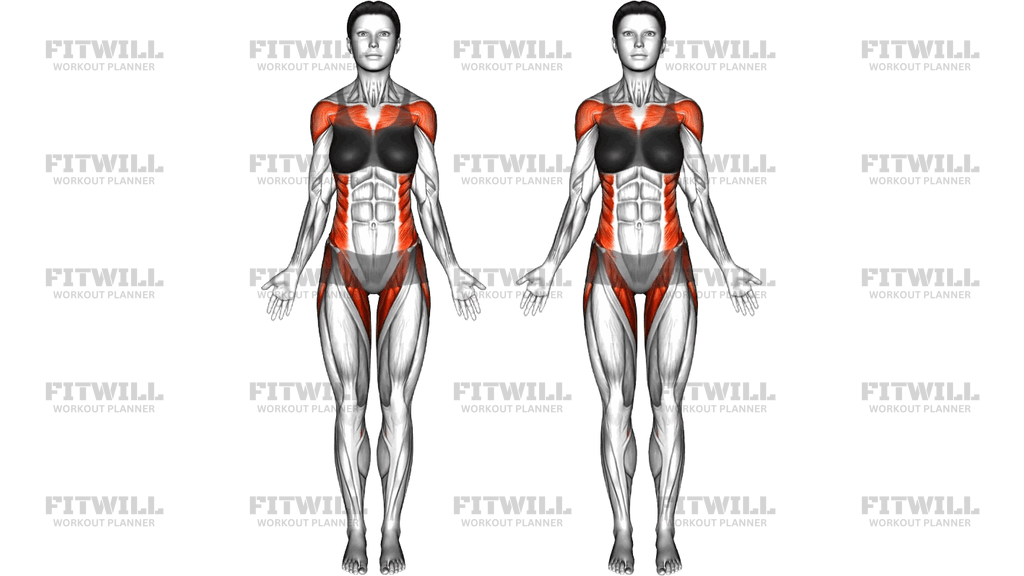
The main work happens at the standing hip. The glute medius and outer hip muscles on your support leg have to hold you steady while the moving leg travels through the air, and the lifting hip's abductors power the leg upward. Because both arms travel from your sides to overhead, the shoulders especially the side delts do continuous work, and the obliques on the standing side brace hard to stop your trunk from tipping away from the lifted leg.
Setup is simple but it decides whether the rep works. You need a tall stance, feet about hip-width apart, arms relaxed at your sides, and weight spread evenly across the whole foot of your standing leg. If you start slouched or with your weight on your toes, the leg lift turns into a sideways lurch and you lose the balance challenge that makes this drill valuable.
To execute it, shift your weight onto one leg with a soft bend in that knee, brace your midsection, and sweep the free leg out to the side while your arms arc up and slightly outward until they meet overhead. Keep the moving leg internally organized, toes facing forward rather than rolled open, and lift only as high as you can without leaning your torso to the opposite side. Reverse the path under control, leg and arms returning together, and reset your balance before the next rep.
This exercise fits well into lower-body and glute warm-ups, home workouts with no equipment, and circuit training where you want a low-impact option that still raises your heart rate. It is also a practical drill for runners and anyone whose daily life involves single-leg standing, because it trains the exact hip stability that keeps your pelvis level on one foot.
The most common fault is chasing height. A controlled lift to roughly forty-five degrees with a level pelvis beats a high swing that tilts your torso and loads your lower back. Keep the tempo steady, treat the return as half the rep, and progress later by adding an ankle weight or a resistance band, not by turning the movement into an uncontrolled swing.
[ Workout Log & Planner ]
Put your next workout in Fitwill
Keep your plan and training log ready when you are.


Instructions
- Stand tall with your feet hip-width apart, arms hanging naturally at your sides, and your gaze on a fixed point ahead of you.
- Shift your weight fully onto your left leg, keeping a soft bend in that knee and your weight spread across the whole foot.
- Brace your abdominal muscles and pull your ribs down slightly so your pelvis stays level before you start the lift.
- Sweep your right leg out to the side in a smooth arc while both arms rise out and up toward overhead, as in the top half of a jumping jack.
- Finish the lift with your right leg extended roughly forty-five degrees from your body, arms overhead or nearly touching, and your torso still upright.
- Pause briefly at the top without letting your pelvis tilt or your torso lean away from the lifted leg.
- Lower your right leg and bring your arms back down to your sides together, taking about the same time as the lift.
- Exhale as you lift the leg and raise your arms, inhale as you return to the starting stance.
- Complete all reps on the right side, or alternate legs rep by rep if you prefer a jack-style rhythm.
- Reset your balance on the standing foot before each rep, then switch sides and repeat on the left leg.
Tips & Tricks
- If your torso tips to the left every time the right leg lifts, your glute medius on the standing leg is being bypassed; shorten the range until your shoulders stay square.
- Do not let the lifting foot rotate open toward the ceiling. Keep the toes of the moving leg facing forward so the outer hip, not the front of the thigh, drives the lift.
- Avoid locking the standing knee. A locked knee plus a tired hip is what usually causes wobble halfway through a set.
- If your arms swing forward instead of out to the sides, slow down and consciously trace the arc wide, since a forward swing turns the rep into a random reach.
- Using momentum from a hip swing is the most common way to cheat this exercise. Touch your free foot lightly to the floor between reps to kill the swing and force the hip muscles to restart each lift.
- Keep the pelvis level rather than hiking the lifting hip upward. Hiking feels easier but it shifts work from the abductors to the waist muscles on the moving side.
- Start with bodyweight only and higher reps. Adding an ankle weight before your balance is solid usually just adds strain to the standing knee.
- On a soft or uneven floor, expect more challenge to your standing balance, which is useful but means fewer quality reps. Move to a firm surface if your form breaks down early.
- If you feel the work mostly in the front of your hip, you are likely lifting with the hip flexors. Think about leading the lift with the outside of the leg instead.
Frequently Asked Questions
Which muscles does the Standing Side Leg Lift Jack work the most?
The primary work comes from the glute medius and outer hip muscles, both on the leg doing the lifting and on the standing leg where they stabilize your pelvis. The shoulders and obliques work continuously as the arms arc overhead and the trunk stays upright.
Why do the arms move in this exercise instead of staying at my sides?
The overhead arm arc adds shoulder involvement and raises the coordination and balance demand, since your center of mass shifts as everything moves at once. It also gives the movement its jack character and makes it useful as a low-impact conditioning option.
Is the Standing Side Leg Lift Jack suitable for beginners?
Yes, as long as you keep the lift modest and the tempo slow. If single-leg balance is difficult at first, stand next to a wall or chair and rest a fingertip on it for support while your hip stabilizers catch up.
How high should I lift my leg during the Standing Side Leg Lift Jack?
Lift to roughly forty-five degrees, or wherever you can go while keeping your torso upright and your pelvis level. Height that comes from leaning or swinging takes the work away from the outer hip and adds it to your lower back.
Should I alternate legs or do all reps on one side?
Both work. Doing all reps on one side before switching makes it easier to notice and fix left-right differences, while alternating gives a rhythmic, jack-like flow that suits circuits and warm-ups.
What is the most common mistake in this exercise?
Leaning the torso away from the lifting leg and using a swinging motion to gain height. Both faults turn a targeted outer-hip exercise into an uncontrolled movement, so shorten the range and slow the tempo until the lean disappears.
Can I add resistance to the Standing Side Leg Lift Jack?
Yes. Once you can complete a set with clean balance, a light ankle weight on the moving leg or a small loop band around the ankles is the natural progression. Keep the added load light enough that your torso stays square.
What can I substitute if standing balance is too difficult?
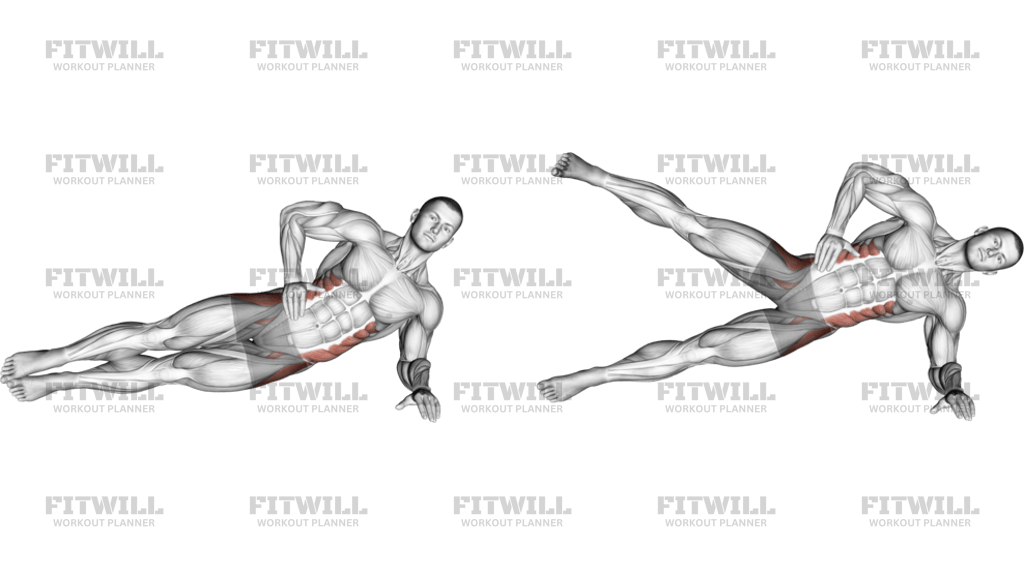
Side-lying leg raises train the same outer hip muscles with no balance demand, and a standing side leg lift holding a chair gives a middle ground. Add the jack arm movement back in once the basic lift feels stable.
Is this exercise safe for my knees?
For most people, yes, when the standing knee stays softly bent and tracks over the midfoot. If bending the standing knee or lifting the leg produces pain in the knee or hip, stop and have the joint assessed before continuing.
Can the Standing Side Leg Lift Jack count as cardio?
It can contribute when performed continuously with alternating legs at a brisk pace, since it raises your heart rate without impact. Treat it primarily as a strength and stability drill, though, and use dedicated conditioning work if cardio is the goal.